Hexagram structure
Why I Ching Lines Are Called Six and Nine
Learn why printed I Ching lines use six and nine, and compare two checked coin records that form the same hexagram with different changing lines.
The short answer
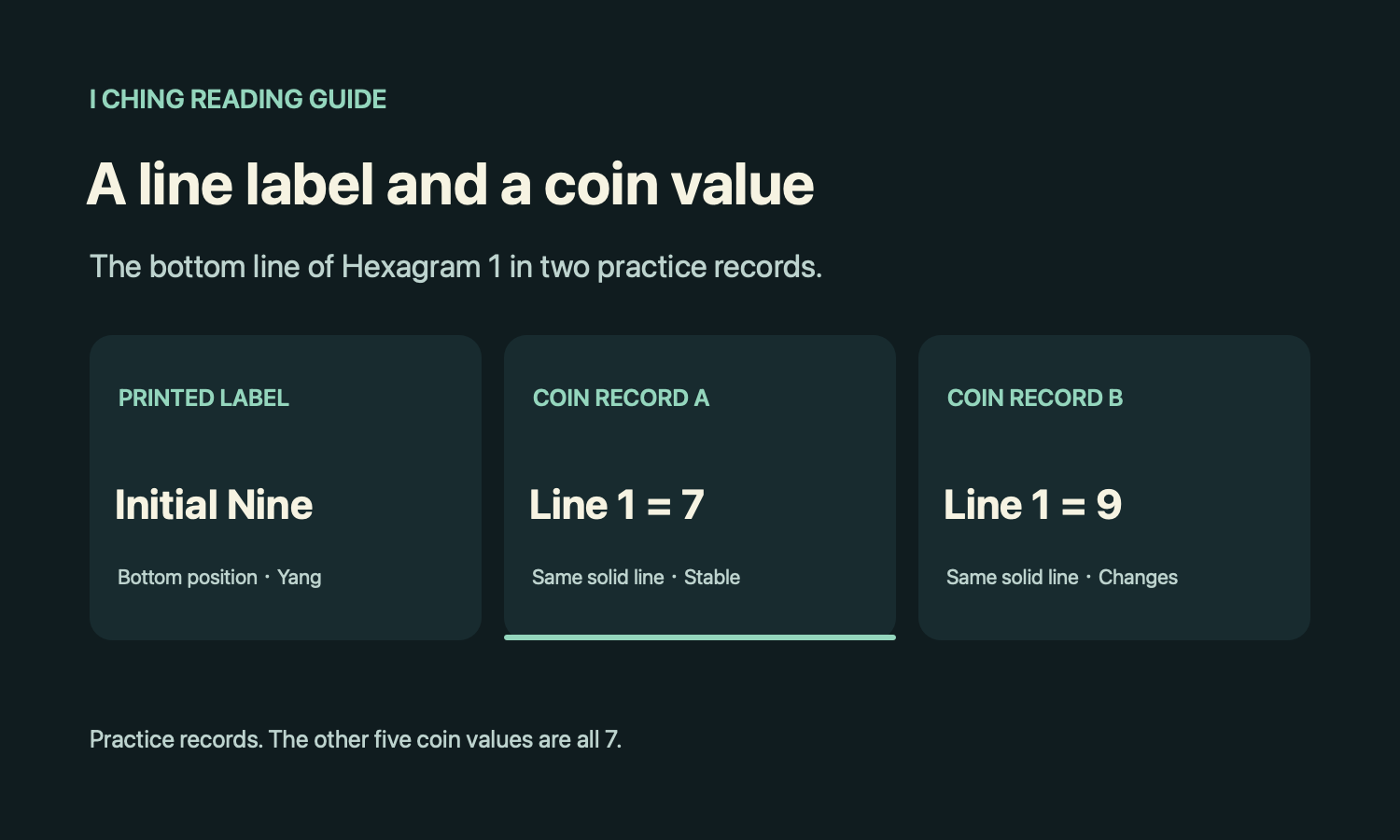
I Ching lines are called six and nine because those numbers identify yin and yang in the written line labels. “Nine at the beginning” points to the bottom yang line. In a coin record, a value of 9 makes that solid line change and a value of 7 keeps it stable. The recorded value determines movement.
Overview
A book may call the bottom line of Qian “Nine at the beginning” while your coin record lists 7. Both entries can be right. The book is identifying the line’s place and shape. Your notes report the number you recorded when you formed the hexagram. Knowing which number you are looking at tells you whether to check an address in the text or which lines actually change.
Read the position and shape in the printed label
“Nine at the beginning” identifies a yang line in the bottom position. A heading such as “Six in the second place” means the second position from the bottom contains a yin line. Translations vary in wording. Look for the position and whether the line is solid or broken.
James Legge’s notes to Hexagram 1 distinguish the printed naming convention for whole and divided lines from the casting use of old yang and old yin. This explains why I Ching lines are called six and nine in the text, even when a coin record for the same figure has a stable 7 or 8.
Read coin values from the bottom up
In the coin method used by the calculator, 6 is changing yin, 7 is stable yang, 8 is stable yin and 9 is changing yang. Line 1 is the bottom line, the first value in the record. Line 6 is at the top. A 7 and a 9 both make a solid line in the primary figure. The 9 also marks that position as changing. An 8 and a 6 both make a broken line in the primary figure. The 6 marks it as changing.
Check two records with the same primary figure
Both of these examples yield primary Hexagram 1, Qian. They are practice records with no personal question attached.
- Record A runs bottom to top as
[7, 7, 7, 7, 7, 7]. All six lines are stable. The result has no changing line or separate relating figure. - Record B runs bottom to top as
[9, 7, 7, 7, 7, 7]. The same primary hexagram appears. This time position 1 changes.
The printed label for the primary bottom line stays the same in both examples. Check the recorded values to see why the changing positions differ.
Try the records in the calculator
Open the I Ching Coin Calculator. Use the first practice record and select 7 for each of the six positions. Select Calculate hexagrams. Check the primary figure and look for Changing lines in the result. Set Line 1 to 9 and calculate again with the other five entries still at 7. Read the primary figure and changing-line list again. The primary figure stays Qian, and the second practice result shows position 1 changes.
Keep the text address with the complete record
When you consult a text afterward, write down its name and edition with the primary figure and line position. In a separate field, keep the recorded coin value and the list of changing positions. This also helps when you share a diagram with another reader. A diagram can preserve a solid or broken line while leaving its movement unknown. If an entry is missing, keep it unknown and recover it from your original notes before using the six-input calculator.
Key takeaways
- Six and Nine in line headings describe yin or yang.
- The recorded coin total determines movement.
- Both practice records give Qian, with different movement.
Conclusion
Use the printed heading to locate a line in the text. Use the six bottom-to-top coin values to identify what changes. When the two records disagree about movement, check the original record rather than copying the heading as a coin value.
Does “Nine at the beginning” tell me I threw a nine?
It gives the location and shape of the line in the traditional text. Your own bottom value of 7 or 9 is recorded in the cast.
Can 7 and 9 produce the same solid line?
Yes. Both produce a solid bottom line when used at position 1. Only 9 marks that line as changing in the manual coin calculation.
Can I calculate with a missing value?
The calculator needs all six recorded values. Keep the gap visible in your notes until you find the original value.
Sources
Reflect on one question
Frame a focused question before starting a new reading.
Explore YiInsight →