BaZi & calendar
BaZi Luck Pillar vs. Annual Pillar: How to Read the Timeline and Cycle Handovers
Distinguish your natal Year Pillar, ten-year Luck Pillar (Cycle context), and Annual Pillar on the YiInsight BaZi timeline, including years with a cycle handover.
The short answer
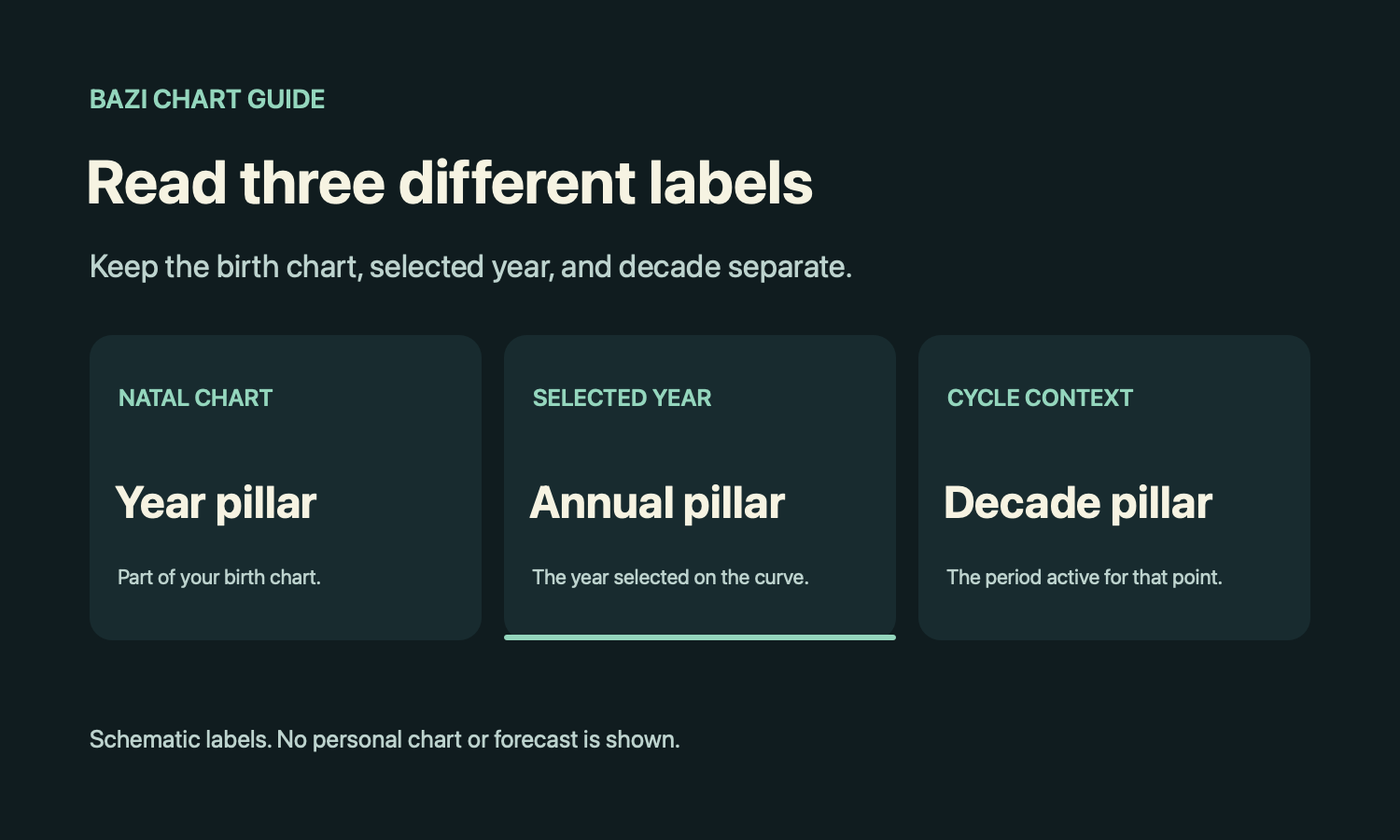
On the YiInsight BaZi timeline, the Natal Year Pillar stays fixed in your birth chart's Four Pillars grid, the selected-year panel displays the chosen year number with its Annual Pillar stem-branch pair, and the Cycle context line identifies the active ten-year Luck Pillar. Keeping these three time layers separate helps you reflect on long-term chapters versus single-year shifts.
Overview
When you explore a Four Pillars (BaZi) life timeline, you work with three different stem-branch pairs that all describe periods of time: the Natal Year Pillar in your birth chart, the ten-year Luck Pillar (Dàyùn, 大運), and the Annual Pillar (Liúnián, 流年). Knowing where each label sits on the screen—and how to read a year where one ten-year cycle hands over to the next—keeps your notes organized and prevents you from mixing up your birth year with a timeline year.
1. Structural Rule: Natal Year, Selected-Year Panel, and Cycle Context
When you generate a chart with a known birth time in the YiInsight Free BaZi Calculator, time is separated into three distinct areas of the interface:
- Natal Year Pillar (in the Four Pillars section): The card labeled Year in the top natal grid shows the stem-branch pair of your birth year. It stays fixed as part of your baseline chart when you click different points on the timeline curve below.
- Annual Pillar (in the selected-year panel): When you click a point on Your life timeline, the details panel displays the chosen year number alongside its annual Heavenly Stem and Earthly Branch as the panel's main heading. In YiInsight's timeline model, each solar year interval starts at Lìchūn (Spring Commences) in the displayed time zone, with an exclusive end boundary noted in the panel.
- Decade Luck Pillar (labeled Cycle context): Inside that same details panel, the visible Cycle context line shows the active ten-year Luck Pillar stem-branch pair and its start and end years, alongside the specific date interval. Because one Luck Pillar covers a decade, several consecutive annual points share the same Cycle context.
Reading a cycle handover year: When a transition between two ten-year Luck Pillars falls inside a single solar year, YiInsight flags a cycle handover in the selected-year panel and displays clickable period buttons with exact date intervals. The panel's annual year number and stem-branch heading stay the same, while switching between the period buttons updates the active Cycle context for the segment before and after the handover. (If your birth time is unknown, the calculator displays confirmed natal pillars without generating a timeline.)
2. Symbolic Metaphor: Baseline Structure, Decade Terrain, and Annual Weather
Traditional BaZi terminology distinguishes the natal chart, ten-year decade pillars, and yearly flow. As an interpretive metaphor for reflection—rather than an astronomical fact or a statistical forecast—commentators often compare these three layers to a journey:
- The Natal Chart frames your baseline habits and starting equipment.
- The Decade Pillar (Cycle context) is likened to the broader ten-year terrain or season you are walking through.
- The Annual Pillar (the selected year's stem-branch) is compared to the shorter-term weather of a single year interacting with that terrain.
Timeline curves and relative scores on YiInsight are part of a structured interpretive model; they do not establish empirical odds or guaranteed outcomes.
3. Practical Reflection: Long-Term Chapters vs. Single-Year Shifts
Keeping a ten-year cycle distinct from a single year offers a practical perspective when reviewing career or personal transitions:
- Separate a single year's pressure from a decade's direction: When a project or role feels demanding this year, are you treating a short-term annual adjustment as if your entire multi-year trajectory had failed?
- Navigate handover years deliberately: During a year where your responsibilities or priorities are shifting between two chapters, which habits belong to the period wrapping up, and what groundwork belongs to the period just beginning?
Key takeaways
- Keep the Year card in the Four Pillars birth chart separate from timeline selections.
- In the selected-year details panel, read the year number and stem-branch heading for the Annual Pillar, and read Cycle context for the active ten-year Decade Pillar.
- In a cycle handover year, use the period interval buttons to inspect both the outgoing and incoming Cycle context segments.
Conclusion
Reading a BaZi timeline clearly starts with matching each label to its time span: your fixed natal Year card, the chosen year's Annual Pillar heading, and the ten-year Cycle context. By checking the printed date intervals—especially during handover years—you can use the timeline as a calm framework for reviewing long-term and short-term priorities. Open the YiInsight Free BaZi Calculator to build your chart and inspect your timeline.
Why does YiInsight's timeline interval start at Li Chun instead of January 1?
In YiInsight's solar-term calculation model, each BaZi solar year begins at Lìchūn (Spring Commences, typically around early February). Always check the exact date interval and time zone printed in the selected-year panel when looking at dates near that boundary.
How can one selected year have two Cycle context values?
When a ten-year Luck Pillar handover occurs inside that solar year, the panel provides separate period buttons for the intervals before and after the transition. Click each period button to view its corresponding Cycle context.
Sources
- YiInsight Free BaZi Calculator (natal Four Pillars, Lìchūn annual intervals, Cycle context, and handover period buttons)
- Yili BaZi — Four Pillars FAQ (terminology definitions for Day Master, Ten Gods, hidden stems, decade pillars, and yearly flow)
- Hong Kong Observatory — The 24 Solar Terms (astronomical background for Lìchūn and the 24 solar terms)
Explore your BaZi timeline
Build your Four Pillars chart to compare your natal Year card, the selected year's Annual Pillar, and its active ten-year Cycle context.
Open the free BaZi calculator →