BaZi & calendar
How to Find Your Day Master in a BaZi Chart: Structure, Meaning, and Reflection
Locate the BaZi Day Master (Heavenly Stem of the Day Pillar) using a worked Jia Zi example, distinguish it from the Year Branch and hidden stems, and use it for reflection.
The short answer
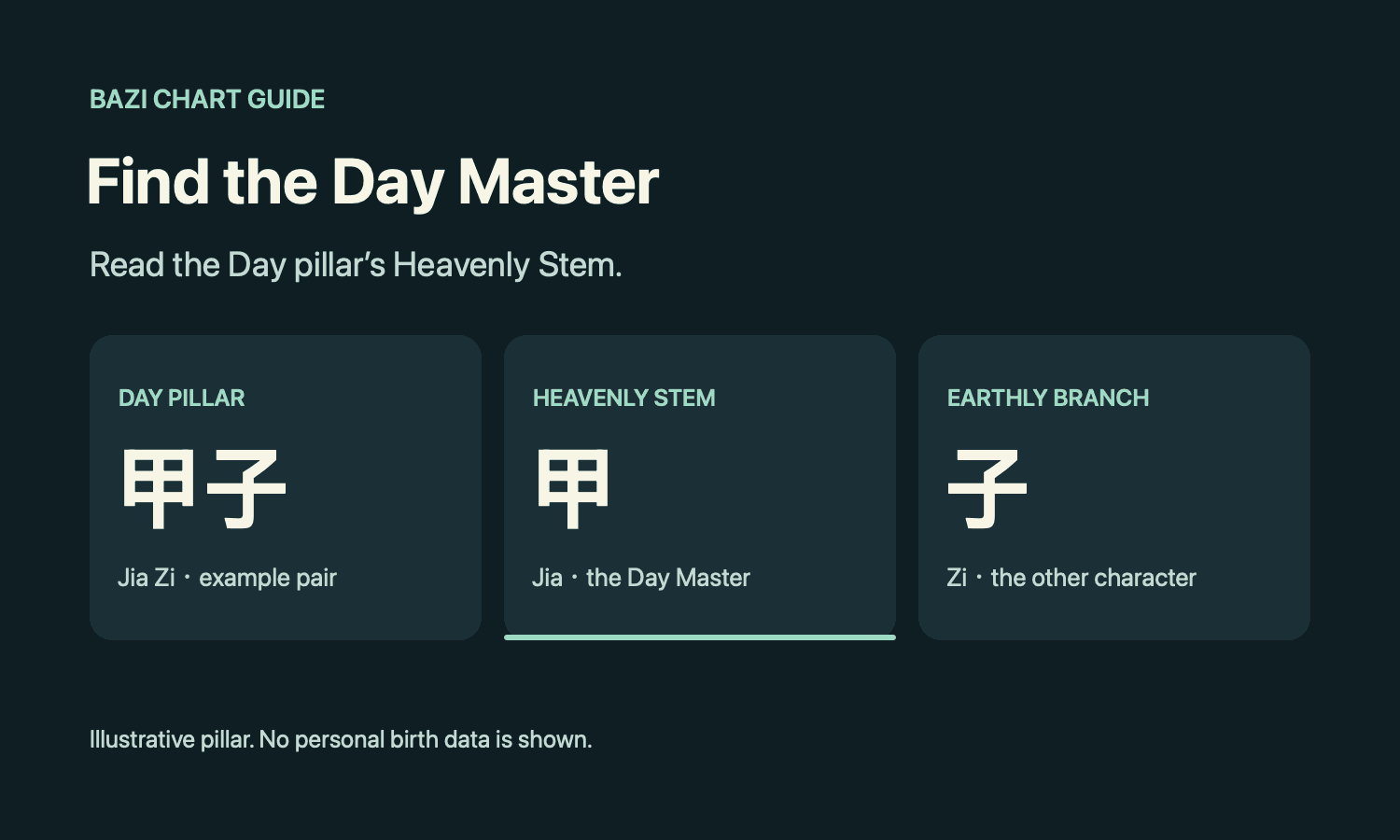
Your BaZi Day Master is the Heavenly Stem of the Day Pillar in a Four Pillars birth chart. By locating the card labeled Day and reading its first stem character—or checking the explicit Day Master line above the pillar grid, such as Jia (甲) in the Day pair Jia Zi (甲子)—you identify the reference coordinate used to map relationships across the chart.
Overview
When you first generate a Four Pillars (BaZi) chart, the grid of Chinese characters and elemental labels can feel unfamiliar. Yet the most important starting point is a single character: your Day Master (Rìzhǔ, 日主), also called the Day Stem (Rìgān, 日干). Knowing how to locate the Day Master—and how to separate it from the Year Branch or hidden stems—gives you the central coordinate for reading the rest of the chart.
1. Structural Rule: Locate the Day Pillar and Its Heavenly Stem
A complete BaZi chart contains four positions called pillars: Year, Month, Day, and Hour. Always check the column heading before reading a character, because different layouts arrange pillars in different orders. The YiInsight Free BaZi Calculator orders pillars from left to right as Year, Month, Day, and Hour, whereas some teaching materials (such as the FengShui BaZi Centre teaching chart) arrange columns from right to left starting with the Hour.
Each pillar pairs one Heavenly Stem (Tiāngān) with one Earthly Branch (Dìzhī). In conventional vertical tables, the stem sits above the branch; on the YiInsight calculator screen, the two characters sit side by side as a horizontal pair inside each labeled pillar card, and the calculator also prints an explicit Day Master summary line above the grid.
Look at the illustrative Day Pillar 甲子 (Jiǎ Zǐ):
- Heavenly Stem — 甲 (Jiǎ): The first character of the horizontal pair (or upper character in a vertical chart). When this pair sits in the Day card, 甲 is your Day Master.
- Earthly Branch — 子 (Zǐ): The second character of the pair, representing the Day Branch rather than the Day Master.
Keep two structural boundaries clear when checking your chart:
- Day Master vs. Year Branch (Zodiac Animal): Within a BaZi chart, the twelve animal branches belong to the Earthly Branches—and the birth-year animal sits in the Year Pillar's Earthly Branch (which in YiInsight switches at the Lìchūn solar term rather than Lunar New Year, so early-year dates can differ from popular zodiac lookups). Your Day Master is always the Day Pillar's Heavenly Stem.
- Day Master vs. Hidden Stems: Each Earthly Branch contains secondary Hidden stems (Cánggān) shown in a separate expandable details section on the card. Even if a hidden stem matches your Day Master character, the role of Day Master belongs strictly to the visible stem of the Day card.
To check your own chart, enter your birth details in the YiInsight Free BaZi Calculator and compare the explicit Day Master line with the first character inside the Day card.
2. Symbolic Metaphor: The Reference Coordinate of the Chart
While astronomical references like the Hong Kong Observatory document the ten Heavenly Stems and twelve Earthly Branches as calendar cycles, traditional Ziping BaZi uses the Day Master as an interpretive reference point. Other visible stems are compared against the Day Master's Five Element (Wood, Fire, Earth, Metal, Water) and Yin-Yang polarity to generate Ten Gods relationship labels.
As an interpretive metaphor (rather than a clinical personality measurement or a claim established by calendar astronomy), practitioners often picture the stems through natural imagery—for example, comparing Yang Wood (Jiǎ 甲) to a straight timber trunk and Yin Wood (Yǐ 乙) to a flexible plant. You can use these metaphors as a vocabulary for reflection rather than a fixed verdict on your character.
3. Practical Workplace and Daily Reflection
Once you locate your Day Master, you can use its role as the chart's center to organize a simple self-inquiry:
- External demands vs. core ground: In a current project or relationship, which commitments reflect external expectations around you, and which ones align with what you can sustainably stand behind?
- Firmness vs. adaptability: Using the stem imagery strictly as a reflective prompt, where does your habitual style—holding a firm line versus adapting to shifting conditions—help your daily work, and where does it create friction?
Key takeaways
- Locate the pillar card explicitly labeled Day (representing the Day Pillar, Rìzhù 日柱) before copying any character.
- Read the Day Master (Rìzhǔ 日主) from the explicit Day Master label above the grid and the first character of the horizontal pair in the Day card.
- Keep the Day Master distinct from the Year Branch animal and from the expandable Hidden stems list.
Conclusion
Finding your Day Master turns an unfamiliar Four Pillars display into a structured map with a clear reference point. Check the Day Master label, verify the first character in the Day card, and use that coordinate as a grounded lens for self-reflection. Open the YiInsight Free BaZi Calculator to locate your Day Master and inspect the pillars displayed for your birth record.
How do I identify the Day Master on the calculator screen if I don't read Chinese?
Look for the explicit Day Master summary line above the four pillar cards and match that character to the first character inside the card labeled Day. If you want the romanized name (such as Jiǎ for 甲) to compare with another guide, match the character against the Hong Kong Observatory's ten-stem table.
Is the Day Master the same as my Chinese zodiac sign?
No. Your Day Master is the Heavenly Stem of the Day pillar. A BaZi chart's year animal is read from the Earthly Branch of the Year pillar (determined in YiInsight by the Lìchūn solar term, which can differ from Lunar New Year zodiac lookups in late January or early February).
Sources
- YiInsight Free BaZi Calculator (natal Four Pillars display and Day Master label)
- Hong Kong Observatory — Heavenly Stems and Earthly Branches (calendar background for the ten stems, twelve branches, and stem-branch pairs)
- FengShui BaZi Centre — Four Pillars Teaching Chart (example of a teaching chart ordered Hour, Day, Month, Year)
Find your Day Master
Enter your birth date, time, and time zone to build your Four Pillars chart and check the Day Master label and Day Pillar.
Open the free BaZi calculator →