Hexagram structure
Wu Earth Day Master (戊土) in BaZi: Mountain Stability, Carving Wood, and Moisture Control
Explore the Wu Earth Day Master in BaZi classical structural analysis. Understand how Jia Wood, Gui Water, and Bing Fire shape this mountain-like energy.
The short answer
The Wu Earth Day Master represents solid, mountain-like Yang Earth energy in BaZi. According to classical texts, its structural balance heavily relies on Jia Wood to loosen the soil, Gui Water to provide moisture, and Bing Fire to warm the earth, avoiding rigidity or barrenness.
Introduction: The Symbolism of Wu Earth
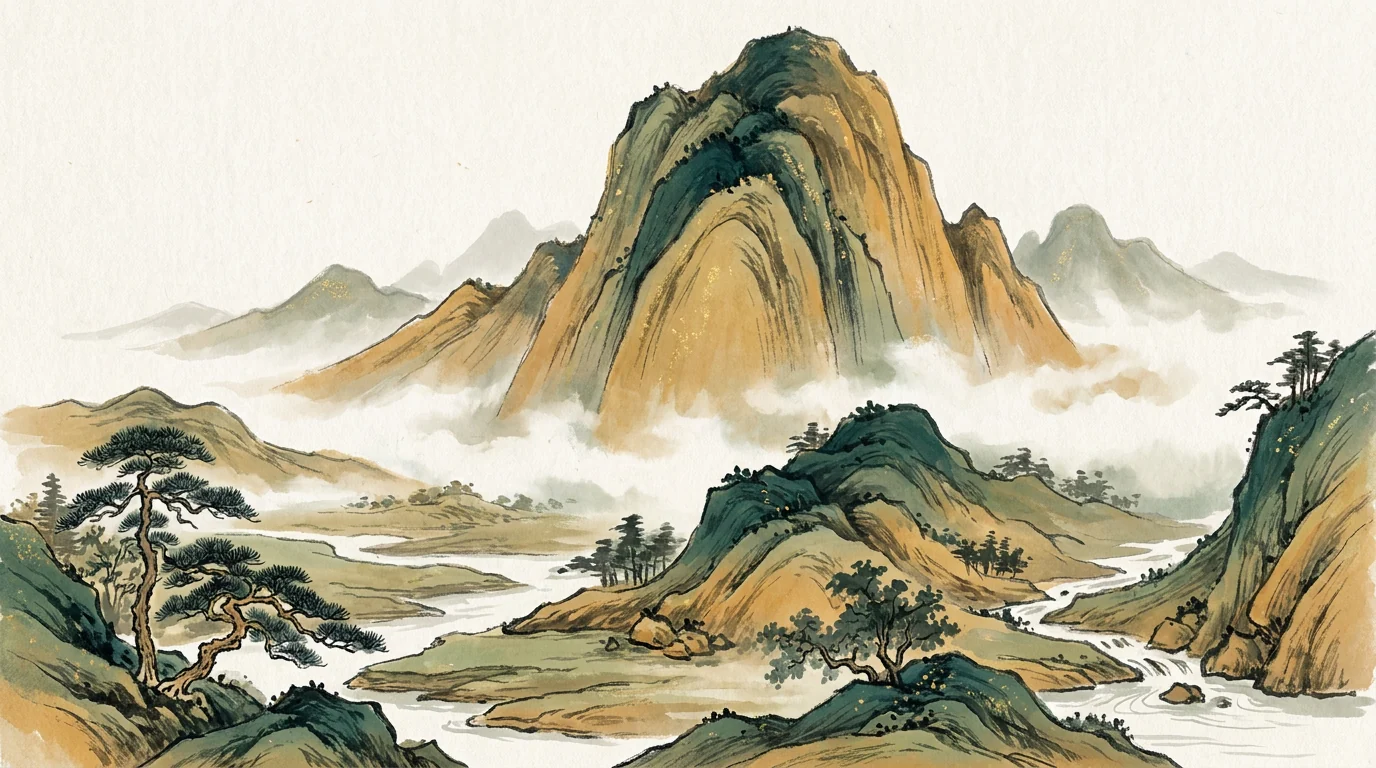
In the system of BaZi (Four Pillars of Destiny), the ten Heavenly Stems serve as fundamental archetypes of energetic patterns. The fifth stem is Wu (戊), representing Yang Earth. In classical literature, Wu Earth is universally compared to a vast, solid, and majestic mountain or heavy bedrock. It embodies stability, endurance, and profound capacity.
Unlike Yin Earth (Ji 己), which is likened to soft, cultivated garden soil, Wu Earth is untamed, dense, and immovable. Because of its sheer mass and density, the central theme of a Wu Earth Day Master chart revolves around managing this heavy structure. If left untouched, a mountain can become a barren, impenetrable mass. Thus, classical BaZi thought introduces three vital agents to bring vitality to Wu Earth: Wood to carve it, Water to moisten it, and Fire to warm it.
Classical Insights: Di Tian Sui and Qiong Tong Bao Jian
The understanding of Wu Earth is deeply rooted in Ming and Qing dynasty classics. The Di Tian Sui (滴天髓) states: 'Wu Earth is solid and heavy, both balanced and upright' (戊土固重,既中且正). It further notes that it requires moisture to support growth and warmth to prevent stagnation.
The Qiong Tong Bao Jian (窮通寶鑑), a manual specializing in the seasonal requirements of the Heavenly Stems, emphasizes a triad of elements for Wu Earth:
- Jia Wood (甲木): Yang Wood acts as a towering tree whose roots can penetrate and loosen the dense, heavy soil of the mountain. Without Wood, the earth remains stubbornly packed.
- Gui Water (癸水): Yin Water represents gentle rain or morning dew. Mountains need moisture to sustain life; without it, Wu Earth becomes a dry desert.
- Bing Fire (丙火): Yang Fire represents the sun. It warms the mountain, allowing energy to circulate and preventing the earth from becoming a freezing, desolate peak in colder seasons.
The Three Pillars of Wu Earth Structure
Understanding a Wu Earth chart means evaluating the presence and quality of Wood, Water, and Fire. The interaction of these elements determines the structural flow of the chart.
- Loosening the Soil (疏土): When Wu Earth is supported by strong Earth elements in the earthly branches (like Chen, Xu, Chou, Wei), the chart is considered structurally dense. The introduction of Yang Wood (Jia or Yin branch) creates a dynamic tension. The Wood 'carves' the Earth, organizing the chaotic mass into a structured landscape.
- Moisture Control (潤澤): Earth is naturally drying. If a Wu Earth chart is born in a Fire-dominant season (Summer) or an Earth-dominant season (like Xu or Wei month), the chart leans towards extreme dryness. Yin Water (Gui) is preferred over Yang Water (Ren) because Gui represents a gentle, continuous hydration that Earth can absorb, whereas Ren (a rushing river) might wash the Earth away.
- Warming the Peak (暖岸): If Wu Earth is born in Winter or early Spring, the mountain is cold and frozen. Bing Fire (the Sun) is necessary to thaw the soil, making it hospitable for interaction with other elements.
Synthetic Chart Comparison
| Feature | Chart A (Spring Chen Month) | Chart B (Autumn Xu Month) |
|---|---|---|
| Pillars (Y-M-D-H) | Yi Hai, Geng Chen, Wu Yin, Yi Mao | Yi Hai, Bing Xu, Wu Yin, Gui Hai |
| Day Master | Wu (Yang Earth) | Wu (Yang Earth) |
| Seasonal Context | Late Spring (Chen month) | Late Autumn (Xu month) |
| Wood Presence | Extremely Strong (Yin, Mao, Chen combo + Yi stems) | Moderate (Yin branch, Yi stem) |
| Water/Fire Dynamics | Water in Hai; weak Fire | Bing Fire (Month), Gui Water (Hour) present |
| Structural Flow | Wu Earth is heavily pressured by an overwhelming Wood structure. The 'loosening' is excessive, risking the collapse of the mountain. Metal (Geng) attempts to regulate the Wood. | Wu Earth is born in a dry Earth month (Xu). The presence of Bing Fire provides warmth, while Gui Water and Hai provide essential moisture. The Yin branch offers moderate 'loosening'. |
To illustrate these classical principles, we analyze two algorithmically generated synthetic charts. These examples demonstrate structural mechanics and are not real individuals.
Analysis: Chart A represents a scenario where the 'carving' element (Wood) is overpowering. According to classical theory, when Wood dominates Earth excessively, Earth loses its foundational stability. Chart B shows a more classical balance for an Autumn Wu Earth, containing both the warming element (Bing Fire) and the moisturizing element (Gui Water), alongside Wood (Yin) to prevent the Xu Earth from becoming too rigid.
Common Misconceptions
A frequent misunderstanding in modern BaZi study is the belief that 'Control' (such as Wood countering Earth) is inherently negative. For a Wu Earth Day Master, avoiding Wood entirely because it 'attacks' the Day Master is a structural fallacy.
Classical texts argue that dense Earth requires this counter-force to be useful. Without Wood, a mountain is just a barren rock. The goal in evaluating a Wu Earth chart is not to eliminate controlling elements, but to ensure that the Wood, Water, and Fire are proportionate to the strength of the Earth itself.
Frequently Asked Questions
Does Wu Earth always need Jia Wood, or can Yi Wood work? Classical texts strongly prefer Jia (Yang) Wood for Wu Earth. Jia represents large, deep-rooted trees capable of breaking apart heavy soil. Yi (Yin) Wood represents grass or vines; while it grows on the mountain, it lacks the structural power to deeply loosen a dense Wu Earth structure.
What happens if a Wu Earth chart has too much Water? If Water (especially Ren Water, representing floods) overwhelms Wu Earth without sufficient Fire or Wood to balance it, the classical imagery is of a mountain eroded by a flood, or a mudslide. The Earth loses its defining characteristic of stability.
Can these principles predict my career or wealth? No. The principles of BaZi are a framework for symbolic calendrical reflection. Terms like 'loosening the soil' or 'warming the peak' describe the harmonious flow of natural elements within a time-based model, not deterministic life events, financial success, or medical health.
Inspect your deterministic Four Pillars
Enter a birth date and local time zone to view your Four Pillars and Dayun structure cleanly.
Open BaZi Calculator →