Hexagram structure
Geng Metal Day Master in BaZi: Tempering Fire, Sharp Refinement, and Heavy Earth Traps
Discover the classical BaZi symbolism of the Geng Metal Day Master. Explore its seasonal structures, the need for tempering fire, and the risk of being buried.
The short answer
In classical BaZi, a Geng Metal (庚金) Day Master symbolizes raw, unyielding iron or a sword. According to ancient texts like Di Tian Sui, its structural ideal is achieved by either being forged by Yin Fire (Ding) to become a sharp tool, or cleansed by Yang Water (Ren) to reveal its brilliant clarity, while avoiding excessive Earth that can bury it.
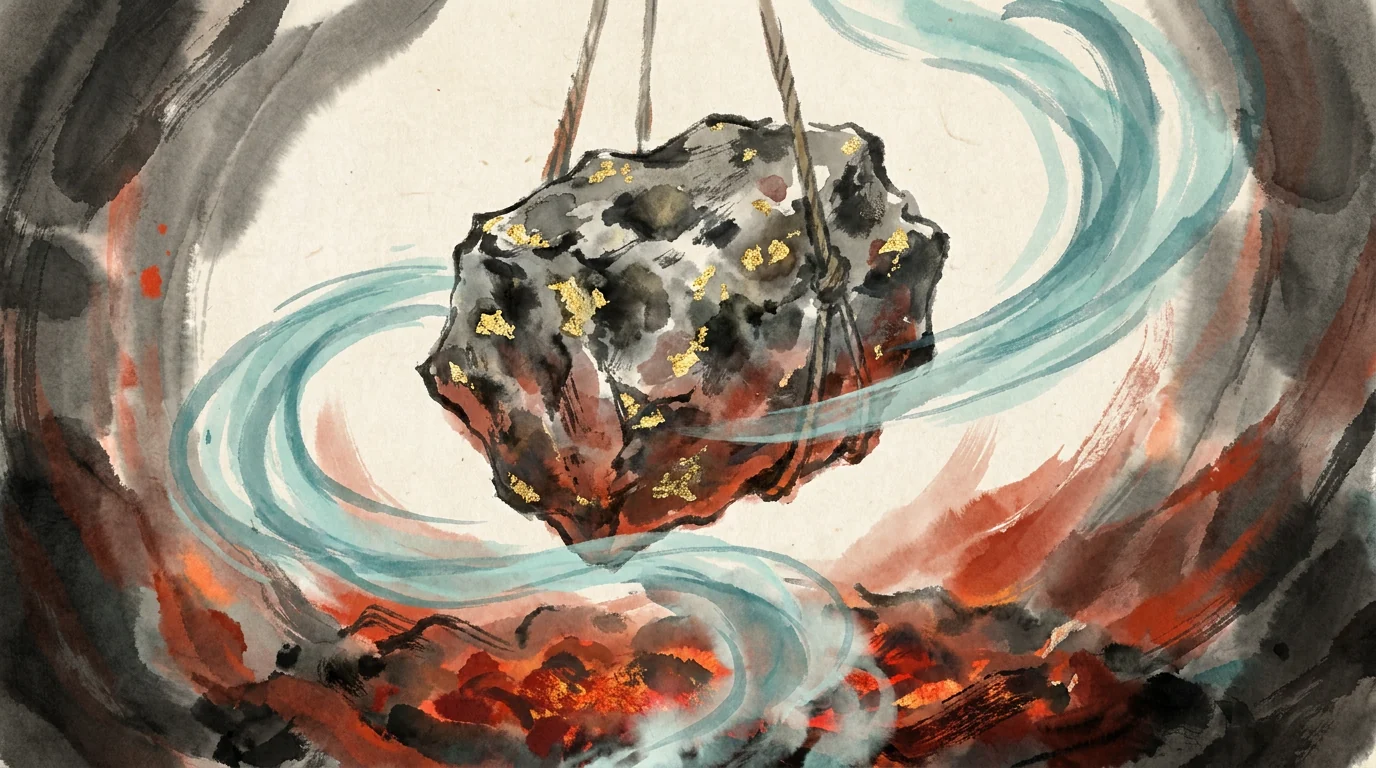
The Core Symbolism of Geng Metal: The Unyielding Ore
In the classical BaZi framework, the Ten Heavenly Stems serve as metaphors for cosmic processes. Geng (庚), the seventh stem, is Yang Metal. Ancient texts such as the Di Tian Sui (《滴天髓》) describe Geng Metal as 'piercing and unyielding' (庚金帶煞,剛健為最). Unlike Yin Metal (Xin), which represents delicate jewelry, Geng represents raw iron, unrefined ore, a heavy broadsword, or an axe.
Because of its robust and rigid nature, Geng Metal fundamentally requires external forces to find its purpose. Left alone in the wilderness, raw iron remains inert and eventually rusts. However, when subjected to the intense heat of a forge and the rapid cooling of water, it transforms into a sharp, structural instrument. This process of tempering is central to evaluating a Geng Metal chart's structural harmony.
Tempering the Blade: The Role of Fire and Water
The structural elegance of a Geng Metal chart often relies on two specific counter-elements:
- Ding Fire (Yin Fire - The Forge): According to the Qiong Tong Bao Jian (《窮通寶鑑》), Geng Metal thrives under the discipline of Ding Fire. While Yang Fire (Bing) acts like the sun—able to warm but not melt iron—Ding Fire represents focused, intense forge heat capable of shaping the raw metal into a functional tool. Symbolically, this indicates a structure that benefits from rigorous discipline, training, and systemic boundaries.
- Ren Water (Yang Water - The Cleansing River): After forging, metal must be quenched and polished. Ren Water washes away the impurities and soot, allowing the blade's sharp edge to gleam. The Di Tian Sui states, 'With Water it becomes clear' (得水而清). Structurally, this represents clarity of thought, eloquence, and the dynamic expression of one's innate strength.
The Danger of Stagnation: Heavy Earth Burying Metal
A well-known structural trap in BaZi theory is 'Heavy Earth Burying Metal' (土重埋金). In the Five Elements cycle, Earth produces Metal. A common misconception is that 'Resource' elements (which produce the Day Master) are always beneficial. However, for Geng Metal, excessive Wu (Yang Earth) or Ji (Yin Earth) is highly problematic.
When Earth dominates the chart without Wood to break it up, the Geng Metal is symbolically buried deep underground. The ore cannot be mined, the forge cannot reach it, and the water cannot cleanse it. In classical interpretation, this structure denotes immense hidden potential that is blocked by over-protection, stagnation, or a reluctance to step out of comfortable but limiting circumstances. Wood elements are theoretically required to 'loosen' the Earth and allow the metal to emerge.
Seasonal Dynamics: Autumn vs. Spring Geng Metal
| Season of Birth | Classical Structural Preference | Symbolic Meaning |
|---|---|---|
| Spring (Yin/Mao) | Prefers Earth and Metal support. | Metal is weak in Spring (the season of Wood). It needs structural reinforcement before it can be forged. |
| Summer (Si/Wu) | Requires Water (Ren/Gui). | Fire is overly aggressive. Water is needed to cool the structure and prevent the metal from melting completely. |
| Autumn (Shen/You) | Strongly requires Ding Fire. | Metal is at its peak strength. It must be disciplined and forged by intense heat to become useful. |
| Winter (Hai/Zi) | Requires Bing Fire (Yang Fire). | The chart is freezing. The sun (Bing) is needed to warm the structure, preventing the metal from becoming brittle and cold. |
The season of birth profoundly impacts the structural requirements of Geng Metal. The Qiong Tong Bao Jian provides a detailed seasonal breakdown:
Synthetic Chart Comparison: Autumn vs. Spring
To illustrate these classical principles, we can examine two synthetically generated calendrical configurations.
- Synthetic Chart A (Autumn Shen Month): Born on August 8, 1991, at 11:30. The pillars are Xin Wei (Year), Bing Shen (Month), Geng Xu (Day), and Ren Wu (Hour). Here, Geng Metal is born in autumn (Shen month), its season of peak strength. The presence of Fire in the Year/Hour branches (Wei, Wu, Xu forming a partial Fire structure) alongside Bing and Ren creates a dynamic tension. The strong metal has access to both heat for forging and water (Ren) for polishing. This is classically viewed as a robust, capable structure.
- Synthetic Chart B (Spring Yin Month): Born on February 9, 1991, at 11:30. The pillars are Xin Wei (Year), Geng Yin (Month), Geng Xu (Day), and Ren Wu (Hour). Born in spring (Yin month), the metal is structurally weaker. However, the chart features multiple Metal elements (Xin, Geng, Geng) providing mutual support. The Yin-Wu-Xu branches form a strong Fire combination. Because the Metal is not in its peak season, the intense Fire here might be overly taxing compared to Chart A, requiring the Ren Water in the hour pillar to play a crucial cooling and balancing role.
Frequently Asked Questions
Q: Does having Ding Fire in a Geng Metal chart guarantee success? A: No. BaZi is a symbolic reflection framework, not a deterministic guarantee of wealth or career success. The presence of Ding Fire merely indicates a structural inclination toward accepting discipline and refinement.
Q: What if a Geng Metal chart has no Fire at all? A: Classically, a lack of Fire might suggest a structure that expresses itself more through Water (clarity and flow) or Wood (interaction with resources), but it may lack the specific 'forged' sharpness associated with Ding Fire. It points to a different symbolic pathway of expression rather than a predefined negative outcome.
Q: Is Geng Metal considered 'better' than Xin Metal? A: In classical Five Elements theory, no stem is superior to another. They simply represent different phases and states of energy. Geng is raw and structural, requiring discipline; Xin is delicate and refined, requiring presentation and care.
Inspect your deterministic Four Pillars
Enter a birth date and local time zone to view your Four Pillars and Dayun structure cleanly.
Open BaZi Calculator →