Hexagram structure
Ren Water Day Master (壬水) in BaZi: Channeling Momentum with Earth Banks and Warmth
Explore the structural dynamics of the Ren Water Day Master in BaZi, drawing on classical principles of Wu Earth banking, Jia Wood channeling, and Bing Fire warming.
The short answer
In classical BaZi, a Ren Water Day Master symbolizes powerful, dynamic river water. Its structural balance depends heavily on Wu Earth to provide sturdy banks, Jia Wood to channel its robust energy, and Bing Fire to prevent freezing in winter months.
Introduction: The Nature of Ren Water (壬水)
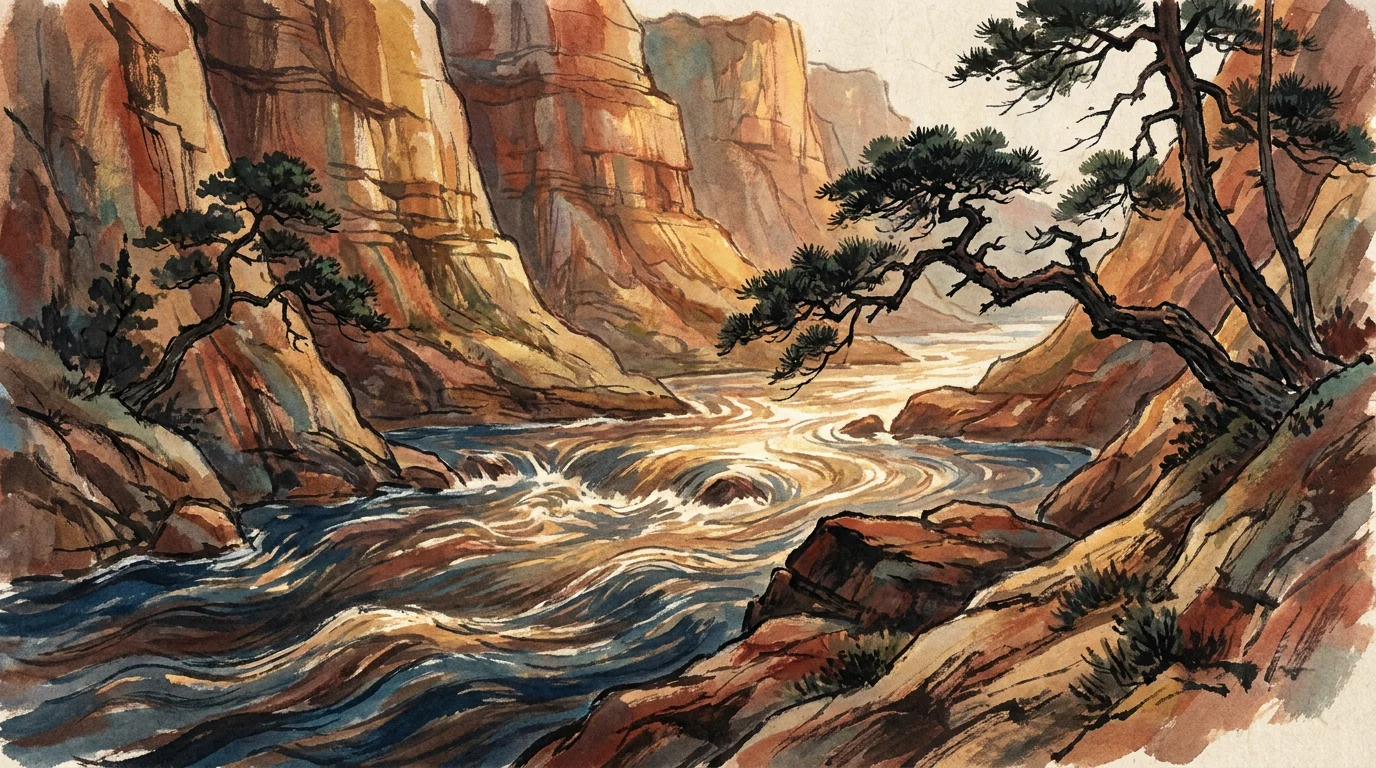
In the Ten Heavenly Stems of BaZi, Ren Water (壬水) represents Yang Water. Unlike the gentle mist or delicate streams of Gui Water (癸水), Ren Water embodies the unstoppable momentum of great rivers, oceans, and sweeping currents. According to classical frameworks, the primary goal for a Ren Water chart is to channel this tremendous energy productively, preventing it from overflowing its bounds while ensuring it remains flowing and vibrant.
Classical texts like Di Tian Sui (滴天髓) note that 'Ren water flows like a grand river, capable of draining metal's energy.' Because of its intrinsic strength and forward momentum, the structural analysis of a Ren Water chart typically revolves around containment, release, and temperature balance, varying significantly depending on the season of birth.
Core Classical Mechanics: Embankments, Channels, and Warmth
To understand a Ren Water configuration, classical BaZi scholars look for three critical elements to establish equilibrium:
- Wu Earth (戊土) for Embankment: When Ren Water is structurally strong, it requires Yang Earth (Wu) to act as a dam or riverbank. Without Wu Earth, strong Ren Water is said to 'flood,' symbolizing misdirected energy. Importantly, Yin Earth (Ji 己土) is generally considered insufficient, as wet soil simply muddies the rushing river rather than containing it.
- Jia Wood (甲木) for Channeling: If water is robust, wood serves as an outlet, 'draining' or channeling the water's vitality into productive growth. Jia Wood acts like the deep roots of ancient trees drinking from the river, transforming raw momentum into steady expansion.
- Bing Fire (丙火) for Warming: Temperature regulation is vital, particularly for Ren Water born in winter. Qiong Tong Bao Jian emphasizes that without Bing Fire (Yang Fire), winter water freezes solid, losing its essential life-giving flow. Bing Fire acts as the sun, melting the ice and returning vitality to the ecosystem.
Seasonal Flow: Winter vs. Summer Dynamics
The season of birth dictates the fundamental needs of a Ren Water chart.
Winter Born (Hai, Zi, Chou Months): Ren Water born in winter is at its peak strength but suffers from extreme cold. The water turns to ice. Here, the absolute priority is Bing Fire to introduce warmth. Even if Wu Earth is present to bank the water, without fire, the earth is frozen and ineffective. The presence of wood can help generate this much-needed fire.
Summer Born (Si, Wu, Wei Months): In summer, the environment is intensely hot, and water evaporates quickly. A summer Ren Water Day Master is structurally weaker and relies heavily on continuous source support—namely Metal (Geng or Xin) to generate water, or additional Water to maintain its volume. The dynamic shifts from 'containing' the water to 'sustaining' it against the summer heat.
Educational Case Studies: Evaluating Synthetic Charts
| Feature | Synthetic Chart A (Winter) | Synthetic Chart B (Early Summer) |
|---|---|---|
| Pillars | Gui You, Gui Hai, Ren Yin, Ding Wei | Gui You, Ding Si, Ren Chen, Wu Shen |
| Season | Hai (Winter) - Strong, cold water | Si (Summer) - Weakening water, strong fire |
| Structure Focus | The chart features an abundance of water (Gui, Hai) requiring warmth. The Yin branch contains Jia wood to channel, while Ding fire and Wei earth offer some containment. Classical texts would look for Bing fire or Wu earth in the dynamic phases to optimize flow. | Born in the heat of Si month, the water relies on You and Shen metal for source support. The Wu earth in the hour pillar acts as a formidable bank, while the Chen earth in the day branch serves as a water reservoir. |
| Classical Need | Requires Yang Fire (Bing) to unfreeze the heavy water presence. | Requires continuous Metal generation to prevent evaporation while Wu Earth maintains structure. |
By examining structural examples calculated through a civil-time engine, we can observe how these classical mechanics operate in theory.
Note: These analyses demonstrate philosophical structural balance, not real-world determinism.
Frequently Asked Questions
Why is Ji Earth (己土) often considered unfavorable for Ren Water? In symbolic terms, Ji Earth represents soft, arable, wet soil. When a powerful river (Ren) meets loose, wet dirt, the result is mud. Classical scholars suggest this obscures the clarity of the water, whereas Wu Earth (dry, massive rocks or mountains) provides clear boundaries and banks.
Does a strong Ren Water always mean a 'good' chart? No. In BaZi, extreme strength without an outlet or boundary is viewed as chaotic imbalance. A strong river that floods destroys crops; thus, strong Ren Water absolutely requires containment (Earth) or an outlet (Wood) to find structural harmony.
How does Ren Water interact with Yin Water (Gui)? If Gui Water appears alongside Ren Water, it often adds volume. However, classical texts emphasize that Ren dictates the main flow. Gui is seen as rain or mist adding to the river's mass, which can be helpful in summer but exacerbates cold and flooding in winter.
Inspect your deterministic Four Pillars
Enter a birth date and local time zone to view your Four Pillars and Dayun structure cleanly.
Open BaZi Calculator →