 YiInsight
YIINSIGHT / Method and reflection
What Is a Hexagram? Six Lines, Trigrams, and Changing Lines
Learn what an I Ching hexagram is, how to count six lines from the bottom, identify two trigrams, and keep changing lines separate from interpretation.
The short answer
An I Ching hexagram is a figure of six stacked lines, each solid or broken. Read its positions from the bottom upward, grouping the lower three and upper three into trigrams. A casting record separately tells you which lines change.
Overview
If you have opened a hexagram chart and found sixty-four unfamiliar symbols, begin with the drawing rather than trying to memorize every name. This guide gives you a repeatable way to identify a figure, keep its line positions straight, and distinguish the pattern from changing status and interpretation. You do not need to ask a personal question or create a reading to follow the exercises. The goal is to leave with a clear structural record you can check against a reference.
Six lines, read from the bottom
An I Ching hexagram is a stack of six horizontal line positions. An unbroken line represents yang; a broken line represents yin. The gap in a broken line does not create two separate positions: count that pair of strokes as one line. Position one is at the bottom, and position six is at the top. This convention matters when you compare a drawing with a line statement in a book.
Start with the shape before looking for a meaning. Put a small number beside each position, beginning at the bottom. Then write “solid” or “broken” beside every number. You now have a record you can compare with a reference even if its font, spacing, or drawing style differs from yours. The decorative width of a line does not change its type.
Why there are 64 hexagrams
Each of the six positions has two possible shapes. Multiplying those choices gives 2 × 2 × 2 × 2 × 2 × 2 = 64 different six-line patterns. You can check this with a small thought experiment: one position allows two patterns, adding a second position doubles that to four, and each new position doubles the total again. Six doublings produce sixty-four.
This counting explains how many patterns are possible; it does not determine their traditional sequence numbers or names. Do not convert a drawing into a binary number and assume that number is its I Ching lookup number. A numbered reference uses a particular ordering. Match the six-line pattern against that reference instead. YiInsight’s hexagram explorer is a place to compare individual figures after you have recorded their lines.
Find the lower and upper trigrams
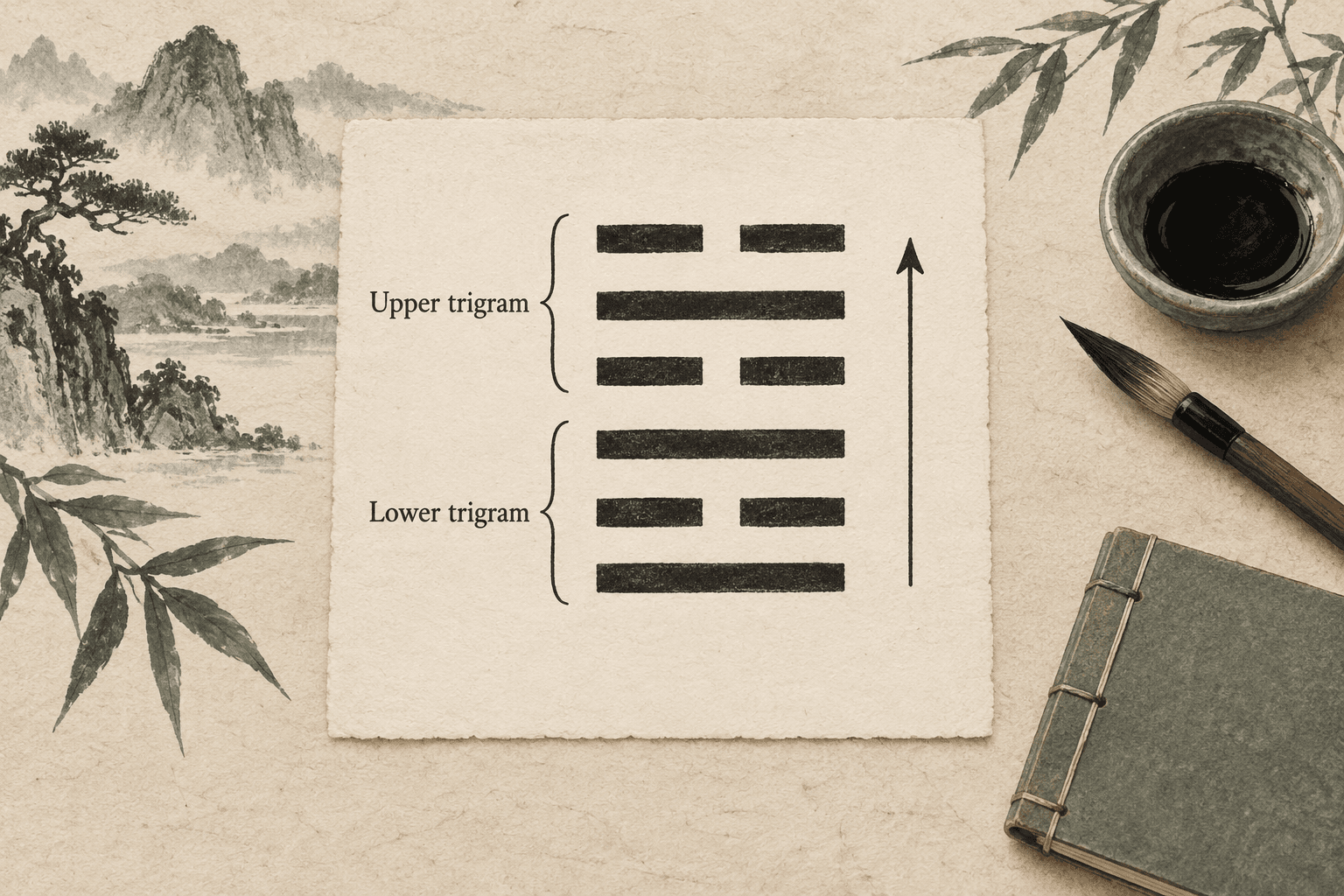
A trigram has three positions. In a hexagram, positions one, two, and three form the lower trigram; positions four, five, and six form the upper trigram. There are eight possible three-line patterns, so pairing a lower trigram with an upper trigram gives the same total: 8 × 8 = 64. Keep the lower and upper labels attached to their groups when using a lookup chart.
The illustration on this page is synthetic. Reading it from the bottom, its lines are solid, broken, solid, broken, solid, broken. The lower group is therefore solid–broken–solid; the upper group is broken–solid–broken. This example teaches grouping and direction only. It is not a cast, a personal reading, or a claim about a future event. Cover the labels and try identifying the two groups yourself before continuing.
Line shape and changing status are different
A six-line drawing tells you the solid or broken shape at each position. That drawing alone may not tell you whether a position was marked as changing during a consultation. Keep changing status as a separate part of your record. In the common three-coin method, totals of six and nine are changing lines, while seven and eight are stable lines. Follow the convention documented for the method you actually used.
To construct a relating figure from a primary figure, reverse the shape of each changing position and leave the stable positions fixed. A changing broken line becomes solid; a changing solid line becomes broken. If no position changes, the relating shape is identical to the primary shape. For the casting steps, see the three-coin method; for the distinction between figures, see primary and relating hexagrams.
A repeatable way to read a figure
Use this short sequence whenever you meet an unfamiliar hexagram. It separates identifying the figure from interpreting a text:
- Count six positions, treating a broken pair as one position.
- Number the positions from one at the bottom to six at the top.
- Record each position as solid or broken without rearranging it.
- Separate the lower three positions from the upper three.
- Match the complete pattern with a reference, then record that reference’s number and name.
- If you have a casting record, mark its changing positions separately and construct the relating figure by reversing only those positions.
As a practice exercise, make position one broken and all five other positions solid. Mark only position one as changing. The relating drawing should have six solid positions: five stayed fixed and the bottom one reversed. If your top position changed instead, you have mixed up the numbering direction. This is a made-up structural exercise, not an interpretation or a prediction.
Separate the figure from its interpretation
Identifying a hexagram establishes which figure you are looking at. Understanding a passage adds another layer: the wording of a chosen edition, its line statements, and any commentary you consult. Record the edition or translator when taking notes. Differences in English titles do not necessarily mean the six-line figures differ. Check the pattern first, then compare how the editions describe it.
A useful reading note has separate fields for the figure, the passage you consulted, and your own reflection. For example, “position one changes” is a statement about the recorded structure. “This reminds me to clarify my next step” is your modern reflection. The second statement should not be presented as a classical quotation. A hexagram does not establish a guaranteed outcome, another person’s hidden intentions, or an instruction to make a high-stakes decision. If your main question is which passages to consult when several positions change, continue with the changing-lines guide.
Key takeaways
- A broken pair of strokes counts as one line position.
- Line one is the bottom line; line six is the top.
- Two three-line trigrams form one six-line hexagram.
- Changing status belongs to the casting record, not just the line shape.
- A structural match does not establish a prediction.
Conclusion
Begin by identifying the six positions from the bottom upward. Record their solid or broken shapes, split the figure into its lower and upper groups, and match the pattern before looking up a title. Keep changing status and your own reflection in separate fields. That small habit makes comparisons between drawings and editions much easier to check.
Is a hexagram the same as a trigram?
No. A trigram has three line positions; an I Ching hexagram has six. The lower and upper groups of three make up its two trigrams.
Why are there 64 hexagrams?
Six positions with two possible shapes each give 2 to the sixth power, or 64 patterns. Equivalently, eight lower trigrams can pair with eight upper trigrams.
Do I read the lines from the top or the bottom?
Number and record the positions from the bottom upward. The bottom position is line one, and the top position is line six.
Can I identify a changing line from a plain drawing?
Not always. A plain solid or broken drawing gives the line shape. You also need the changing-status marks or the original casting record.
Is the six-line figure a six-pointed star?
Here, “hexagram” means an I Ching figure made from six stacked horizontal positions, rather than the six-pointed geometric star that shares the English word.
Sources
Reflect on one question
Frame a focused question before starting a new reading.
Explore YiInsight →