 YiInsight
YIINSIGHT / Method and reflection
Primary and Relating Hexagrams: What Changes in the Calculation
Primary and Relating Hexagrams: What Changes in the Calculation. Follow a synthetic example and handle casts with no changing lines.
The short answer
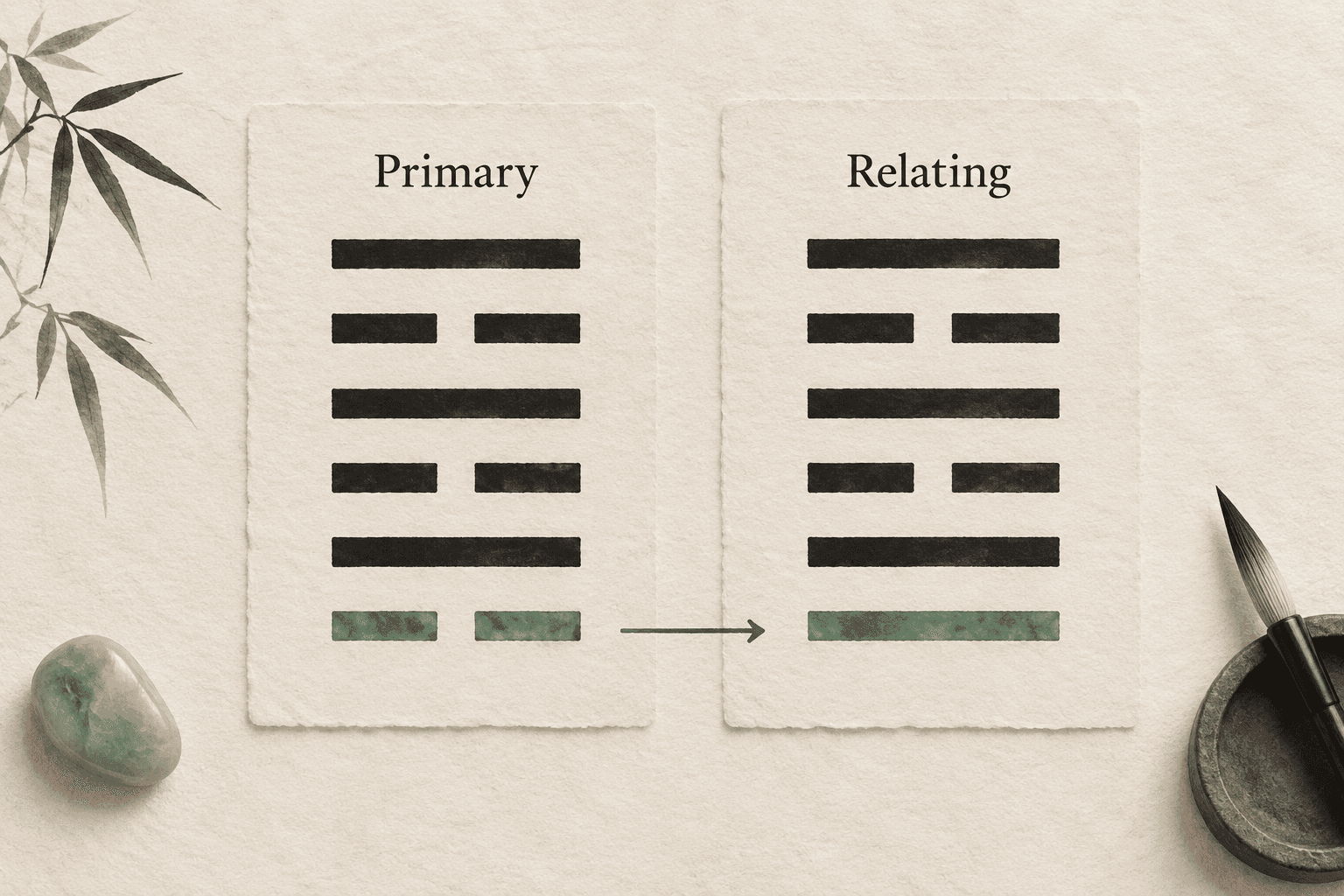
The primary hexagram uses the six original line states. The relating hexagram is the figure produced by changing the marked lines while leaving stable lines alone. In YiInsight’s calculation, 6 changes from yin to yang and 9 from yang to yin. The relating figure is a structural result, not a guaranteed picture of what happens next.
Overview
These terms are often encountered together, but they answer different structural questions: what figure did the cast produce, and what figure results from its changing lines? This guide defines how YiInsight uses the labels without claiming that every interpretive school assigns them the same meaning.
Keep the original figure as the reference
The primary figure is built from the original line values in bottom-to-top order. Values 7 and 9 produce solid lines; 6 and 8 produce broken lines. Save the original numbers as well as the drawing, because a solid or broken shape alone does not tell you whether that line is changing.
A relating figure comes from those same recorded values. It is not obtained by tossing again, choosing another hexagram that seems relevant, or asking an AI model to infer a better result. The three-coin method explains how the input values are recorded.
Change only the marked positions
In the YiInsight implementation, a 6 is changing yin and becomes solid; a 9 is changing yang and becomes broken. Values 7 and 8 retain their original shape. Line positions continue to be counted from the bottom in both figures. Do not reverse the sequence when drawing the second figure beside the first.
This is deterministic transformation of supplied input. It does not decide what the change means for your question. Keep that distinction visible when a diagram is accompanied by an evocative name or an interpretation that sounds like a forecast.
Work through one synthetic example
Take bottom-to-top totals 7, 8, 6, 7, 8, 9. The primary states are solid, broken, broken, solid, broken, solid. Positions 3 and 6 change. After transformation, the states are solid, broken, solid, solid, broken, broken. Positions 1, 2, 4 and 5 provide a useful check: they must remain the same.
This example is invented to demonstrate structure and is not taken from a private reading. If you obtain a different result, first check orientation and which totals you changed. There is no need to interpret a discrepancy before resolving a copying or arithmetic error.
Handle no change without inventing a second message
If all six totals are 7 or 8, the transformed pattern would equal the original pattern. YiInsight records no separate relating hexagram in that case. This is an implementation convention; it does not mean that life is frozen, that a reading failed, or that you should cast until a second figure appears.
How a tradition prioritizes the primary figure, changing lines and relating figure is a separate interpretive question. This guide does not settle that question or treat the relating figure as a guaranteed future. Continue with changing lines for that distinction and reading the layers for a reflection workflow that keeps calculation and meaning separate.
Key takeaways
- Keep the original figure as the reference.
- Change only the marked positions.
- Handle no change without inventing a second message.
Conclusion
Place the original and transformed figures side by side and check the same six positions. Only marked positions may differ. Keep both figures attached to the original record, then state your interpretive method separately instead of reading a guaranteed timeline into the transformation.
Explore the method
Review the method overview before deciding whether to begin a reading.
Explore YiInsight →