Hexagram structure
Summer Metal Under Heat: Reading Cooling Water (Tiaohou) in Geng Metal Charts
Explore the classical BaZi concept of Tiaohou (climate adjustment) for Geng Metal born in summer, where Water acts as a crucial cooling symbol.
The short answer
In classical BaZi theory, a Geng Metal Day Master born in the peak of summer (Wu month) exists in an environment of intense Fire. The structural addition of Water (Ren or Gui) provides 'Tiaohou' or climate adjustment, metaphorically cooling the molten metal and restoring systemic balance.
Introduction: The Nature of Summer Metal
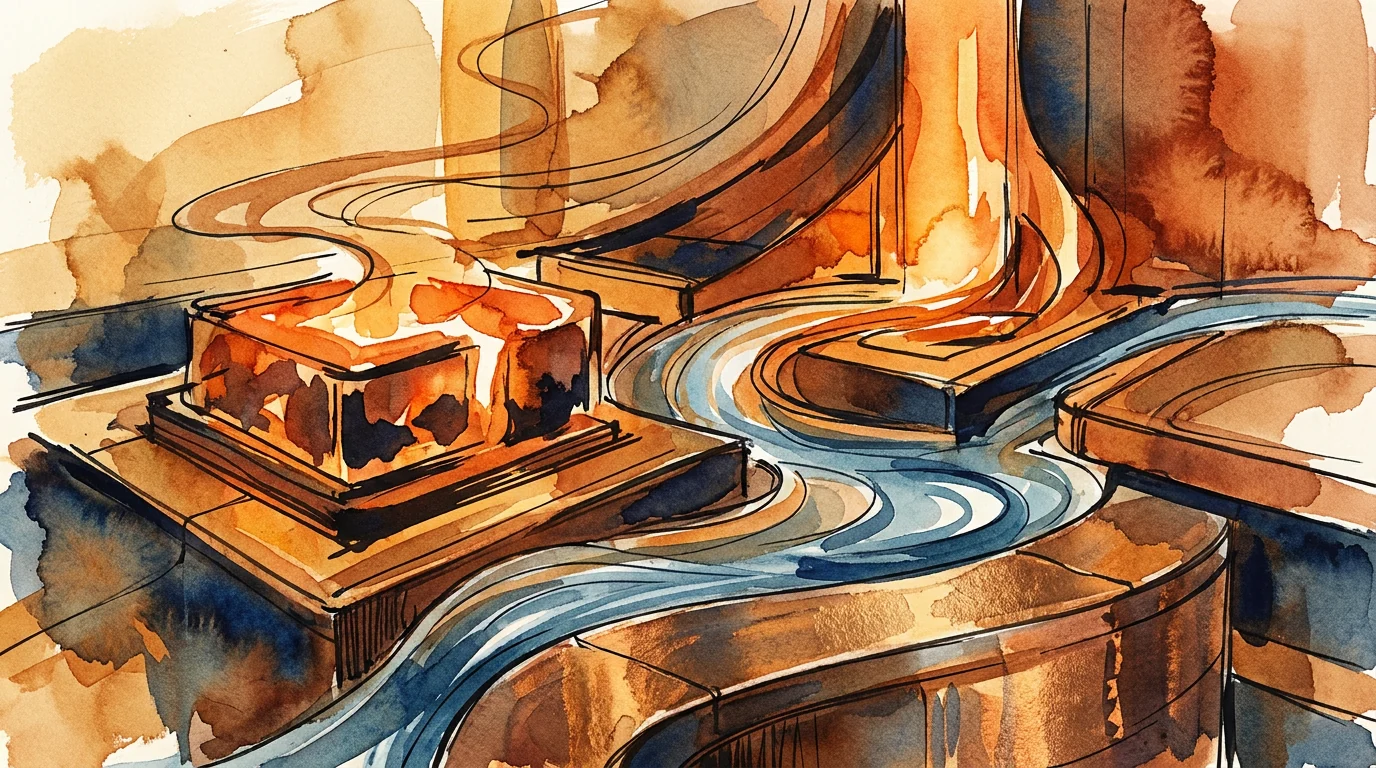
In the calendrical system of classical BaZi, the Day Master serves as the primary focal point of a given chart. When the Day Master is Geng (Yang Metal) and the birth month falls in the Wu (Horse) period—the peak of summer—the foundational imagery is that of raw ore placed inside a blazing forge. The Qiong Tong Bao Jian, a renowned Qing Dynasty classic, emphasizes that while Metal requires Fire to be shaped into useful tools, excessive heat threatens to melt it entirely. Therefore, the structural environment calls for a moderating force.
The Principle of Tiaohou (Climate Adjustment)
Tiaohou, or 'climate adjustment', is a vital interpretive lens in classical BaZi. It suggests that charts exhibiting extreme temperatures—whether freezing winters or scorching summers—benefit symbolically from opposing elements that restore equilibrium. For a summer Geng Metal chart, the required element is Water. Ren (Yang Water) represents powerful rivers or heavy rain, capable of rapidly cooling the heat, while Gui (Yin Water) symbolizes gentle mist or clouds that provide sustained moisture and shade. Together, they create a balanced structural dynamic known as 'Water and Fire in harmonious cooperation'.
Synthetic Chart Comparison: Observing Structural Balance
| Pillar | Chart A (Peak Fire Noon Hour) | Chart B (Cooling Water Hai Hour) |
|---|---|---|
| Year | Ren Shen (Water/Metal) | Ren Shen (Water/Metal) |
| Month | Bing Wu (Fire/Fire) | Bing Wu (Fire/Fire) |
| Day | Geng Shen (Metal/Metal) | Geng Shen (Metal/Metal) |
| Hour | Ren Wu (Water/Fire) | Ding Hai (Fire/Water) |
To understand how the time of day affects this dynamic, we can examine two mathematically generated synthetic charts. Both share the same Year, Month, and Day pillars, but differ in their Hour pillars.
In Chart A, the presence of a second Wu (Horse) in the hour pillar intensifies the summer heat. Although Ren Water is present in the heavenly stems, the foundation is intensely hot. In Chart B, the Hai (Pig) hour introduces deep-rooted Water at the base of the chart. This provides a profound cooling effect precisely at the end of the day, offering a different structural resilience against the intense Bing Wu Fire of the month pillar.
The Symbolic Role of Ren and Gui Water
In the context of Tiaohou, the presence of Water is not a literal guarantee of wealth or health; rather, it represents systemic regulation.
- Ren Water (Yang Water): Acts as a rapid cooling agent. In the classics, it is said to 'wash and polish' the metal, bringing out its natural shine amidst the soot of the forge.
- Gui Water (Yin Water): Acts as atmospheric cooling. It suppresses the dry heat of the summer sun (Bing Fire) gently, ensuring the environment remains temperate.
When evaluating a chart conceptually, the interaction between these Water elements and the prevailing Fire provides insights into how tension and resolution operate within the chart's symbolic ecosystem.
Common Questions and Myths
Does lacking Water mean a bad chart? No. BaZi is not a deterministic outcome generator. A chart with intense Fire and no Water simply possesses a different structural dynamic—one of extreme focus or intensity. It does not predict failure.
Is Tiaohou the only way to read a chart? Classical texts use multiple lenses. While Tiaohou addresses 'climate', other methods look at the structural strength of the Day Master (Wang Shu) or the overarching pattern (Ge Ju). They are overlapping maps of a calendrical moment, offering diverse avenues for personal reflection.
Inspect your deterministic Four Pillars
Enter a birth date and local time zone to view your Four Pillars and Dayun structure cleanly.
Open BaZi Calculator →