Qimen Dunjia Guide
How to Reproduce a Qimen Dunjia Hour Chart Step by Step
Follow a worked 2027-07-01 Chai Bu example to verify time zones, solar terms, four pillars, and the south-up nine-palace layout in a deterministic Qimen hour chart.
The short answer
To reproduce a Chai Bu Qimen Dunjia hour chart, resolve your Gregorian date, 24-hour clock time, and IANA time zone to one absolute instant, convert it to fixed Beijing standard time (UTC+08:00), and verify the active solar term, Yin or Yang cycle, four pillars, and south-up nine-palace grid.
Start with one verified instant
Suppose two people compare notes on the same moment from different cities. Before checking any palace, they first confirm the Gregorian date, 24-hour clock time (including seconds if recorded), and exact IANA time zone, along with whether daylight saving time or another clock shift was recorded accurately. Civil wall time converts to one absolute instant using historical zone and offset rules documented in the IANA Time Zone Database.
When a clock or UTC offset change makes a local time occur twice, you must choose the earlier or later occurrence so the instant stays unambiguous. A skipped clock time did not exist in that zone and cannot be calculated. Once resolved, YiInsight casts that instant in fixed Beijing standard time (UTC+08:00) without true solar time, so identical moments entered from different zones yield the exact same chart.
Check the calculation conventions first
Different schools and calculators handle boundaries differently, so verifying a chart begins with stating the exact implementation rules. YiInsight casts an hour-based rotating chart (Shi Jia Zhuan Pan) under the Chai Bu (Split-and-Supplement) method, with Tian Qin accompanying Tian Rui. Classical precedents for Yang 1 and Yin 9 Chief Star and Chief Door examples, Xun heads, and Tian Qin pairing with an outer palace appear in Dunjia Yanyi, Siku Quanshu edition, on Wikisource.
In this engine, the active solar term switches at its computed term instant. The entered moment itself does not change, yet different calendars can compute slightly different solar-term instants and therefore assign a different active solar term to the same moment near a boundary. As an astronomical reference, the 24 solar terms divide apparent solar longitude into 15-degree steps and list Summer Solstice in their sequence in Hong Kong Observatory's 24 Solar Terms.
During the 23:00 late Zi hour in fixed Beijing standard time, the day pillar and Three Yuan remain on the civil day until midnight while the hour stem follows the next day's Zi-hour rule. Treat these details as YiInsight's documented implementation conventions rather than universal rules across classical texts or other tools.
Worked example: 2027-07-01 at 09:01 Beijing time
To verify the method end to end, enter 2027-07-01 at 09:01 in Asia/Shanghai, or 2027-07-01 at 01:01 in UTC, which resolves to the exact same instant. Both inputs produce the deterministic outputs below.
| Chart field | Verified output |
|---|---|
| Solar term and cycle | Summer Solstice (夏至), Upper Yuan (上元), Yin 9 |
| Four pillars | 丁未 Ding Wei year, 丙午 Bing Wu month, 辛巳 Xin Si day, 癸巳 Gui Si hour |
| Xun head | 甲申 Jia Shen |
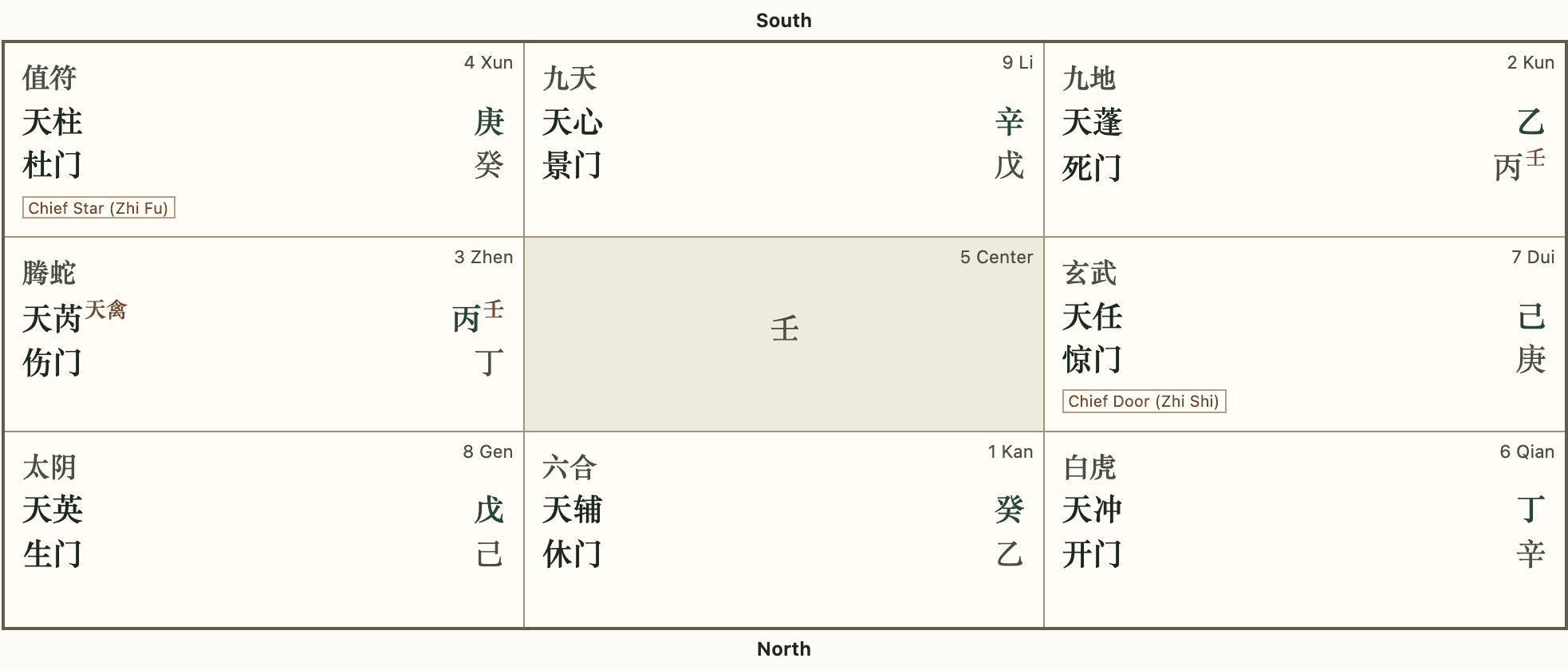
| Chief Star (值符) | Tian Zhu (天柱), origin Dui 7, lands in Xun 4 |
| Chief Door (值使) | Fear Door (Jing) / Jing Men (惊门), lands in Dui 7 |
On the south-up nine-palace grid (4-9-2 top, 3-5-7 middle, 8-1-6 bottom), check three anchor cells against the example image. In Xun 4 (top left), the heaven stem is 庚 Geng, the earth stem is 癸 Gui, the star is 天柱 (Tian Zhu), and the door is 杜门 (Du Men). In Dui 7 (middle right), the Chief Door 惊门 (Jing Men)—marked Chief Door (Zhi Shi) on the grid and shown as Fear Door (Jing) in the calculator's palace details—lands in place, while Center 5 holds earth stem 壬 Ren. To enter these values yourself and inspect every cell, open the Qimen Dunjia Calculator.
Study scope and a practical check
The calculator runs deterministically in your browser with no fee or sign-in, and it reproduces chart structure only. It does not include AI readings, auspiciousness scores, timing forecasts, auspicious date selection, or saved charts. Keep the output within a traditional learning framework rather than using it for medical, legal, financial, or other serious decisions.
Whenever two charts for the same moment disagree, ask one practical question before reading the grid: did both entries share the exact same absolute instant and Chai Bu boundary rules, or did a time zone, clock shift, or calendar convention change the underlying chart?
Reproduce an hour chart
Enter a Gregorian date, 24-hour local time, and IANA time zone to calculate a deterministic Chai Bu chart locally in your browser.
Open Qimen Dunjia Calculator →