Hexagram structure
Ten Gods Pair Dynamics: Officer–Resource Flow vs. Indirect Resource Seizing Eating God
How two BaZi Ten-God pairings that both involve a Resource star run in opposite directions: the Officer–Resource generating chain versus the traditional Indirect Resource seizing Eating God tension, read through adjacency, root depth, season, and Wealth.
The short answer
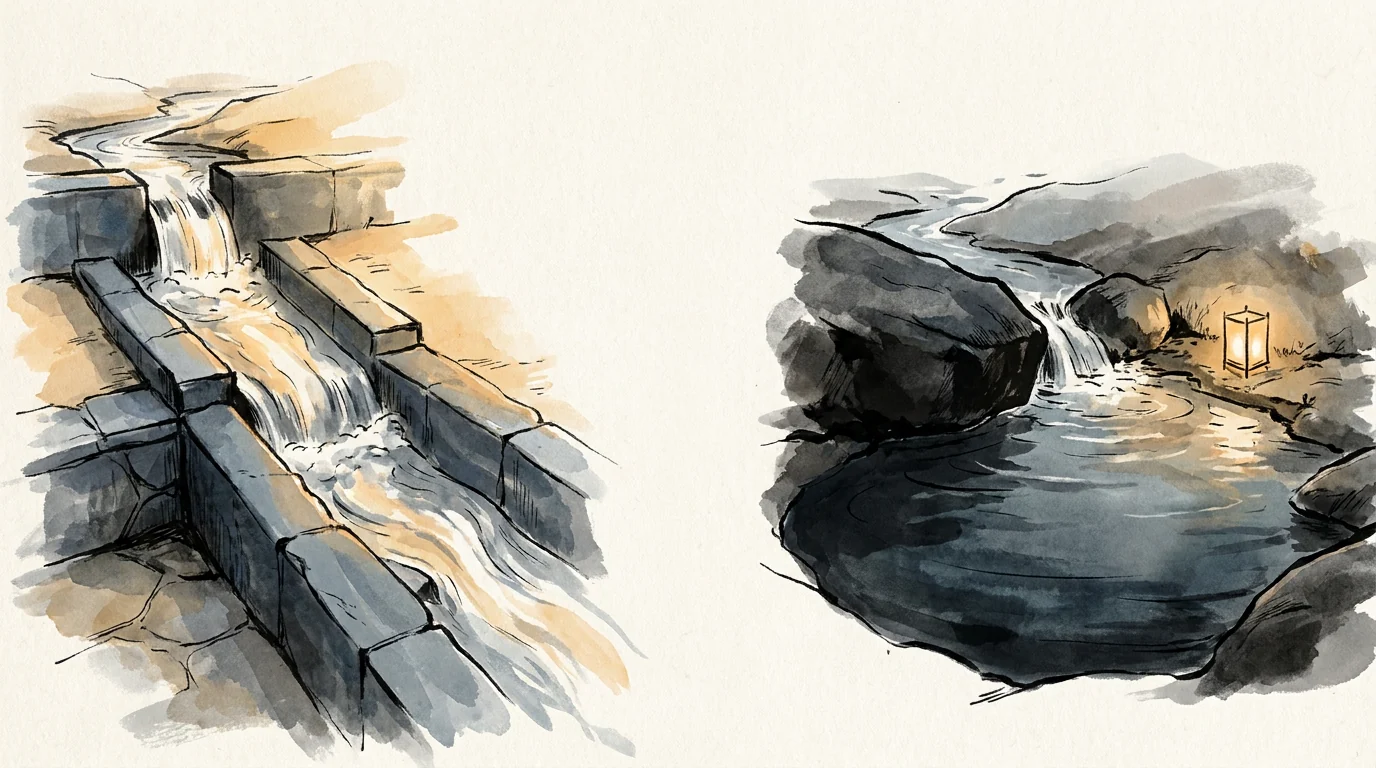
Two Ten-God pairings look alike on paper because both involve a Resource star, yet they run in opposite directions. In an Officer–Resource chain, external structure feeds the Resource and the Resource feeds the Day Master, turning expectations into learning. In the traditional pairing called Indirect Resource seizing Eating God, a strong Indirect Resource presses on the Eating God and can crowd out easy expression. Whether either dynamic is actually active depends on adjacency, root depth, season, and whether a Wealth element restrains the Indirect Resource, so read the conditions before the label.
Overview
Most Ten Gods explanations describe each star on its own: Direct Officer means structure, Direct Resource means support and learning, Indirect Resource means unconventional insight, Eating God means relaxed, natural output. That is a useful vocabulary, but charts rarely speak in single words. They speak in pairs and chains, and the same star can behave very differently depending on what sits next to it.
This guide focuses on two pair dynamics that beginners often confuse because both feature a Resource star. One is a generating chain (Officer → Resource → Day Master), where pressure from outside is converted into nourishment. The other is a blocking pair (Indirect Resource pressing on Eating God), where an inward, analytical force can crowd out natural expression. Following YiInsight's layered editorial method, we keep three layers apart: deterministic calendar calculation, public-domain classical theory, and modern reflective interpretation. Nothing below is a verdict about a person; it is a structural reading checklist.
Why Classical Ziping Treats These Two Pairings Differently
The Qing-era treatise Ziping Zhenquan (《子平真詮》, chapter On Yongshin) sorts Month-Branch focal stars into two operating modes before discussing any outcome:
> Classical source (Public Domain, Qing Dynasty — Ziping Zhenquan, "On Yongshin"): "八字用神,專求月令,以日干配月令地支,而生克不同,格局分焉。財官印食,此用神之善而順用之者也;煞傷梟刃,用神之不善而逆用之者也。當順則順,當逆則逆,配合得宜,皆為貴格。"
Read structurally, the passage places Direct Officer (官) and Resource (印) among the stars that are guided forward and protected, while Indirect Resource (梟) sits with Seven Killings, Hurting Officer, and Yang Blade among the stars that need counterbalance. That single sorting explains our two pairings:
- When Officer feeds Resource, two "forward" stars cooperate. The usual task is to keep the chain unbroken.
- When Indirect Resource meets Eating God, a "counterbalanced" star leans on a "forward" one. The usual task is to check whether something restrains the Indirect Resource before it smothers the output.
Note the final clause of the quote: the classical text treats either mode as workable when the arrangement fits. Neither pairing is "good" or "bad" by name; each depends on placement.
The Generating Chain: Officer → Resource → Day Master
In the Five-Element generating cycle, the element that controls the Day Master (Officer) produces the element that nourishes the Day Master (Resource). For a 甲 Yang Wood Day Master, 辛 (Yin Metal) is Direct Officer and 癸 (Yin Water) is Direct Resource: Metal generates Water, Water generates Wood. Traditional texts treat this as a constructive loop in which outside expectations are routed through learning before they reach the self.
Three structural checks decide how smoothly that loop runs:
- Continuity of position. The cleanest chain places the three stems in sequence, for example Officer in the year stem, Resource in the month stem, and the Day Master in the day stem. If the Officer instead sits directly beside the Day Master with the Resource on the far side, the elemental chain is still complete, but pressure reaches the Day Master first and the conversion happens one step away.
- Root depth of the Resource. A Resource stem with a solid branch root can keep converting pressure over time. A Resource with only a residual hidden-stem root may convert well in some years and thin out in others, depending on which branches luck cycles bring.
- Interruption by Wealth. Wealth controls Resource. A visible, rooted Wealth stem placed against the Resource can break the chain, leaving Officer pressure to land directly on the Day Master. Hidden Wealth is a latent risk rather than an active break.
As a reflection lens (not a prediction), a working chain often maps to questions like: Do I treat outside standards as a curriculum or as a judgment? Where do credentials, mentors, or structured study help me absorb pressure instead of resisting it?
The Blocking Pair: When Indirect Resource Presses on Eating God
The traditional four-character term for the second dynamic is 梟神奪食, often rendered "the owl seizes the food." For a 甲 Day Master, 壬 (Yang Water) is Indirect Resource and 丙 (Yang Fire) is Eating God. Water controls Fire, so a strong Indirect Resource can suppress the Eating God, the star that represents easy, unforced expression and enjoyment of one's own output.
The label is often applied far too quickly. A careful reading checks four conditions together:
- Strength and season of the Indirect Resource. Is it the month command or rooted in its own primary-qi branch? A floating Indirect Resource is a theme, not a force.
- Dependence on the Eating God. Is the Eating God the chart's main outlet, for instance because the Day Master is already well supported? If the chart barely relies on it, pressure on it matters less.
- Adjacency. Stems side by side interact directly. Stems at opposite ends of the chart interact weakly, and anything placed between them can act as a buffer or a bridge.
- A Wealth restraint. Earth (Wealth for a Wood Day Master) controls Water. A visible, rooted Wealth stem works like a release valve that keeps the Indirect Resource from overrunning the Eating God.
One more subtlety: when the Day Master itself sits between Indirect Resource and Eating God, the sequence Water → Wood → Fire becomes a pass-through flow. The Day Master can absorb the Water and pass energy on to the Fire, softening the classic clash. For a deeper treatment of how counterbalanced stars are contained, see assertive patterns and containment rules.
As a reflection lens, an active blocking pair often maps to questions like: Where does analysis, preparation, or second-guessing delay work I could already share? Which habits let me finish a draft before I perfect it?
A Synthetic Comparison: Two Yang Wood Charts
| Comparison Field | Synthetic Chart A (`1993-09-10 01:30`) | Synthetic Chart B (`1992-11-14 03:30`) |
|---|---|---|
| Four Pillars | 癸酉 / 辛酉 / 甲午 / 乙丑 | 壬申 / 辛亥 / 甲午 / 丙寅 |
| Month command | 酉 (primary qi 辛, Direct Officer), mid-autumn Metal | 亥 (primary qi 壬, Indirect Resource), early-winter Water |
| Key stems | 辛 Direct Officer (month), 癸 Direct Resource (year), 乙 Rob Wealth (hour) | 壬 Indirect Resource (year), 辛 Direct Officer (month), 丙 Eating God (hour) |
| Root depth | 辛 very deep (酉, 酉, plus residual 辛 in 丑); 癸 shallow (middle qi in 丑); 甲 has no branch root | 壬 deep (亥 primary qi, 申 middle qi); 丙 rooted (寅 middle qi, Fire in 午); 甲 rooted (寅 primary qi, 亥 middle qi) |
| Pair geometry | Chain complete in elements, but Officer sits between Resource and Day Master | Indirect Resource and Eating God at opposite ends; Day Master sits next to Eating God |
| Wealth (Earth) | Hidden only (己 in 午 and 丑) | Hidden only (戊 in 申 and 寅, 己 in 午) |
| Structural reading | Officer-frontloaded generating chain: pressure arrives first, the Resource converts it from one step away | Classic seizing effect buffered by distance and by the Day Master acting as a bridge; valve latent |
The two fully synthetic teaching charts below were calculated with YiInsight's deterministic BaZi engine (civil time, Asia/Taipei, local-midnight day boundary). They are not real people and carry no predictive claim. Both have a 甲午 day pillar, and both happen to place Resource in the year stem and 辛 Direct Officer in the month stem, which makes the contrast easier to see.
Chart A. 辛 Direct Officer is the month command and protrudes in the month stem, with 酉丑 adding further Metal weight. The Day Master 甲 has no branch root and leans on 乙 Rob Wealth and 癸 Direct Resource. Elementally, Metal → Water → Wood is complete, which is why Resource matters so much here: it is the converter that turns a strong Officer into usable support. Positionally, though, 辛 sits right beside 甲 while 癸 sits on the outer edge with only a shallow root. A fair reading is "a real chain whose conversion step is thin," not "a perfect Officer–Resource loop." Wealth is hidden, so the chain is not visibly broken.
Chart B. 壬 Indirect Resource is the month command, protrudes in the year stem, and is fed by 辛 next to it. 丙 Eating God is out of season in winter but rooted in 寅 and supported by 午, and a well-rooted 甲 in a Water month genuinely needs an outlet. So two of the classic conditions are present: a strong Indirect Resource and a chart that depends on its Eating God. The other two are absent: the stems are as far apart as stems can be, and 甲 stands between them as a pass-through. Wealth appears only as hidden stems, so the release valve is latent rather than working. The honest classification is buffered tension, a background theme that becomes more noticeable only if later cycles add Water or remove the buffer. Winter Wood seeking Fire also matters here; the classic line "甲木參天,脫胎要火" points the same way, and winter Wood and seasonal warmth explores that seasonal layer separately.
Turning Structure into Reflection Prompts
Pair dynamics are most useful when translated into questions you can test against ordinary experience, not into fixed character labels:
- Work style (chain). When a new rule, review, or standard arrives, do you first look for what it can teach you? Would a course, a mentor, or written notes make outside pressure easier to digest?
- Work style (blocking pair). Do you research a task so thoroughly that the doing keeps slipping? What is the smallest version you could release this week?
- Communication (chain). Do you explain ideas better when you can anchor them in a framework, credential, or precedent?
- Communication (blocking pair). Do you edit your words in your head until the moment to speak has passed? Where could a lighter, first-draft tone serve you better?
- Release valves. What practical, concrete tasks pull you out of rumination and into action? In chart language this is the Wealth role; in daily life it may be deadlines, budgets, or hands-on work.
Practical Checklist
Before applying either label to a chart, walk through these steps (you can generate your pillars in the YiInsight BaZi calculator):
- Confirm the pillars and the month command. Identify the month branch's primary qi and whether it protrudes; this tells you which star carries seasonal authority. If you are unsure how hidden stems and protrusion interact, see month command versus protrusion.
- Label every stem with its Ten God relative to the Day Master. Double-check polarity: for
甲,辛is Direct Officer,庚is Seven Killings,癸is Direct Resource,壬is Indirect Resource,丙is Eating God,丁is Hurting Officer. - Map positions. Note which stems are adjacent and which star, if any, sits between the members of a pair.
- Check roots. Primary-qi, middle-qi, and residual roots carry different weight.
- Look for Wealth. Is it visible and rooted, or hidden? Is it helping (restraining Indirect Resource) or interrupting (pressing on a needed Resource)?
- Write the reflection question, not the verdict.
Does every chart with Indirect Resource and Eating God suffer from "the owl seizing the food"?
No. The traditional effect needs several conditions at once: a strong, rooted Indirect Resource, a chart that relies on its Eating God, close placement, and no effective Wealth restraint. When the stems are far apart or the Day Master sits between them as a bridge, the effect is usually described as buffered.
Is an Officer–Resource chain always favorable?
The classical framing treats it as a constructive structure, but its quality depends on placement and roots. A chain with a thin Resource, or one where visible Wealth presses on the Resource, converts pressure less smoothly. Treat it as a description of how pressure is processed, not as a promise about career results.
Can these pairings tell me what job to take or how a relationship will end?
No. Ten-God dynamics are a traditional symbolic vocabulary for reflecting on work style, pacing, and communication habits. Career, legal, financial, health, and relationship decisions call for real-world information and qualified professionals.
Inspect your deterministic Four Pillars
Enter a birth date and local time zone to view your Four Pillars and Dayun structure cleanly.
Open BaZi Calculator →