Casting method
Meihua Two-Number Calculator: Why the Order Matters
See why reversing two Meihua calculator inputs can change the hexagram while preserving the moving line, with checked examples and a record checklist.
The short answer
In YiInsight’s Meihua two-number calculator, the first value selects the upper trigram and the second selects the lower. Swapping the values can change the hexagram. The moving line stays the same because it is calculated from their sum. Save the pair in its original order if you want to reproduce the result.
Overview
Open the YiInsight Meihua calculator and choose Two numbers. Enter two integers between 1 and 99. The order tells the calculator where to place each trigram. This guide shows how to read the output, check what changed when the order is reversed, and keep a reproducible record of your original inputs.
1. Match each number to its position
Each number is reduced to a trigram index by applying modulo 8. The tool assigns a zero remainder to index 8, Kun, because its table uses indices 1 through 8.
- First number mod 8 → upper trigram
- Second number mod 8 → lower trigram
- (First + Second) mod 6 → moving line (zero result counts as line 6)
The moving line is then counted from the bottom of the hexagram upward, as YiInsight counts the lines.
2. Swap the pair in a worked example
| Input pair | Upper trigram | Lower trigram | Primary hexagram | Moving line | Changed hexagram |
|---|---|---|---|---|---|
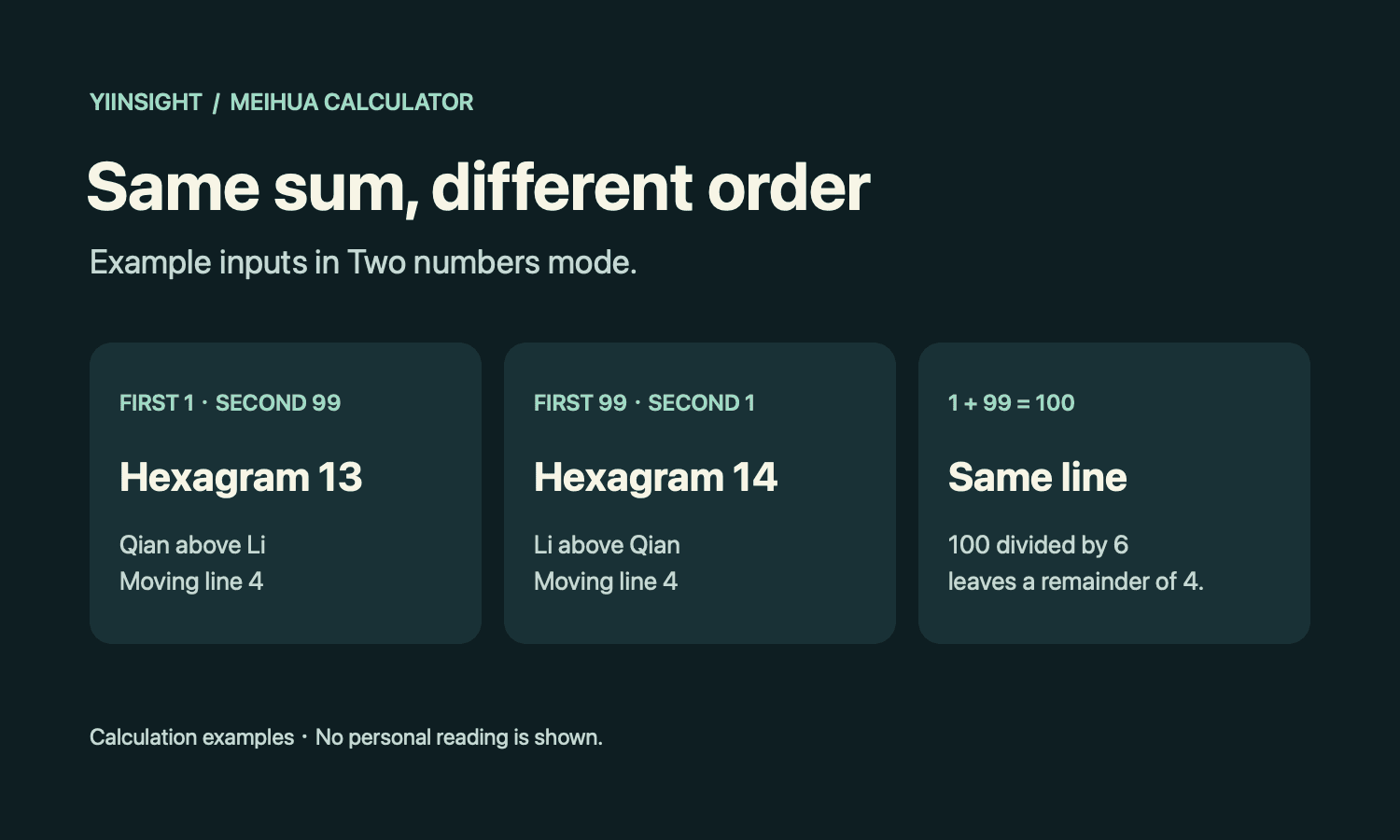
| First 1, Second 99 | Qian (1) | Li (3) | 13 Tong Ren | 4 | 37 Jia Ren |
| First 99, Second 1 | Li (3) | Qian (1) | 14 Da You | 4 | 26 Da Xu |
The following are calculation examples using the current tool rules. They contain no personal question or forecast.
Both pairs share the same sum (100), so they produce the same moving line (line 4, because 100 mod 6 = 4). But the upper and lower trigrams are swapped, yielding two distinct hexagrams with different names and different changed hexagrams.
An edge-case worth noting: entering 8 and 16 gives upper Kun and lower Kun (both numbers leave a zero remainder, which maps to 8). Their sum 24 mod 6 = 0, which maps to line 6. The hexagram is 2 Kun, moving line 6.
Two values can also lead to the same trigram. For instance, 4 and 12 both leave remainder 4, Zhen. Their positions can be exchanged while leaving the figure and moving line the same. Retain the original input order even in this case. It makes your calculation easier to check later.
3. Check which mode you used
The Two numbers mode uses the ordered pair for its arithmetic. A timestamp can be recorded alongside the result, but changing that timestamp leaves this mode’s figures unchanged.
The Single number and Time modes include time in their own calculations. If a result differs from what you remember, check the mode first. A single number with a time and an ordered pair supply different inputs. Record the original mode beside your result so you know which path to repeat.
The calculator displays a figure and a moving position. Interpretation comes afterward, using the recorded figure as its starting point. Treat a changed hexagram as another figure derived by changing the indicated line in the primary figure.
4. Keep a record you can reproduce
Save the method, the first value, the second value, the primary hexagram number, and the moving line. Add the calculator version if you have it. A note like “Two numbers, first 1, second 99, hexagram 13, moving line 4” gives you the information needed to repeat the example.
If two calculations disagree, compare the mode and the ordered pair first. Then check how the tool treats a zero remainder and which end of the figure it counts from. Finally, compare the primary figure and the changed figure separately.
A hexagram number on its own leaves out the inputs and the moving position. If you cannot find the original pair, preserve the known figure and mark the missing values in your record. Entering other values produces a separate calculation.
Key takeaways
- Keep the first and second values in the original order.
- Use the shared sum to check the moving line when values are swapped.
- Record the mode and figure with your input values.
Conclusion
Begin your comparison by checking the mode and the order of the two inputs. Then confirm each trigram and the moving line. Keeping these details together lets you revisit the arithmetic that produced the recorded figure.
Why can reversing the numbers give the same hexagram?
Two different values can leave the same remainder when divided by eight. In that case the same trigram appears in both positions, so swapping it leaves the primary figure unchanged.
What happens when the sum is divisible by six?
A remainder of zero selects moving line 6, counted from the bottom. In the worked 8 and 16 example, the sum is 24 and line 6 moves.
Which details should I write down to repeat a result?
Record the Two numbers mode, first and second inputs in order, the primary hexagram, and the moving line. Add the calculator version if you know it.
Sources
Reflect on one question
Frame a focused question before starting a new reading.
Explore YiInsight →