 YiInsight
YIINSIGHT / Method and reflection
How to Find the Judgment, Image, and Lines in Wilhelm–Baynes I Ching
Find the Judgment, Image and Lines in the Wilhelm–Baynes I Ching, then use its three-book structure to locate commentary without confusing it with a new result.
The short answer
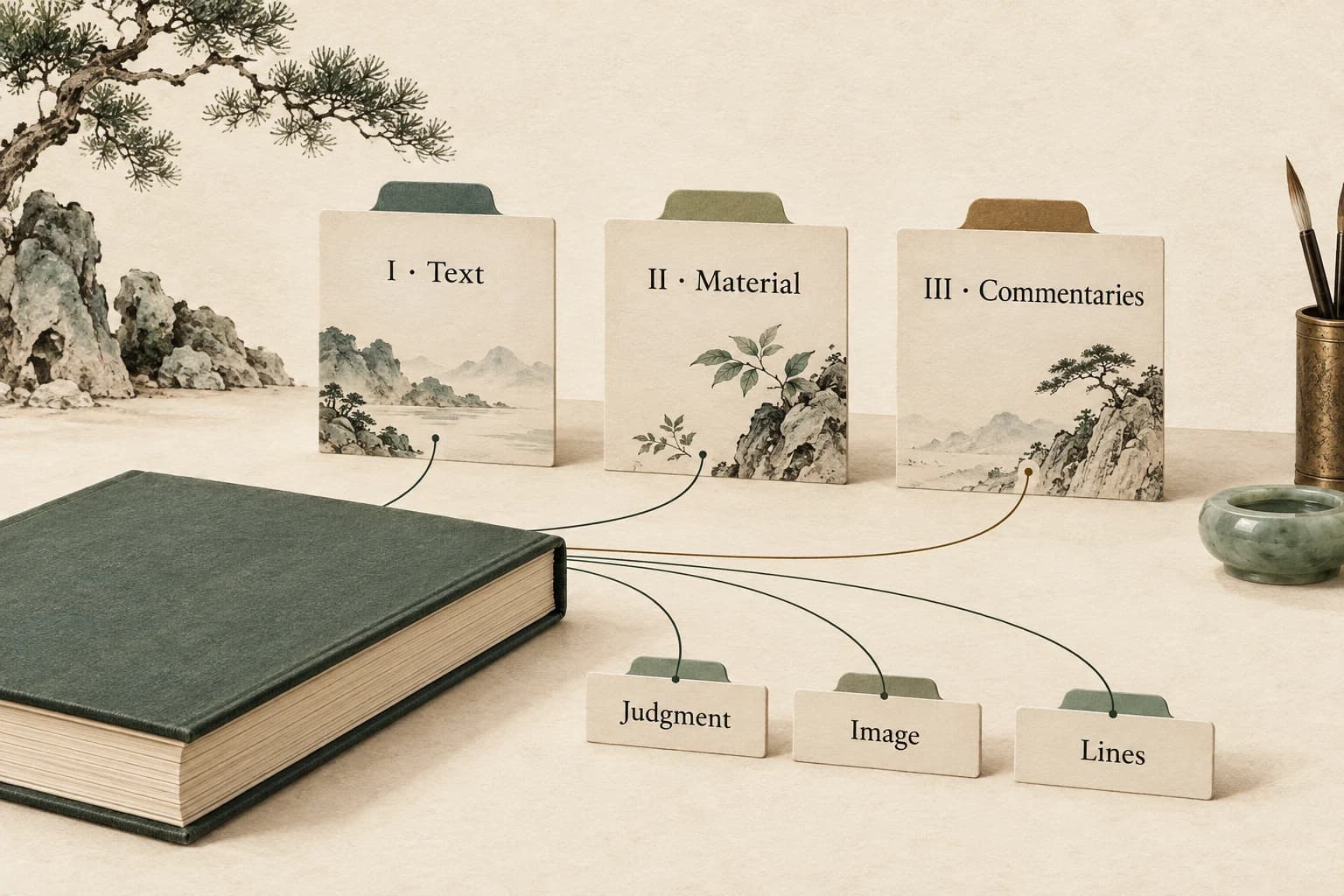
In the inspected Wilhelm–Baynes I Ching publisher preview, use the contents to locate Book I (The Text), Book II (The Material), and Book III (The Commentaries). Book I and Book III list numbered hexagrams; the verified Book I layout example in this guide is Hexagram 1.
Overview
The inspected publisher preview separates Book I, Book II, and Book III. Repeated numbered listings in its contents can look like duplicate material until you distinguish the text from the commentaries. This guide explains those verified divisions and uses only the inspected Hexagram 1 entry for the Judgment, Image, and Lines layout example.
This guide uses the Princeton University Press publisher preview identified as 9780691284576.pdf (hosted under the 9780691097503 directory at pup-assets.imgix.net). Because that preview filename and its parent directory carry different catalogue numbers, this guide does not assert a printing year or equate folder and preview edition without additional publisher metadata. All locators here are book, section, and hexagram number—not universal page numbers, which shift between printings.
Check your own table of contents first: the section names below should appear there clearly.
The Three-Book Map: Text, Material, and Commentaries
The inspected contents label Book I The Text and list numbered hexagrams. This guide uses the first listed entry, Hexagram 1, for the heading-layout example.
Book II is called The Material. It steps back from individual hexagrams and offers thematic essays: a Discussion of the Trigrams, The Great Treatise, and a section on the Structure of the Hexagrams. If you want background on how the system works conceptually, Book II is where that lives.
The inspected contents label Book III The Commentaries and repeat numbered hexagrams for commentary. Match the listing in your own contents rather than assuming a universal page number.
Here, “Books” names divisions of the work, not a requirement to buy three physical volumes. For navigation, record both the Book label and hexagram number: Book I is The Text, while Book III is The Commentaries in the inspected contents.
Finding the Judgment, Image, and Lines in Book I
In the inspected Book I entry for Hexagram 1, several distinct textual categories appear. The publisher preview visually confirms these heading labels for Hexagram 1 (The Creative): The Judgment appears as a distinct heading, followed by The Image, followed by The Lines.
Key layout observations based on the verified preview:
- Heading labels (The Judgment, The Image, The Lines) are typographically distinct from the surrounding explanatory prose that follows each one.
- An "Image" heading is a textual category—a named textual section of the hexagram reading—not necessarily a photograph or diagram.
- Bold or heading formatting distinguishes the section labels from surrounding explanations. This guide does not assert a universal indentation rule, because visual presentation can vary between printings; consult your own copy.
The Lines section enumerates individual line positions. Each line has its own brief text, introduced by positional labels; the inspected first line is labeled as being at the beginning. Read the short labeled passage and the surrounding explanatory prose as different parts of the presentation; do not assume every nearby sentence has the same source or role.
Why Every Hexagram Appears Twice (Book I vs. Book III)
| Location | Content | Purpose |
|---|---|---|
| Book I, inspected Hexagram 1 | Judgment, Image and Lines, with accompanying explanations | Locate the inspected Book I passage |
| Book III, Hexagram N | Commentaries organized under the same hexagram number | Locate further commentary |
The repeated numbering discussed here is the arrangement shown in the inspected preview's contents. It does not mean that every edition or excerpt follows the same layout.
For navigation, distinguish the two locations:
For this navigation exercise, use the inspected Hexagram 1 entry in Book I, then find the same number in the Book III contents. Record those as two different locations: The Text and The Commentaries. The contents alone do not verify the detailed layout of the Book III entry.
How to Cross-Reference Book III Without Getting Lost
A practical sequence:
- Use the inspected example, Hexagram 1. This is a navigation exercise; no new cast is required.
- Go to Book I, Hexagram 1 in the preview. Locate The Judgment, The Image, and The Lines, the headings verified in that entry. Check labels independently in any other entry.
- Locate Book III in the preview contents. Match the listed hexagram number as a navigation exercise. The contents alone do not verify the detailed headings or text inside that entry.
- Record the Book and hexagram number together. Book II is arranged thematically, so use its named sections instead of assuming every Book is a hexagram index.
Hexagram numbers connect Books I and III; section titles navigate Book II.
What Online "Wilhelm" Pages May Not Include
Some widely used online texts present Wilhelm–Baynes material. Whether any particular website includes Books II and III depends on that site's editorial choices. Check your own edition's table of contents before assuming an online excerpt is complete. If your table of contents lists Book II and Book III sections, and an online version you are consulting does not display them, you are working with a partial excerpt of the full work.
For broader edition choice and source attribution, see Choosing an *I Ching* Book and Sources and Editorial Method.
Navigating Your Physical Copy: A Practical Example
For a study exercise, use the inspected Hexagram 1 entry. This is a lookup example, not a cast or interpretation.
> Recommended sequence: Open the inspected preview contents → locate Hexagram 1 in Book I → locate The Image, a heading verified in that entry → distinguish the labeled passage from surrounding explanation → return to the contents to locate the Book III listing. Verify the contents and labels independently in your own copy.
This sequence keeps the Book label attached to the hexagram number throughout the lookup exercise. It does not establish a rule for interpreting a cast.
For comparison with another major translation's locator system, see James Legge *I Ching* Reading Locators.
Key takeaways
- Book I is labeled The Text; Book III is labeled The Commentaries in the inspected contents. Use the Book label and listed hexagram number to distinguish these locations. This is a navigation guide, not a rule for interpreting a cast.
- Use Book and hexagram labels as locators in the inspected preview, then check the contents of your own edition; this guide does not verify every edition or printing.
- In the inspected Book I entry for Hexagram 1, The Judgment, The Image, and The Lines are named textual headings. They are distinct from surrounding explanations. "Image" is a section label, not a picture; check other entries independently.
Conclusion
In the inspected preview, Book I is labeled The Text, Book II The Material, and Book III The Commentaries. Use the contents to record the Book and the listed hexagram number; use named thematic sections for Book II. The Judgment, Image, and Lines layout example verified here is Hexagram 1 in Book I. Check the contents and headings independently in your own copy rather than assuming that every edition has the same layout.
For editorial context on how this guide itself handles sources, see Sources and Editorial Method.
What is the difference between The Judgment and The Image in Wilhelm–Baynes?
In the inspected publisher preview, The Judgment and The Image are separate headings within the first hexagram entry in Book I. Use the printed labels to locate the two passages. This guide verifies their placement, without assigning a classical source layer or interpretive meaning to either passage; Image here is a textual heading, not a photograph.
If I find Hexagram 3 in Book III, does that mean I should re-read it as part of my cast?
This navigation guide does not establish a rule for interpreting your cast. In the inspected contents, Book III is The Commentaries and repeats numbered hexagrams. Use the Book division to identify which part you are reading; finding a number in the contents does not itself instruct you to perform another cast.
Can I rely on page numbers to find my place across different Wilhelm–Baynes printings?
This guide uses the inspected publisher preview rather than verifying other printings. In that preview, Book I and Book III use numbered hexagrams, while Book II has named thematic sections. Record those labels and check them against your own copy; this guide does not establish a locator that works in every printing.
Reflect on one question
Frame a focused question before starting a new reading.
Explore YiInsight →