 YiInsight
YIINSIGHT / Method and reflection
Chinese Zodiac Year Boundaries: A Worked HKO Calendar Lookup
Check two calendar dates with a clearly stated convention, trace each result to its source, and keep observations separate from interpretation.
The short answer
For this Chinese zodiac rabbit lookup, the two dates below give Rabbit then Dragon under the declared lunar-first-day convention. The table separates printed calendar cells from the rule applied here.
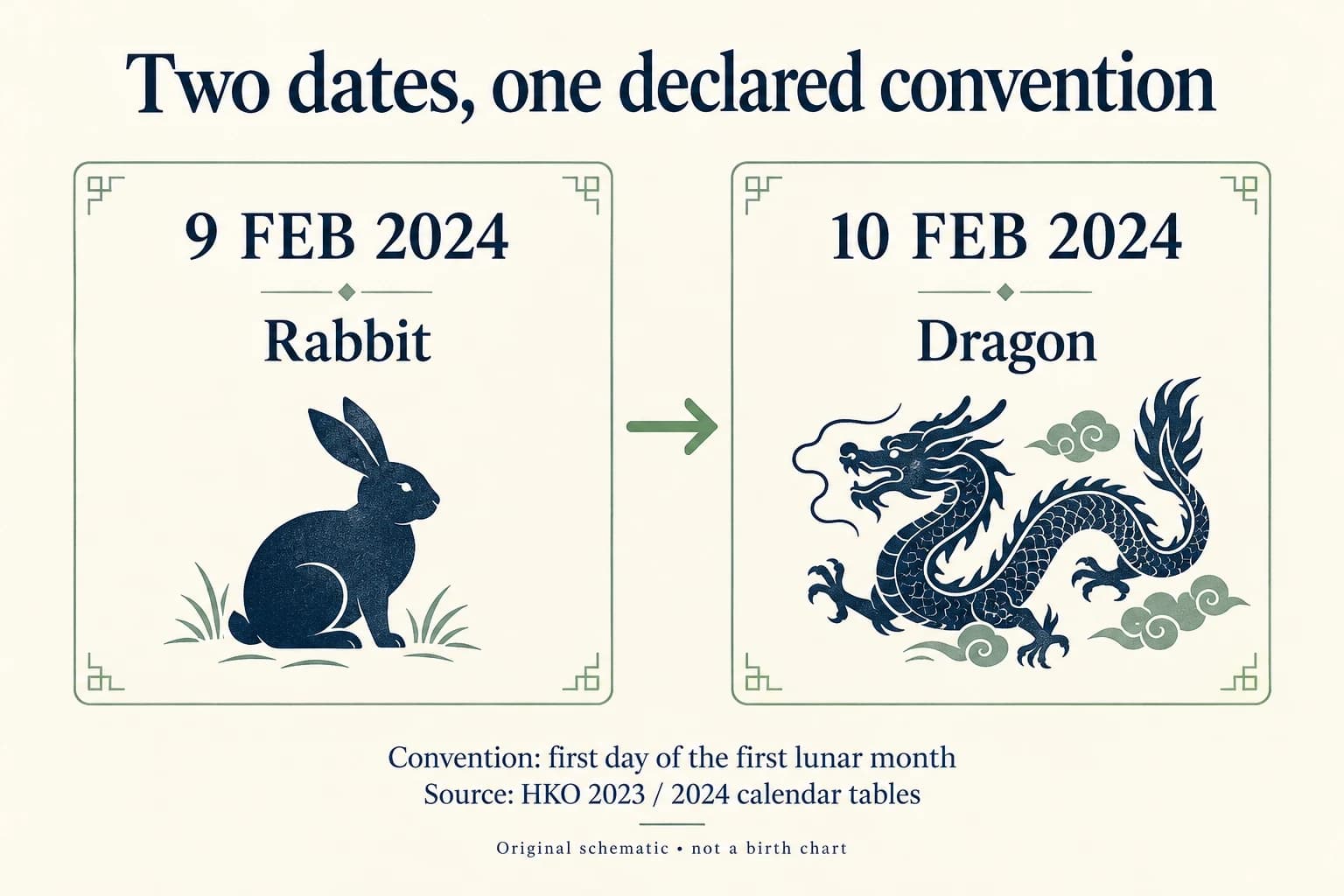
Overview
For a Chinese zodiac rabbit lookup, make the question specific before deciding what to record. Write a complete date and name the convention you are testing. The aim is a result another reader can check, with the calendar observation and your interpretation clearly separated.
State the calendar convention before the lookup
Here, the animal-year label changes on the first day of the first lunar month. Treat that as the rule chosen for this comparison.
Write it above your notes before checking either date, then apply it consistently. If your question concerns a personal birth instant or another convention, record that as unresolved context rather than silently changing the question.
Identify the twelve HKO animal-year labels
HKO links a repeating twelve-animal year cycle to twelve earthly branches: matching branches share animal labels. Its list is mouse, ox, tiger, rabbit, dragon, snake, horse, goat, monkey, rooster, dog and pig.
Keep the source’s spellings in your transcription so someone else can match your note to the cited page.
Read the 2023 Rabbit and 2024 Dragon table headings and boundary cells
The 2023 table names Gui-mao, year of the Rabbit. On page 1, January 22 starts lunar month one; footnote 1 explains the grey month-start cells.
The 2024 heading names Jia-chen, year of the Dragon.
Copy the heading separately from the particular cell you inspect. This keeps the document identifier distinct from the evidence for a specific date. If you cannot read either clearly, leave your conclusion open and inspect the source again.
Compare February 9 and 10, 2024 step by step
| Gregorian date | Lunar cell | Convention result |
|---|---|---|
| 2024-02-09 | [Month 12, day 30](https://www.hko.gov.hk/en/gts/time/calendar/pdf/files/2024e.pdf) | Rabbit: before |
| 2024-02-10 | [Month 1, day 1](https://www.hko.gov.hk/en/gts/time/calendar/pdf/files/2024e.pdf) | Dragon: start |
Page 1, February row, columns 9–10:
- Find the date before copying its lunar entry.
- Compare the entry with the convention you wrote down.
- Record the resulting label alongside both, so a later reader can repeat the comparison.
The final column applies this guide’s convention; the middle column transcribes the calendar.
Keep Spring Commences and uninspected conventions separate
2024 lists Spring Commences separately under solar terms: February 4.
Do not substitute that entry for the boundary selected above. If another reference produces a different answer, first identify its stated rule and supporting entry. Without those, record the comparison as unresolved; this guide supplies no result under an alternative astrological convention.
Record source, date, convention and unresolved context
Save one record per lookup using these fields:
- Date checked: full Gregorian date.
- Source: direct document URL, page and cell locator.
- Observation: the entry transcribed before interpretation.
- Convention: the boundary rule applied.
- Conclusion: the label deduced under that rule.
- Unresolved context: missing date details, unclear text, an unspecified convention, or a question involving a personal birth instant.
Add the date you consulted the source separately; do not confuse it with the date being checked or assume it is the publication date. For editorial practice, see sources and editorial method.
Key takeaways
- Calendar observation and editorial inference belong in separate fields.
- An unreadable cell or unspecified convention leaves the lookup unresolved.
- Keep conclusions within the dates and convention actually checked.
Conclusion
Keep the completed record with the result so its reasoning remains checkable.
What if I only have a Gregorian year?
Leave the result unresolved for this method. Obtain the month and day, then inspect the matching entry under a named convention.
What if the calendar and my notes disagree?
Return to the row and column, transcribe the entry again, and check whether you changed conventions. Preserve the uncertainty until you can identify the discrepancy.
What should I save if a source cell is unclear?
Save its document URL and page locator, describe the unclear field, and leave the result unresolved until the entry can be read.
Sources
Reflect on one question
Frame a focused question before starting a new reading.
Explore YiInsight →