 YiInsight
YIINSIGHT / Method and reflection
Who Invented Astrology? A Mesopotamian and Greek-Roman Evidence Map
Read a bounded evidence map for who invented astrology, distinguish reported dates from invention claims, and check attribution before drawing conclusions.
The short answer
Who invented astrology? Neither Michigan’s exhibition nor Hamburg’s CSMC article establishes a sole inventor or universal origin.
Overview
An origin question can ask about a practice, a written record, a classification, or a named person. Decide which answer you need before treating a historical date as a discovery.
Define the traditions covered and give a qualified answer
The scope is Mesopotamian and Greek-Roman traditions (Michigan).
For a founder claim, require an explicit connection between a named person and a defined contribution. A regional label cannot supply a person's identity. Keep the question open when the evidence supports a process without identifying its inventor.
Separate celestial omens, divided zodiac and personal horoscopes
Use three questions to classify what you are reading:
- Celestial omens: Is this about interpreting celestial events as signs?
- Divided zodiac: Is this about a framework of divisions?
- Personal horoscopes: Is this about an individual's horoscope?
These are reading categories, not a dated sequence. No personal-horoscope chronology is established here. Do not transfer a date between categories.
Build a source-attributed chronological evidence map
| Reported period or date | Account and attribution | Evidence type and limit |
|---|---|---|
| Early second millennium BCE | Celestial-omen texts — [Michigan](https://www.early-astronomy-um.org/ancient_intro.php). | Reported textual evidence; no named inventor. |
| Fifth century BCE | Uniformly divided zodiac; introduction — [Michigan](https://www.early-astronomy-um.org/ancient_intro.php). | Reported classification stage; approximate period. |
| 419 BCE | Text discussed alongside twelve zodiac signs — [Hamburg](https://www.csmc.uni-hamburg.de/publications/mesopotamia/2026-01-17.html). | Reported text date; not an invention date. |
| Approximately 400 BCE | Zodiac; timeline — [Michigan](https://www.early-astronomy-um.org/ancient_intro.php). | Approximate overview entry; not a precise origin. |
The dated entries below are source accounts.
Dates not supplied here: later Babylonian observational traditions; transmission and further Greek and Roman development (Michigan). Later Greek adaptation (Hamburg).
For your own notes, copy the date together with its row's subject and source. Keep qualifiers attached.
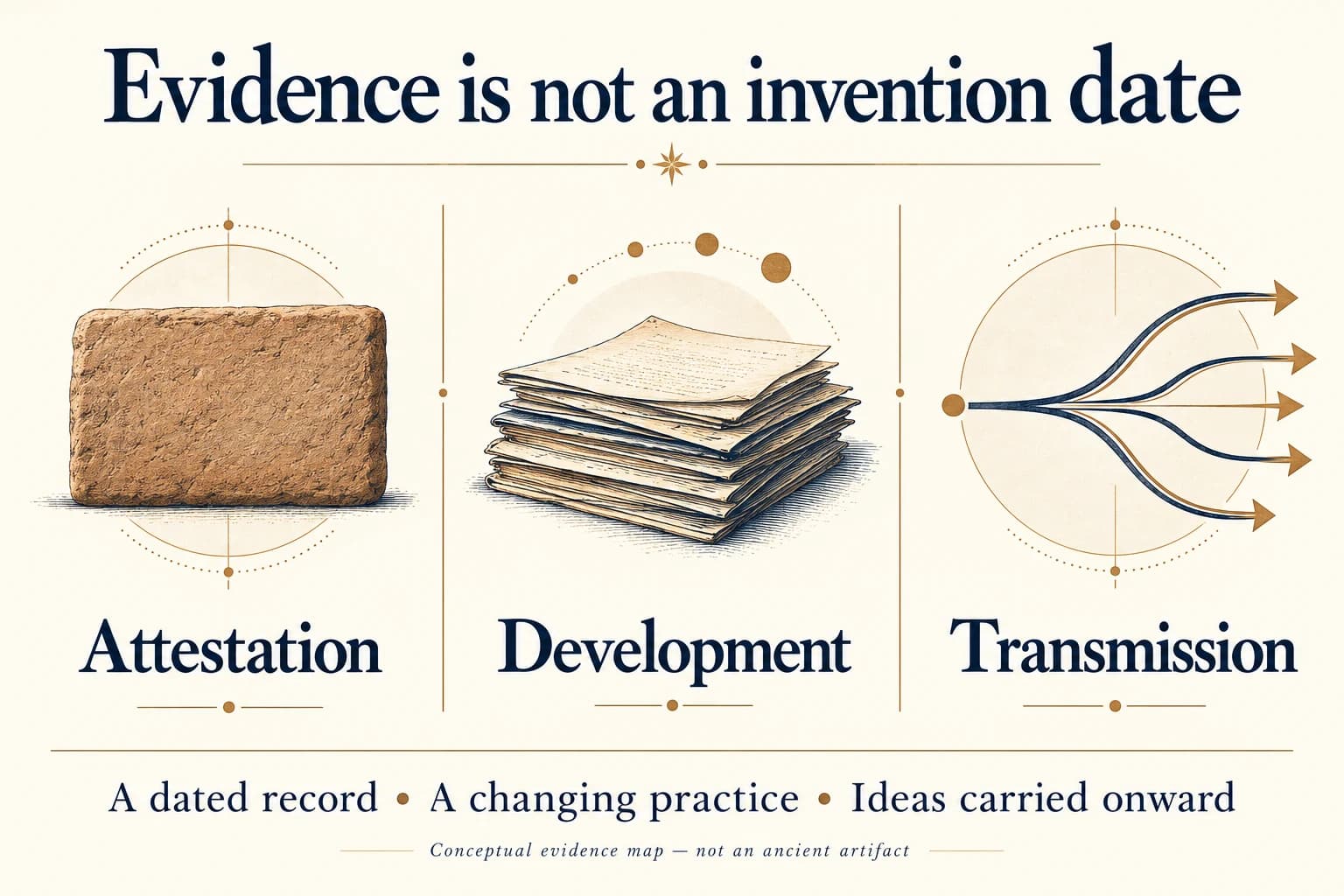
Distinguish reported attestation from invention date
A report that a text is dated establishes a different claim from a report that someone invented a practice. To check the wording, separate three fields: the item being dated, the date assigned to it, and the source making that assignment.
Also distinguish a modern article's publication date from its subject's date. A retrieval timestamp records access; it should not replace either. When information is missing, leave the corresponding field blank rather than infer it.
A compact note can read: source; object or practice; reported date; claim type; unresolved question. Fill only fields the account supports.
Follow transmission and adaptation without assigning a single inventor
When following an account across communities, ask what is said to move: a text, a classification, a practice, or an interpretation. Then ask whether the source describes adoption, modification, or an explicitly documented new contribution.
Keep those answers separate in your notes. Do not promote a recipient into the inventor of everything received, or turn an adapting community into a single named founder. If the account lacks that detail, record the limit.
If two retellings disagree, compare the specific contribution each assigns before deciding that the accounts conflict.
Preserve limits, attribution and uninspected originals
Here, scholarly overviews supply the evidence; ancient originals remain uninspected.
Keep the attribution attached when quoting a date elsewhere. If you follow a reference to an original object or transcription, record what you actually inspected before making a stronger claim. Distinguish calculations from astrological interpretations; neither label alone establishes the other.
For editorial method, see Sources and editorial method.
Key takeaways
- Name the category before comparing dates.
- Keep an attested record separate from an invention claim.
- Preserve attribution when summarizing transmission.
Conclusion
A useful origin answer should identify its subject, attach each date to the right claim, and preserve what remains unestablished. Follow the evidence before supplying a founder.
How can I check a secondary summary?
Open its citation and locate the passage supporting its claim. Check whether the summary preserves the passage's subject, qualifications, and scope.
What should I do when a source is inaccessible?
Mark the passage as unchecked. Preserve the citation for follow-up, and avoid presenting the summary as a firsthand reading.
Does a date in a timeline establish an invention date?
Check what the entry dates and which source supplies it. A date attached to a record cannot by itself identify a founder or the beginning of an entire tradition.
Sources
Reflect on one question
Frame a focused question before starting a new reading.
Explore YiInsight →