Hexagram structure
The Bridging Element (Tongguan) Myth: When a Middle Element Cannot Mediate a BaZi Clash
Discover why the mere presence of a bridging element in BaZi doesn't automatically resolve conflicts. Explore spatial proximity and structural coherence.
The short answer
The 'Tongguan' (Bridging) myth is the false assumption that having a mediating element in a BaZi chart automatically resolves clashes. In classical text, a bridging element only works if it has spatial proximity to the conflicting elements and possesses sufficient structural vitality to facilitate a continuous flow of energy.
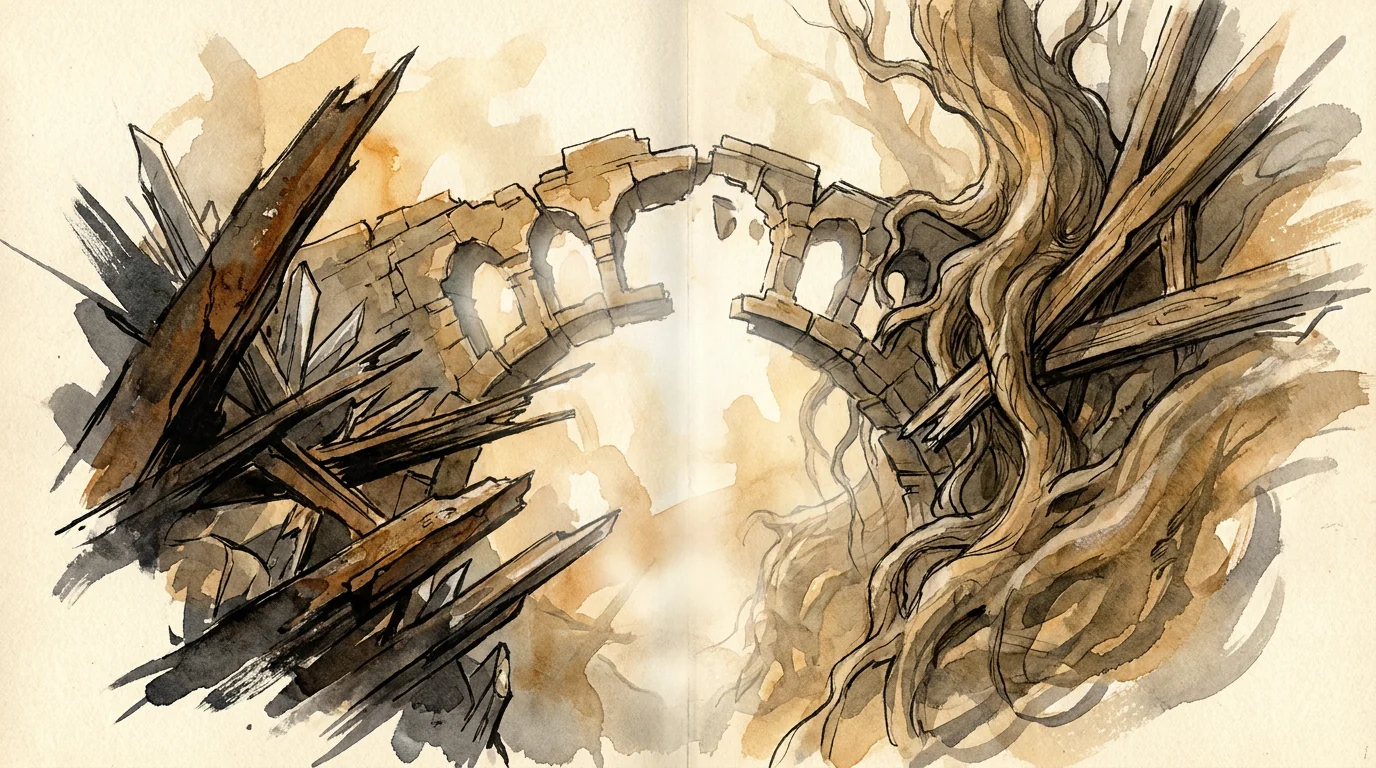
Understanding the 'Tongguan' (Bridging Element) Concept
In traditional BaZi analysis, a fundamental mechanism for resolving conflict is the concept of Tongguan (通關) or the 'Bridging Element.' When two elements in a chart are in direct opposition—for example, Metal attempting to cut Wood—the theoretical remedy is to introduce a middle element. In this case, Water. Metal generates Water, and Water, in turn, generates Wood. The hostile clash transforms into a continuous, supportive flow.
While this concept, heavily detailed in Ming Dynasty classics like the Shen Feng Tong Kao (神峰通考), serves as an elegant theoretical model, modern interpretations have drastically oversimplified it. A pervasive myth assumes that if the bridging element exists anywhere in the chart, the clash is automatically neutralized. This 'checklist' approach completely ignores the sophisticated spatial and structural rules defined by classical BaZi.
The Origin of the Myth vs. Classical Reality
The classical text Zi Ping Zhen Quan (子平真詮) places immense emphasis on the structural layout (Ge Ju) of a BaZi chart. It is not merely a question of what elements are present, but where they are positioned and how strong they are.
For a bridging element to successfully mediate a clash, it must meet two critical conditions:
- Spatial Proximity: The bridging element must physically reside between the two conflicting forces. If the conflicting elements are adjacent, but the bridge is situated far away (e.g., at the Year pillar while the conflict is in the Hour), it cannot effectively intercept the clash.
- Vitality and Support: The bridging element must sit on a supportive base. If it sits on an element that exhausts or destroys it, its capacity to mediate is severely compromised.
Structural Analysis: The Myth in Action
| Feature | Synthetic Chart A | Synthetic Chart B |
|---|---|---|
| Time | 1991-05-14 11:30 | 1991-05-14 15:30 |
| Pillars | Xin Wei, Gui Si, Jia Shen, Geng Wu | Xin Wei, Gui Si, Jia Shen, Ren Shen |
| Conflicting Forces | Metal (Shen, Geng, Xin) vs. Wood (Jia) | Metal (Shen, Xin) vs. Wood (Jia) |
| Bridging Element | Gui Water (Month Stem) | Gui Water (Month Stem), Ren Water (Hour Stem) |
| Position & Vitality | Gui is isolated on Si (Fire); Geng attacks Jia directly. | Ren sits directly on Shen (Metal), smoothly intercepting Metal to nourish Wood. |
| Bridging Status | Ineffective (Myth Exposed) | Effective (Structural Flow) |
To illustrate why the checklist approach fails, we can examine two synthetically generated charts that share the same Day Master, Year, Month, and Day pillars, differing only in their Hour pillars. In both charts, the Day Master is Yang Wood (Jia), facing strong Metal pressure (Seven Killings / Direct Officer). The theoretical bridging element here is Water (Resource).
Deconstructing Chart A: The Broken Bridge
In Chart A, the Day Master is Jia Wood. Directly beside it in the Hour Stem is Geng Metal, initiating a direct conflict. Observers might point to the Gui Water in the Month Stem and claim, 'Water is present; therefore, it bridges the Metal and Wood.'
However, a structural reading based on classical principles reveals a different story. The Gui Water is separated from the Geng Metal by the Day Master itself. Furthermore, Gui Water sits on Si Fire—an element that evaporates Water. The bridge is not only spatially disjointed from the immediate conflict in the Hour pillar, but its foundation is also too weak to carry the heavy burden of mediating the strong Metal-Wood clash.
Deconstructing Chart B: The Continuous Flow
Chart B paints a starkly different structural picture. Here, the Hour pillar is Ren Shen. Ren is Yang Water. Importantly, Ren Water sits directly on top of Shen Metal.
Because they share the same pillar, the generative sequence is perfectly aligned spatially: Shen Metal generates Ren Water directly beneath it, and the strong Ren Water flows smoothly into the adjacent Jia Wood Day Master. In this scenario, the Tongguan is functionally active. The element is not just present on a checklist; it holds strategic positional value and vitality.
Using BaZi for Symbolic Self-Reflection
Understanding the nuances of the Bridging Element allows us to use BaZi not as a deterministic oracle, but as a framework for self-reflection. When we recognize 'unbridged clashes' in our symbolic chart (like Chart A), it mirrors internal psychological tensions or recurring environmental frictions that don't easily resolve on their own.
Rather than passively waiting for a 'lucky year' to fix the problem, recognizing a broken bridge invites proactive awareness. It asks the individual to consciously build internal mediation strategies—such as pausing before reacting, or actively cultivating the traits of the missing bridge—to navigate life's inevitable pressures.
Frequently Asked Questions
Q: Does an unbridged clash mean I will have a hard life? No. BaZi is a calendrical and symbolic system, not a determinant of guaranteed outcomes. An 'unbridged' structure simply suggests that certain tensions or dualities may require more conscious effort and self-awareness to navigate gracefully.
Q: Can favorable decades (Da Yun) fix a broken bridge? In classical theory, certain ten-year periods can temporarily introduce elements that structurally complete the bridge, symbolizing windows of time where resolving specific tensions feels more intuitive or where external environments provide smoother pathways.
Q: Why do modern sources oversimplify the Tongguan concept? Oversimplification makes complex systems easier to digest and market. Counting elements is straightforward; analyzing spatial dynamics and vitality requires deeper study of classical texts like the Zi Ping Zhen Quan.
Inspect your deterministic Four Pillars
Enter a birth date and local time zone to view your Four Pillars and Dayun structure cleanly.
Open BaZi Calculator →