 YiInsight
YIINSIGHT / Method and reflection
I Ching Hexagram Chart: Find a Number from Two Trigrams
Use a complete 64-combination I Ching hexagram lookup. Identify the lower and upper trigrams, check the line order, and find the corresponding number.
The short answer
To use this I Ching hexagram chart, read the six lines from bottom to top. Identify the lower three lines and the upper three lines separately. Find the lower trigram’s row, then the upper trigram’s label in that row. The number identifies the hexagram; it does not interpret your question.
Overview
A chart is useful when you already have a six-line pattern but need its number. Its main trap is orientation: reversing the groups or reading from the top can lead to a different entry. This text-based chart includes all 64 lower-and-upper combinations and stays readable without relying on a small image. It is a lookup aid, not a casting method or a prediction.
Keep the bottom and top groups separate
Write your pattern in six numbered positions, with position 1 at the bottom. The lower trigram contains positions 1, 2 and 3; the upper trigram contains positions 4, 5 and 6. Preserve the order within each group. The Stanford Encyclopedia of Philosophy appendix explains the bottom-to-top convention and lists the trigrams.
If you are new to the six-line figure, read what a hexagram is first. For this lookup, you only need each line’s broken or unbroken form. Keep any changing-line marks in a separate note so that a mark does not get mistaken for a gap in a line.
Identify the two trigrams
Read each three-digit pattern from bottom to top. Here 1 means an unbroken line and 0 means a broken line.
- Heaven: 111.
- Lake: 110.
- Fire: 101.
- Thunder: 100.
- Wind: 011.
- Water: 010.
- Mountain: 001.
- Earth: 000.
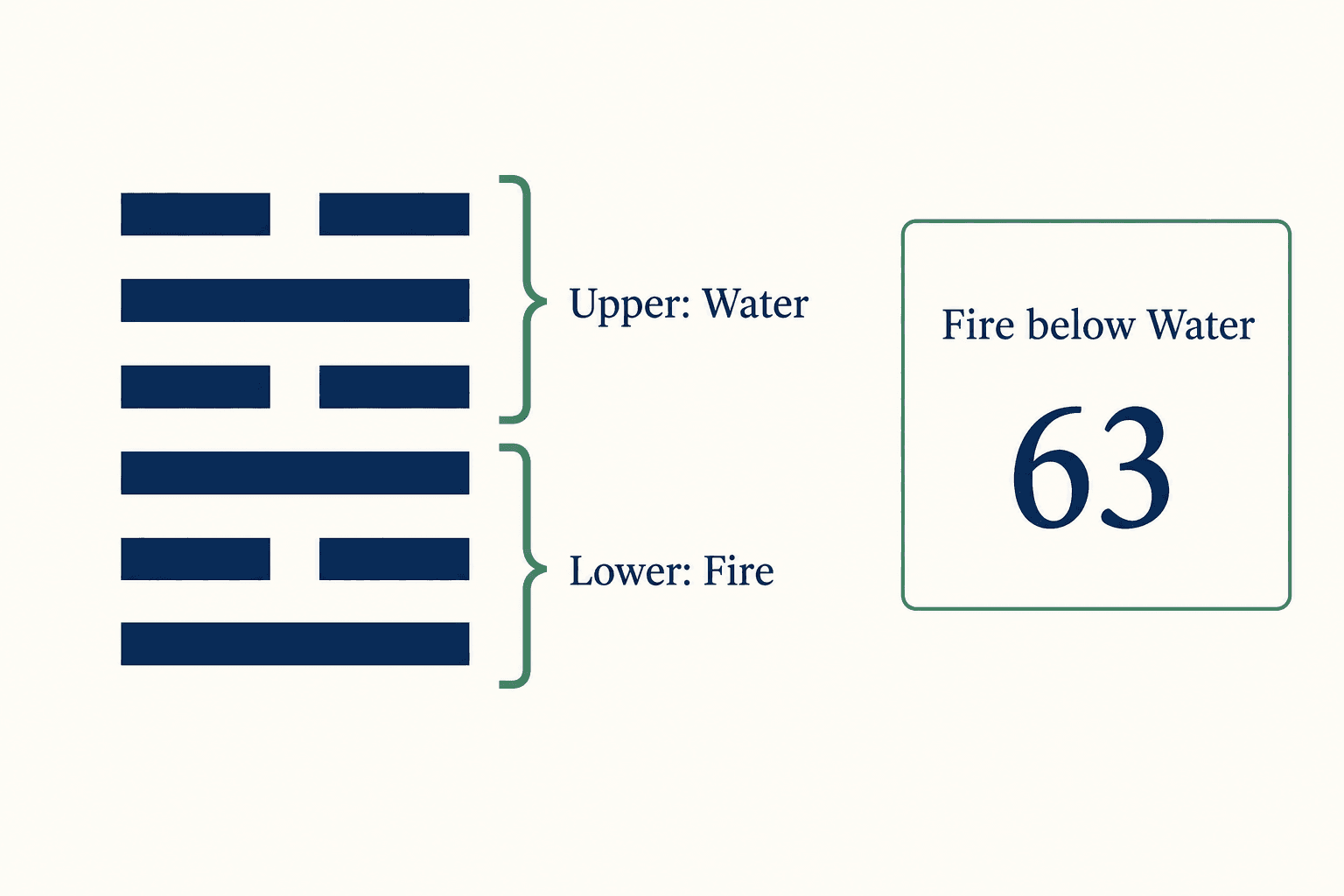
For example, Fire is unbroken, broken, unbroken when read from bottom to top. Water is broken, unbroken, broken. Copy the group as three positions rather than trying to recognize a pattern from an angled or cropped picture. The names here are labels for finding a chart entry, not instructions about a real-world outcome.
Use the complete 64-combination lookup
Each row names the lower trigram. Within that row, find your upper trigram and read the number after it. These are lookup numbers, not scores.
- Lower Heaven: Heaven 1; Lake 43; Fire 14; Thunder 34; Wind 9; Water 5; Mountain 26; Earth 11.
- Lower Lake: Heaven 10; Lake 58; Fire 38; Thunder 54; Wind 61; Water 60; Mountain 41; Earth 19.
- Lower Fire: Heaven 13; Lake 49; Fire 30; Thunder 55; Wind 37; Water 63; Mountain 22; Earth 36.
- Lower Thunder: Heaven 25; Lake 17; Fire 21; Thunder 51; Wind 42; Water 3; Mountain 27; Earth 24.
- Lower Wind: Heaven 44; Lake 28; Fire 50; Thunder 32; Wind 57; Water 48; Mountain 18; Earth 46.
- Lower Water: Heaven 6; Lake 47; Fire 64; Thunder 40; Wind 59; Water 29; Mountain 4; Earth 7.
- Lower Mountain: Heaven 33; Lake 31; Fire 56; Thunder 62; Wind 53; Water 39; Mountain 52; Earth 15.
- Lower Earth: Heaven 12; Lake 45; Fire 35; Thunder 16; Wind 20; Water 8; Mountain 23; Earth 2.
The lookup is generated from YiInsight’s canonical structural mapping. Every lower-and-upper pair appears once, and the entries contain each number from 1 through 64 exactly once. This completeness check verifies the chart construction; it does not establish an interpretation of the associated classical passage.
Work through the illustrated example
The illustration shows Fire below Water. Reading its lower three positions gives 101, while the upper three give 010. In the Lower Fire row, the Water entry is 63. Keep the picture’s grouping and the chart labels together while checking that result.
Now reverse only the groups: Water below Fire. The Lower Water row with upper Fire gives 64. This is a different six-line pattern, not a disagreement between two correct lookups of the same pattern. If your book and this chart disagree, compare the actual six positions before comparing English titles. Similar names or translation choices are less reliable identifiers than the pattern and number.
Keep changing lines outside the initial lookup
First identify the primary pattern exactly as recorded. If a reading includes changing lines, a relating pattern is a separate lookup after the specified positions have changed. Do not flip every line, swap the two trigrams or reverse the whole stack as a shortcut. Those operations can produce an unrelated figure.
This page does not select which passages to interpret when several lines change. Keep the original result and consult the method you are using. A chart supplies a stable identifier; understanding a reading also requires the relevant text, its source and an explanation of the interpretive approach. Avoid treating the chart number as a rating of how good or bad a situation will be.
Key takeaways
- Positions 1–3 form the lower trigram; positions 4–6 form the upper trigram.
- The complete lookup contains each of the 64 pairs once.
- Changing-line interpretation is separate from identifying a six-line pattern.
Conclusion
Use the lower trigram to choose a row and the upper trigram to find the entry. Double-check bottom-to-top order whenever the result seems unexpected. Once the number is secure, move to the relevant source text while keeping identification and interpretation distinct.
Does the chart cast a new hexagram?
No. It identifies a pattern you already have. Looking up a number does not create, reroll or change a saved reading.
Why do two charts seem to give different numbers?
First check whether each chart places the lower trigram in rows or columns. Then compare the actual bottom-to-top pattern. Do not assume the axes use the same layout.
Can I use the illustration as a chart for every hexagram?
No. The illustration is one example, Fire below Water, number 63. Use the complete text lookup for other combinations.
Sources
Reflect on one question
Frame a focused question before starting a new reading.
Explore YiInsight →