Palm Reading: What Palmistry Claims and How to Read Its History
Read Richard Saunders as a historical example of palmistry, distinguish a named line from a personal forecast, and check what a catalogue can establish.
The short answer
Palm reading interprets features of the hand according to a reader’s system. To study its history, start with a specific manual: identify the feature the author names, the meaning they assign it, and what evidence, if any, supports that inference. A crease you can see and a forecast about its owner are different kinds of statement.
Overview
Richard Saunders names several “principal” lines in his 1663 palmistry manual. He calls one the vital line or line of life, and claims that its favourable disposition indicates a healthy heart and a long, comfortable life. This is an example of what Saunders taught. It gives us his terminology and the kind of conclusion he wanted readers to draw. It provides no clinical evidence about anyone’s heart or lifespan.
What did one historical palm reader actually claim?
Read that sentence twice. On the first pass, underline the name he gives the feature. On the second, circle what he says it signifies. If your question is “What did Saunders believe?”, both markings help answer it. If your question is “How long will I live?”, neither marking supplies an answer.
Identify the edition before quoting the claim
The Wellcome Collection holds a 1676 edition of Saunders’s *Palmistry, the Secrets Thereof Disclosed*. Its catalogue is a place to verify the author's name, title and that edition's date. The example above comes from a transcription of the 1663 edition. Use the date of the edition you read rather than assuming every edition contains the same words on the same page.
This distinction matters even in a brief notebook entry. “The library has a 1676 edition” is a bibliographic observation. “Saunders connects the vital line with longevity in the 1663 text” attributes a particular claim to a source. “My life will be long because of a line” makes a prediction that neither source verifies.
A beginner’s exercise: label what you see
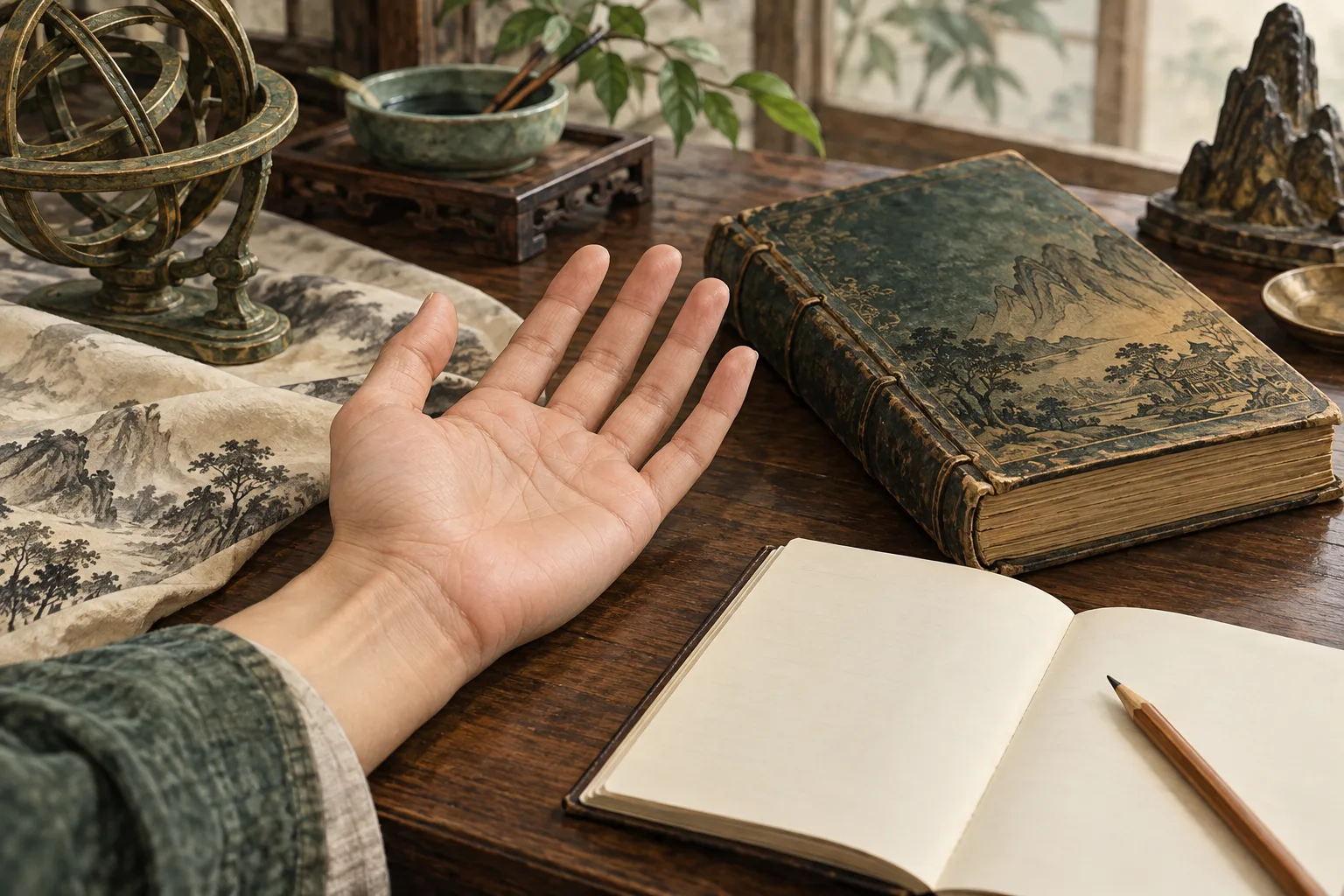
On a piece of blank paper, sketch the outline of your hand and one visible crease. Describe its shape in ordinary language first: for example, “a curved crease near the thumb.” If you consult a manual, record its author, edition, term and page or section beside the drawing. If you cannot match your sketch to the labelled feature confidently, write “uncertain.”
Finally, give the author's interpretation its own line. You can ask why a historical author chose a particular anatomical or planetary image, or what associations it calls to mind for you. Leave health, lifespan and financial decisions to evidence appropriate to those questions.
Key takeaways
- Record the author and edition before quoting a historical claim.
- Label the physical feature and the meaning the author assigns it separately.
- Treat a historical claim about longevity as evidence of the author’s teaching, not a medical test.
Conclusion
Keep the date and edition beside your notes. It should be possible for a second reader to find the author’s claim without mistaking it for a conclusion about the hand you sketched.
Do I need to identify which crease Saunders meant?
Only if you want to compare how the feature is depicted in a particular edition. You can study his historical claim by reading the passage without assigning a label to your own hand.
What if two manuals label the same feature differently?
Put the two terms and publication details side by side. First check that both diagrams indicate the same location. A disagreement tells you about the manuals; it does not establish a fact about the person whose hand you examined.
Which edition supplies the vital-line example here?
The passage discussed is from the 1663 text. The Wellcome entry identifies a 1676 edition; its catalogue description is a separate bibliographic source.
Sources
Reflect on one question
Frame a focused question before starting a new reading.
Explore YiInsight →