 YiInsight
YIINSIGHT / Method and reflection
I Ching vs Tarot: Compare the Record Before the Interpretation
Compare I Ching and Tarot records through six-line source lookup and Waite's ten-position method, with a blank study example and a follow-up checklist.
The short answer
An I Ching record contains six lines and any changing positions. Waite’s “An Ancient Celtic Method of Divination” records a separate Significator and ten position cards; that is his title, not proof of ancient origins or a universal Tarot method. Compare each record with its own source before interpreting it; similar themes do not establish a conversion.
Overview
A useful comparison starts with what you can verify on the page: the question, the recorded result, and the reference used to read it. Keep three layers visible: what was recorded, what the source says, and what you think it might mean. This guide helps organize an existing record or a blank study exercise; it does not cast, draw, or choose a reading.
What is actually recorded in each method
| Field | I Ching | Waite: “An Ancient Celtic Method of Divination” |
|---|---|---|
| Original result | Six solid/broken shapes, in recorded order | Separate Significator; ten position cards |
| Positions | Lines 1–6, bottom to top | Card identity at each recorded position |
| Additional detail | Changing positions, marked separately | Method labels kept beside card names |
| Reference | Chosen edition and matching figure entry | Part 3, §7 and chosen card reference |
Use the table to identify what is present before assigning meaning. The Tarot column refers only to Waite’s named “An Ancient Celtic Method of Divination”; his title does not establish ancient origins.
Source for the Tarot column: Waite, Part 3, §7.
For either record, retain the original question and record date. If either is missing, mark it unknown. A date added while organizing notes is a transcription date, not evidence of when the original reading occurred.
If the Tarot method is unnamed, keep its layout unidentified until you can recover the instructions; assigning Waite’s labels would add information that your record does not contain.
An I Ching figure and its matching source entry
| Position | Recorded shape |
|---|---|
| 6 — top | ━━━━━ solid |
| 5 | ━━━━━ solid |
| 4 | ━━━━━ solid |
| 3 | ━━━━━ solid |
| 2 | ━━━━━ solid |
| 1 — bottom | ━━━━━ solid |
Read an I Ching figure from the bottom: position 1 is lowest and position 6 highest. Preserve the six recorded solid/broken shapes, and keep any changing markers separately. Do not infer missing line information from an interpretation.
Use the primary shape to locate its matching source entry in your chosen edition. What is a hexagram? explains the record’s basic structure. Keep the entry locator with the record, so another reader can check the same passage. Include a section heading with any page number. If you consult another edition, add it as a second reference rather than overwriting the first.
If changing positions are recorded, reverse only those positions to identify the relating figure; keep the original figure intact in your notes. Write the source wording or a clearly marked paraphrase beside your own response. A possible application to your situation belongs in the interpretation field, rather than replacing the original line data.
Fixed structural lookup example—not a cast or a reading. Here are six solid positions, shown from top to bottom:
Read back bottom-to-top: solid, solid, solid, solid, solid, solid. Match that complete pattern with YiInsight’s indexed entry for hexagram 1, Qian (乾). The web entry’s section “Heaven over Heaven: sustained effort without overreach” explicitly identifies six solid lines and Heaven in both three-line groups. Web reference: the 1 乾 qián/Qian entry at the full public URL above, section “Heaven over Heaven: sustained effort without overreach,” retrieved 27 October 2026. This identifies a source entry; it does not choose a personal result or supply an interpretation. Changing status is not provided in this static example, so no relating figure is inferred.
The named ten-position Tarot method in Waite’s text
The linked transcription’s Part 3, §7 is headed “An Ancient Celtic Method of Divination.” The title does not establish ancient origins.
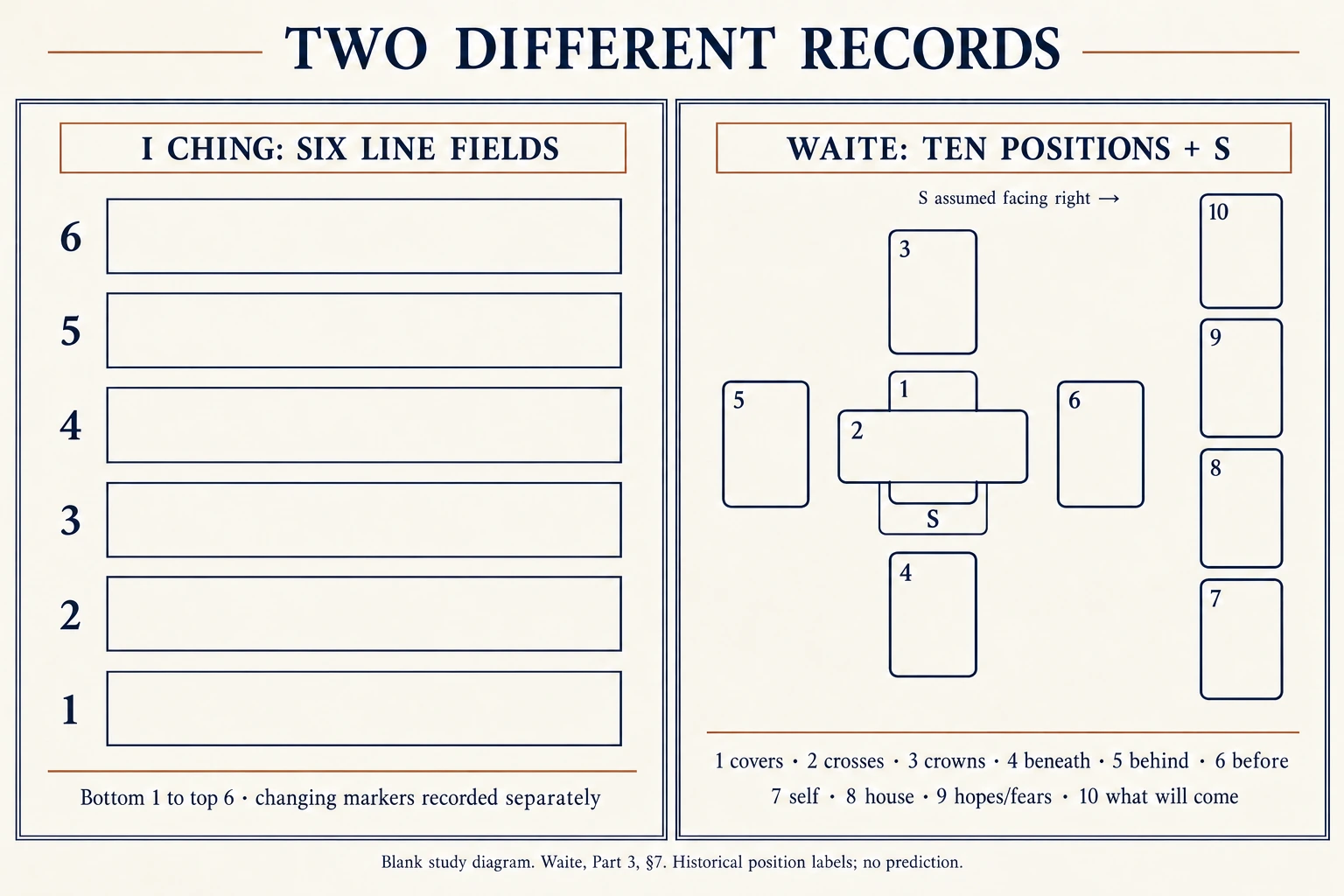
Waite specifies a separate Significator and ten dealt position cards: 1 covers; 2 crosses; 3 crowns; 4 beneath; 5 behind; 6 before; 7 self; 8 house; 9 hopes/fears; 10 what will come. Cards 1–6 form a cross: 1 covers the Significator and 2 crosses 1. Cards 7–10 form a vertical line to its right. Behind/before depend on the Significator’s facing direction; for a non-facing card, decide that direction beforehand. Source: Waite, Part 3, §7.
These are historical position labels, not factual predictions. Neither “behind” nor “before” fixes left or right. Preserve the recorded orientation or mark it unknown.
Why a card position is not an I Ching changing line
A position number answers “where is this item in this record?” A changing marker answers a different question: “which original line is marked for reversal?” Sharing a numeral does not give those fields the same function.
For example, “position 3” in a card record cannot establish that I Ching line 3 changes. Neither a number match nor a similar phrase supplies a rule for generating cards from a hexagram.
Compare your documentation instead: can you reconstruct the original result, find the stated reference, and distinguish a source description from your own hypothesis? If two notes suggest a similar theme, record that as your observation. It does not demonstrate that the records agree or validate each other.
An explicitly fictional comparison without matching the outcomes
Imagine a fictional person preparing for an informal team meeting. The following is an unfilled study template, not a performed consultation. Its two questions deliberately differ; there are no outcomes to reconcile.
- I Ching question: “What should I consider in preparing my contribution?”
- Tarot question: “What assumptions am I bringing to this meeting?”
- I Ching record: solid/broken shapes at positions 1–6 [blank]; changing markers [blank]; primary reference [blank]; relating reference [blank only if applicable and supported by the recorded changing status].
- Tarot record: Significator [blank]; position-card entries 1–10 [blank]; recorded orientation [blank].
- For each: original record date [blank]; chosen edition/source [blank]; method [blank]; page or section [blank]; source notes [blank]; personal hypothesis [blank]; uncertainties [blank].
Compare the two blank records: the I Ching record needs six ordered shape entries and any documented changing markers; Waite’s record needs a separate Significator entry and ten position-card entries. The records therefore require different information, even before interpretation. Because no result has been supplied, leave the source notes and hypotheses empty. A practical meeting checklist can still cover an agenda, one question to ask, and information to bring, but those preparations are ordinary choices, not conclusions attributed to either blank record.
Which original record to keep before asking a follow-up
Before asking a follow-up, retain a separate unchanged reference copy of each original record. Keep the source identification and your own judgment in separate fields.
- Original question: retain the exact wording; put a revised question in a separate note.
- Exact unchanged record: preserve original values, markers, card identities, and placements as applicable.
- Reference: include the chosen edition, method, and page or section locator.
- Context: retain the record date; label missing information explicitly.
- Own hypothesis and uncertainties: state what you inferred and what you cannot check.
- No forced agreement: do not reroll, redraw, or rewrite results to make the two records match.
A useful follow-up points to a specific uncertainty or passage, so someone else can inspect the same evidence.
Key takeaways
- Preserve the original result before adding source notes or personal interpretation.
- Compare what each field records; matching numbers do not create a conversion.
- Keep the question, date, and reference available for a precise follow-up.
Conclusion
Keep the comparison anchored to records you can inspect. A clear question, an unchanged result, and a traceable reference give you a sound basis for discussing your interpretation.
What if I have only an interpretation?
Treat it as an incomplete record. Ask for the original values or card placements and the reference used. Keep unavailable fields marked unknown instead of reconstructing them from the explanation.
Can the same question be kept with both records?
Yes, as a documentation choice. Preserve the exact wording with each record and consult each source independently; identical questions do not make the results interchangeable.
What if my edition uses different wording?
Record the edition and passage you actually consulted. Keep alternative wording in a separate source note, then identify which phrasing your interpretation responds to.
Sources
Reflect on one question
Frame a focused question before starting a new reading.
Explore YiInsight →