 YiInsight
YIINSIGHT / Method and reflection
Beginner Tarot Card Spreads: Three Layouts and What Each Position Does
Compare one-, two-, and three-card tarot layouts, understand position roles, and work through an Eight of Pentacles example without fixing an outcome.
The short answer
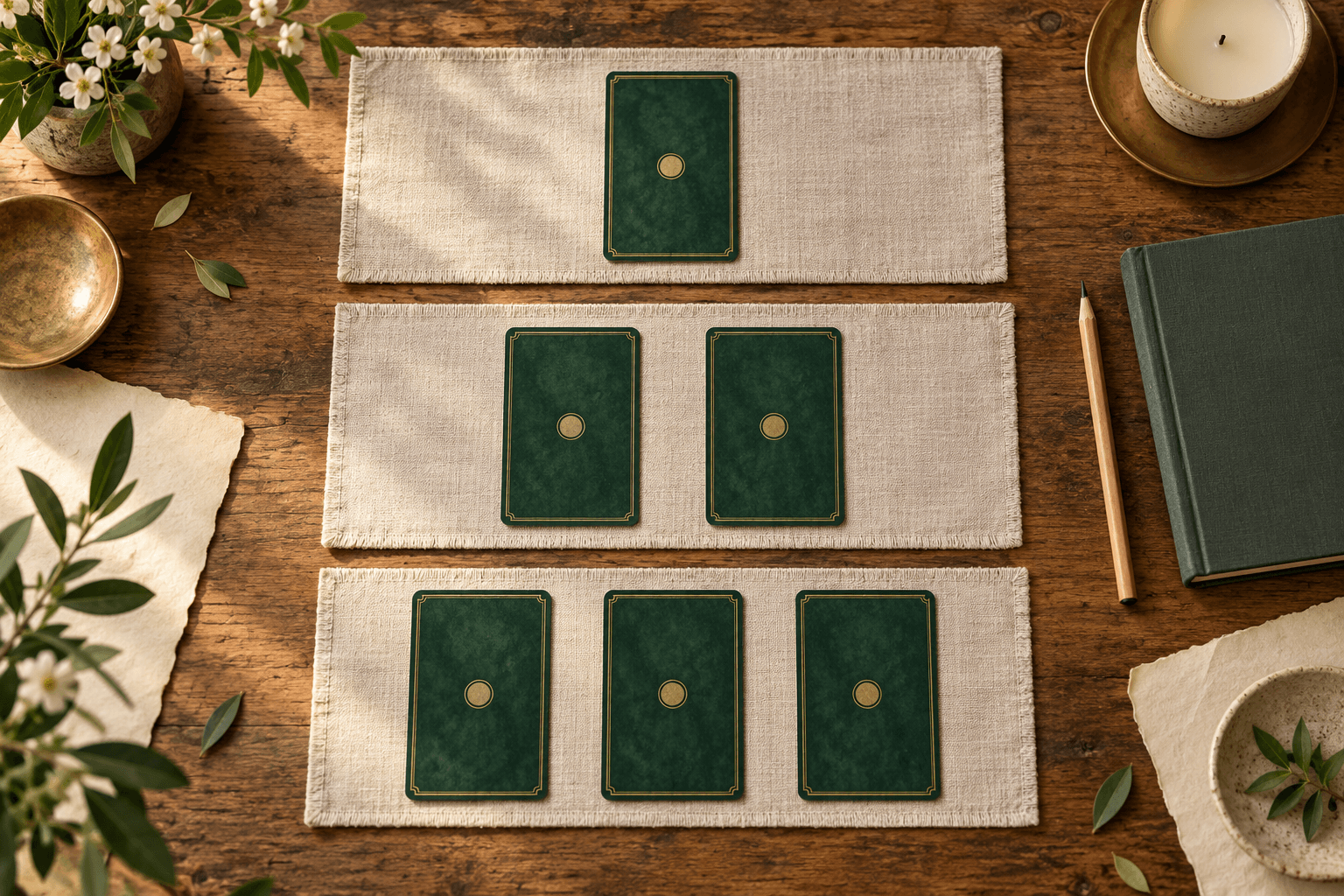
Beginner tarot card spreads work best when you know what every position is for before selecting cards. This guide compares a one-card focus, a three-card Situation–Action–Check exercise, and a two-option comparison. Each layout serves a different task, so choose the task first and the number of cards second.
Overview
The three layouts below are editorial learning exercises. They sit alongside published tarot methods rather than replacing them. You will also see how they differ from a time-based spread and why a card's position matters when reading a specific card meaning.
1. Choose a layout by the question it organizes
| Task | Layout used here | Roles chosen before drawing |
|---|---|---|
| Find one perspective to consider | One card | A focus for reflection |
| Plan and review a small step | Three cards | Situation / Action / Check |
| Investigate two choices fairly | Two cards | A consideration for option A / the same role for option B |
A spread is more than several cards on a table. Its position labels define how you intend to connect those cards to a question. Without those labels, it is easy to move a meaning into whichever role makes the story feel more convincing.
Write the labels first. Then select the cards using your usual handling method, place them in order, and record their names and orientations. Keep the original order even if rearranging it would tell a more appealing story.
2. Put these exercises in context
In Part 3, §7 of *The Pictorial Key to the Tarot*, Waite presents a method with ten numbered positions and a significator. His title calls it a Celtic method; that title alone does not establish an ancient origin. It is useful here as a published example of assigning different jobs to positions.
Modern practitioner Brigit Esselmont also lists three-card layouts, including Past / Present / Future, in her own teaching material. That time-based layout organizes a question chronologically. Situation–Action–Check, used below, instead organizes planning and review. Neither label system means every third card is a guaranteed future event.
Waite's §4 discusses how meanings can vary with their place in a sequence. In these beginner exercises, the practical consequence is to keep the role visible: a card in the Action position is being read as an action prompt, not silently converted into a prediction.
3. Layout one: a single focus
Put one card beneath a written question such as “What aspect of this conversation should I consider?” Treat it as a perspective to examine. Describe its image, check the explanation in the system you are using, and write one possible connection.
For a hypothetical example, imagine selecting the Two of Cups. Waite associates this card with connection and affinity. You might ask whether you have made room for a mutual exchange in the conversation. That is an interpretation for your own consideration, not confirmation of what the other person feels.
Finish by identifying what you can actually ask or observe. If no association helps, record that instead of enlarging the spread simply to produce a more satisfying answer.
4. Layout two: Situation–Action–Check
Arrange three cards from left to right and label them before drawing:
- Situation: A perspective on how I am currently framing the issue.
- Action: A possible step to examine.
- Check: A consideration when deciding how to review that step.
In a hypothetical presentation exercise, suppose the Action card is the Eight of Pentacles. Waite's work-and-skill meaning, combined with the position, suggests considering preparation or practice. A student might shorten an outline and rehearse it with a classmate.
The student then chooses an observable review question: “Which part did the classmate find unclear?” The actual review measure comes from the task; the Check card does not become a promised grade. If its imagery adds nothing useful, the student can leave that association unresolved and still review the rehearsal.
This example isolates one card so that its relationship with its position is clear. It is not a complete three-card divination or a report of a real student's outcome.
5. Layout three: compare two options with the same role
Write option A and option B in full before placing one card beneath each. Give both cards the same job: “A consideration to investigate before choosing this option.” Unequal labels such as “why A is good” and “why B is bad” build the conclusion into the exercise.
For a hypothetical weekend choice, A might be attending a gathering and B spending the afternoon alone. After reading the images and your guidebook, list one benefit, one cost, and one missing fact for each option. Travel time, existing commitments, and how much rest you need remain ordinary information to assess.
If one card feels more attractive, note the preference. It may reveal what you hope to choose, but it does not prove that option is objectively better. For a significant commitment, investigate the actual terms before deciding.
6. Keep the position labels when reviewing
Save the original question, layout, names, orientations, interpretations, and the next action you chose. Return after the relevant event and add what you learned. Preserve associations that did not fit as well as those that were useful.
If you later change a position's meaning, treat that as a new exercise and label the change. The record should not make a revised spread look like the one you originally used. Clear labels are especially helpful when comparing a planning exercise with a published time-based or multi-position method.
Key takeaways
- One, two, and three cards can organize different tasks; more cards are not automatically clearer.
- The Action card in the worked example connects a named meaning to an assigned position.
- Keep a planning layout distinct from a time-based spread and from Waite's ten-position method.
Conclusion
Choose a spread whose positions you can explain in plain language. Fix those roles before drawing, interpret each card within its role, and retain the original layout when reviewing. That gives you a way to learn how positions change a reading without quietly turning a reflection exercise into a forecast.
Are the three exercises historical spreads?
No. They are presented as editorial learning layouts. The source section separately identifies published methods used for comparison, without assigning these exercises an invented historical origin.
Does a three-card spread always mean past, present, and future?
No. That is one published way to label three positions. The labels chosen for the question determine the roles; three cards alone do not specify them.
Can I add a clarifying card?
You can design a separate role, but write it before selecting the extra card and preserve the original spread. Another image does not independently verify the first interpretation.
Sources
Reflect on one question
Frame a focused question before starting a new reading.
Explore YiInsight →