Hexagram structure
Four Earth Storage Branches (Chen, Xu, Chou, Wei): Separating Classical Storage Rules from 'Wealth Vault' Hype
Explore the classical BaZi mechanics of the four Earth storage branches. Understand why the modern commercial myth of 'clashing a wealth vault' is structurally misleading.
The short answer
In classical BaZi, the Earth branches (Chen, Xu, Chou, Wei) act as storages for mixed elemental Qi. Rather than relying on a 'clash' to violently force the vault open, classical texts emphasize that hidden energies become useful when they naturally protrude into the Heavenly Stems.
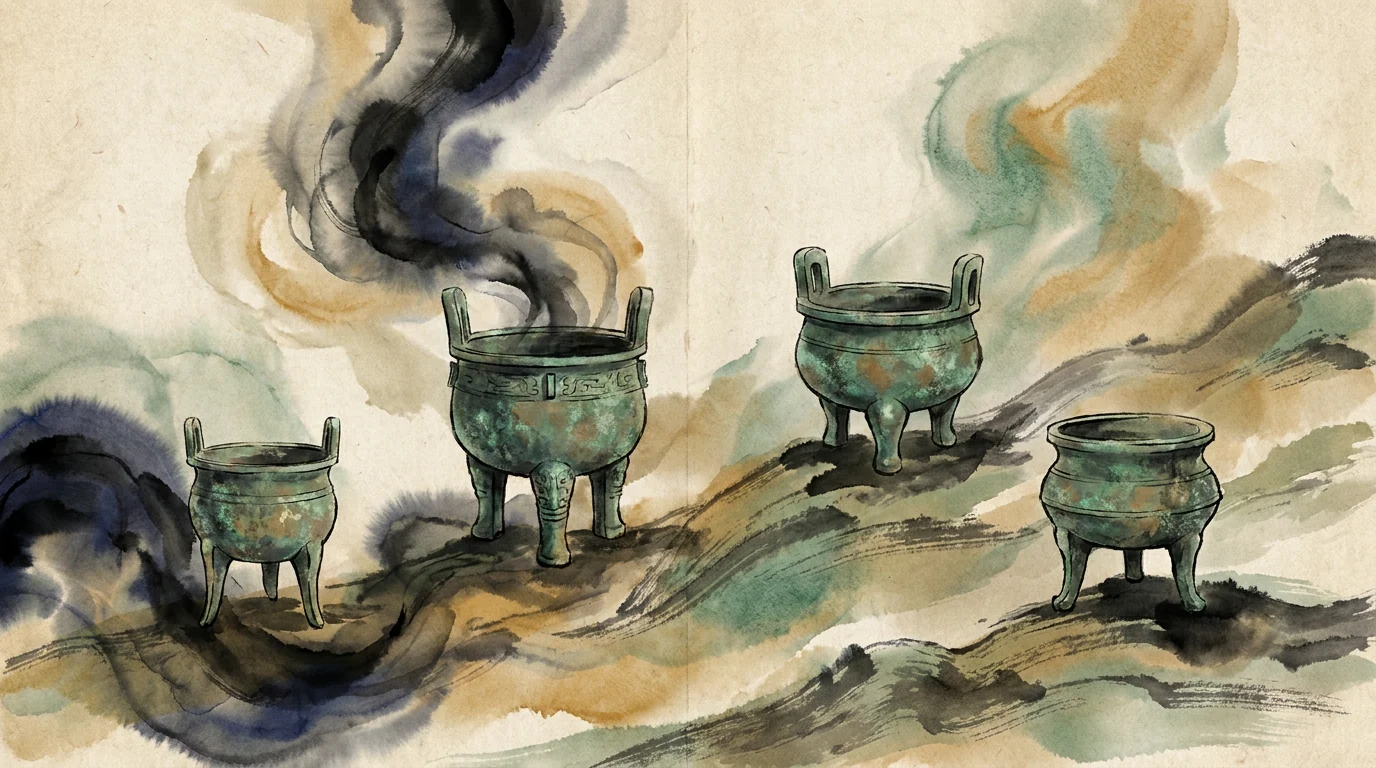
The Myth of the 'Wealth Vault'
One of the most pervasive myths in modern BaZi commercialization is the concept of the 'Wealth Vault' (財庫). The narrative suggests that if an individual has one of the four Earth branches—Chen (辰), Xu (戌), Chou (丑), or Wei (未)—in their chart acting as a storage for their wealth element, they are destined to be rich if and only if that branch is clashed by another branch.
This oversimplification treats BaZi like a slot machine: 'clash the vault, get the payout.' However, classical structural analysis views these branches fundamentally differently. They are merely phases where elemental energy is transitioning, resting, or combining, rather than literal bank accounts waiting to be broken open.
The Classical View: 'Mixed Qi' (Za Qi)
In the Qing Dynasty classic Zi Ping Zhen Quan (《子平真詮》), these four branches are defined not primarily as 'vaults', but as containing 'Mixed Qi' (雜氣). Unlike the pure cardinal branches (Zi, Mao, Wu, You), the Earth branches contain the remnants of the previous season, the core energy of the current phase, and the storage of an element entering its resting phase.
Because the Qi is mixed and deeply buried, classical theory asks a fundamental question: How does this energy express itself? The answer lies in the concept of 'Protrusion' (透干)—when a hidden element appears in the Heavenly Stems of the chart. If the energy protrudes, it is already active and organizing the chart's structure; it does not need a clash to be released.
Protrusion vs. Clashing
Classical mechanics prioritize natural expression over forced disruption:
- Protrusion (Tou Gan): When the hidden stem of a storage branch is mirrored in the Heavenly Stems, the energy flows smoothly from the hidden foundation to the visible surface. The 'vault' is already open by design.
- Clashing (Chong): A clash (such as Chen clashing Xu, or Chou clashing Wei) is a destabilizing force. While early texts acknowledge that a clash might agitate stagnant Qi under very strict structural conditions, mindlessly clashing a storage often destroys the useful elements hidden within it or destabilizes the foundation of the chart.
Chart Analysis: Examining Storages in Practice
| Feature | Synthetic Chart A (Chen) | Synthetic Chart B (Xu) |
|---|---|---|
| Day Master | Geng (Yang Metal) | Geng (Yang Metal) |
| Storage Branch | Chen (辰) in Month & Hour | Xu (戌) in Month & Hour |
| Hidden Stems | Wu (Earth), Gui (Water), Yi (Wood) | Wu (Earth), Ding (Fire), Xin (Metal) |
| Protruding Stems | Gui (Water) protrudes in Year, Bing (Fire) in Month. | Ren (Water) protrudes in Month, Bing (Fire) in Hour. |
| Structural Note | The storage energy (Water) is already expressing itself through Gui. No clash is needed. | The Fire energy rooted in Xu expresses via Bing. A clash to Xu would disrupt this established flow. |
To understand this structurally, we can compare two synthetic charts that both feature Earth storage branches but demonstrate different mechanics.
In both cases, the usefulness of the storage is defined by the Heavenly Stems organizing the chart's overall theme, proving that waiting for a disruptive 'clash' is a misunderstanding of classical mechanics.
Navigating Storage Periods: A Reflective Approach
When analyzing Earth branches, it is more beneficial to view them as periods of consolidation rather than hidden treasure chests. If your chart contains storages, consider what latent skills, resources, or emotional reserves you are holding onto.
Instead of waiting for an external event (a clash in a 10-year luck cycle) to force a change, reflection should focus on how to gently cultivate and 'protrude' these talents into your daily visible life through deliberate action and learning.
Frequently Asked Questions (FAQ)
Q: Does having multiple storages mean a person will be wealthy? No. Wealth in classical BaZi is a structural relationship involving the Day Master's capacity to engage with the elements it controls. Storages are just one type of elemental configuration and have no deterministic link to actual financial net worth.
Q: If my storage is clashed in my current 10-year pillar, is it bad? It is neither inherently good nor bad. A clash represents movement, change, or the destabilization of a foundation. How that manifests depends entirely on the overall structure of the chart, not a simplistic 'vault opening' rule.
Inspect your deterministic Four Pillars
Enter a birth date and local time zone to view your Four Pillars and Dayun structure cleanly.
Open BaZi Calculator →