 YiInsight
YIINSIGHT / Canonical hexagram
Hexagram 9: Small Taming, Gentle Restraint, and Unfinished Conditions
Read Hexagram 9, Small Taming, through clouds without rain, gentle restraint, six distinct lines, and practical questions about limited influence.
Hexagram 9: 小畜 · xiǎo chù
Heaven below Wind. Lines are numbered from the bottom upward.
The short answer
Hexagram 9, Xiao Chu or Small Taming, describes limited restraint and influence. Its clouds have gathered without rain: conditions are developing, but the visible result is not yet present. This is a setting for careful adjustment rather than a promise that waiting will produce the outcome you want.
Overview
Small actions can matter without being powerful enough to settle the whole situation. That distinction is central to reading Xiao Chu responsibly. A useful reflection asks what can actually be influenced now, what remains beyond one's control, and whether further pressure would help. The chapter's different line settings prevent gentle restraint from becoming a universal instruction to remain passive.
Clouds without rain: distinguish preparation from delivery
The pinned Chinese digital transcription separates the Judgment, Commentary on the Judgment, Great Image and six line statements. The English orientation below is original editorial interpretation, not a certified translation.
The Judgment names success and presents dense clouds without rain, arising from the western outskirts. The Commentary discusses a yielding position, firmness, and responsive influence. These are features of the displayed text, not a weather forecast or a measure of how close an individual is to success.
For modern reflection, the distinction between gathering and release can help identify an unfinished dependency. A project may have ideas but no agreement, or materials but no workable method. Naming that missing condition is more useful than treating every delay as a favorable sign. The chapter does not establish a personal timetable. Nor does it justify controlling another person through small pressures. Consider influence that is transparent, proportionate, and open to refusal.
Wind above Heaven: refine the form of an action
The figure in the pinned Chinese chapter has Heaven below and Wind above. Its bottom-to-top pattern is 111011, with 1 for a solid line and 0 for a broken line. This identifies hexagram 9, 9-xiao-chu, not a personal cast or outcome.
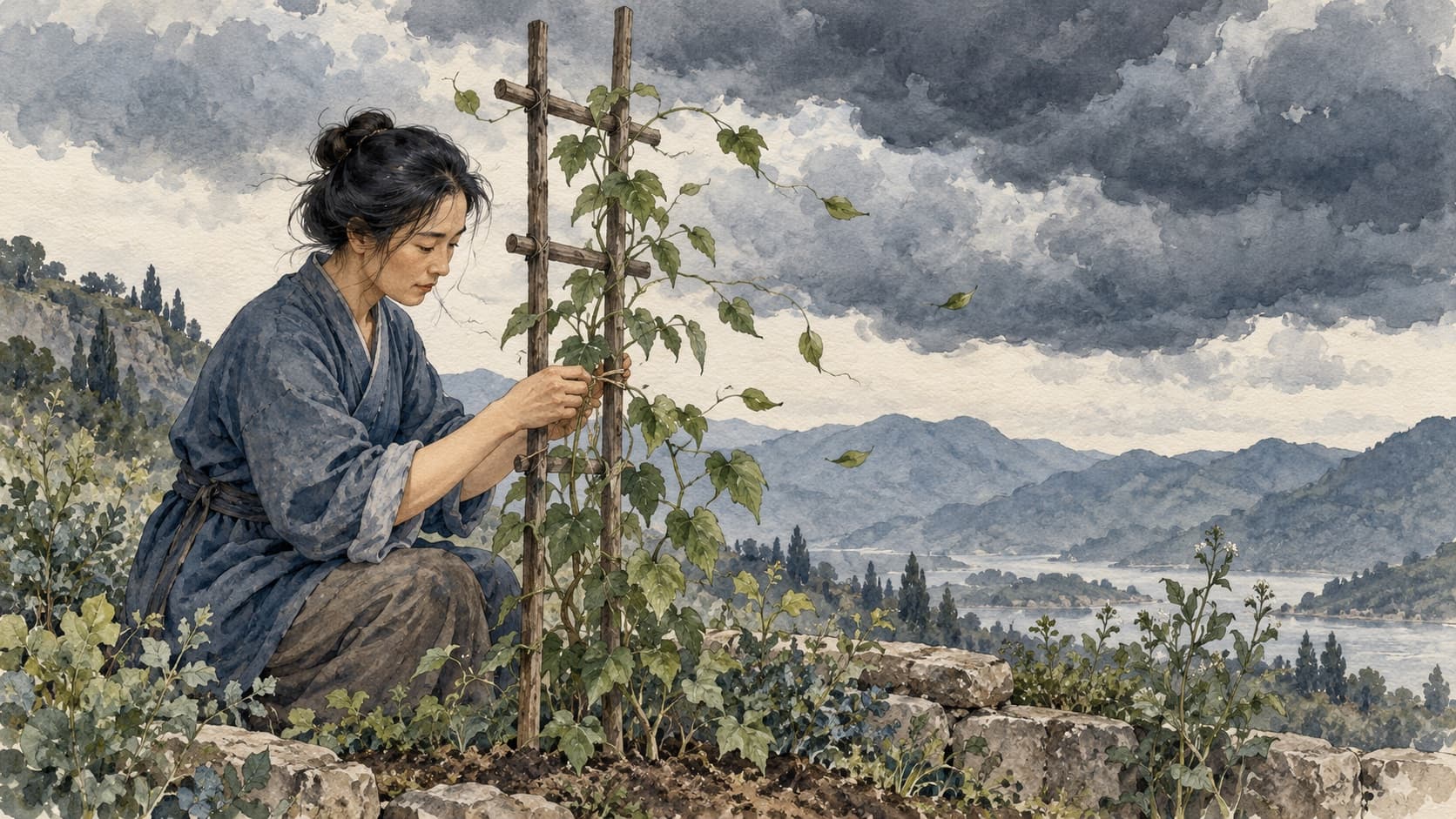
The Great Image connects wind moving above Heaven with refinement of cultured conduct. The garden illustration is an original analogy: a light support can guide a young plant without forcing its growth. It is not a reconstruction of an ancient illustration. In an everyday decision, refinement might mean clarifying a request or correcting a small mistake before seeking a larger commitment.
Six line settings: read the particular position
The following original English orientation notes refer to the six distinct statements in the linked Chinese transcription. They are not six predicted events in sequence.
- Line 1: The first returns by its own way and names a favorable result. Returning to an appropriate course is different from abandoning all initiative.
- Line 2: The second describes being drawn back together, with favorable language. Mutual adjustment should not be equated with coercing a reluctant person.
- Line 3: The third presents a vehicle losing a part and a couple at odds. Its image signals disrupted cooperation; it does not predict a particular relationship dispute.
- Line 4: The fourth joins sincerity with the departure of blood and fear. This is historical imagery, not a medical claim or a promise of physical safety.
- Line 5: The fifth links sincerity and close connection with sharing prosperity with neighbors. The emphasis is not solitary accumulation or guaranteed financial gain.
- Line 6: The upper line brings rain and rest, then cautions about pressing onward. Its gendered and lunar imagery requires context rather than literal prediction or modern gender rules.
Use the changing-lines guide for the position actually recorded in a cast, rather than selecting a more encouraging statement.
A fictional example: improve the request before escalating
Imagine a volunteer group planning a small event. One member keeps asking for a final decision while the venue's accessibility arrangements remain uncertain. A Xiao Chu-inspired reflection could replace repeated pressure with one bounded action: identify the missing information, ask the venue a clear question, and agree when the group will review the answer. That does not guarantee permission or success. It makes the present limit explicit and prevents preparation from being mistaken for delivery.
Questions for a grounded modern reflection
These prompts are modern editorial reflection, separate from the classical wording and its historical commentary:
- Which small action is within my responsibility now?
- What condition is still missing before the larger result is possible?
- Where would additional pressure damage cooperation?
Write down one influence you can exercise directly, such as clarifying a request. Next record the dependency that remains outside your control. Choose a small, reversible action and define what observable response would make another step appropriate. If the response is absent, do not treat additional pressure as proof of commitment. Reconsider whether the larger undertaking has the support it needs.
Use the chapter without changing the cast
Start with the question and the cast as actually recorded. Identify the primary figure, any changing positions, and the relating figure without recasting to improve the answer. The reading guide explains this distinction. This educational article does not choose, infer, alter, or reroll a cast.
Read the Judgment for the broad setting and the actual line for its particular circumstances. The Great Image and Commentary are distinct source layers. The modern examples and illustration here are fictional teaching material, not observed outcomes or classical quotations. The cited source is a public digital transcription; this article does not certify an ancient edition or attribute unreviewed Gao Heng annotations.
Key takeaways
- Gathering conditions are not the same as a completed outcome.
- Gentle influence has limits and must respect other people's agency.
- The six positions do not all recommend waiting.
Conclusion
Read Small Taming as a question about the scope and limits of influence. Preserve the recorded cast and attend to the actual line before deciding whether to adjust, return, cooperate, or stop pressing.
Does Hexagram 9 mean success is guaranteed after a delay?
No. Clouds without rain describe the chapter's setting, not evidence that a desired outcome will eventually arrive. Check the practical conditions and the particular line.
Does Small Taming tell me to control another person?
No such instruction is supported here. A modern reflection should concern your own conduct, clear requests, and mutually accepted limits.
Is the rain image a prediction of literal weather?
This article uses the image to explain the displayed chapter. It does not offer a weather forecast or assign a date to a personal event.
Sources
Reflect on one question
Frame a focused question before starting a new reading.
Explore YiInsight →