 YiInsight
YIINSIGHT / Canonical hexagram
Hexagram 7: The Army, Discipline, and Responsible Collective Action
Understand Hexagram 7, Shi or The Army, through its historical military setting, six line contexts, and a nonviolent reflection on coordinated responsibility.
Hexagram 7: 師 · shī
Water below Earth. Lines are numbered from the bottom upward.
The short answer
Hexagram 7, Shi or The Army, concerns an organized body, discipline, and the responsibility of leadership. Its Judgment favors a mature or experienced person, while the lines distinguish order, central responsibility, failed handling, retreat, appointment, and the aftermath of achievement. It is not an instruction to fight or control other people.
Overview
A group can have an urgent purpose and still lack a workable way of acting together. Shi directs attention toward how people are organized, who is responsible, and what happens when authority is poorly assigned. Its military and political images belong to an ancient setting. Modern applications should be explicitly bounded and should preserve consent, accountability, and nonviolent options.
The Judgment: leadership is a responsibility, not just a title
The pinned Chinese digital transcription separates the Judgment, Commentary on the Judgment, Great Image and six line statements. The English orientation below is original editorial interpretation, not a certified translation.
The displayed Judgment joins persistence with a mature or experienced leader and favorable language. The Commentary discusses the organized multitude and the figure's relationships. This is a historical account of order and command; it is not evidence that authoritarian leadership works in a present-day group.
A modern reflection might ask whether someone has the competence and responsibility needed for an entrusted task. That question differs from demanding obedience because a symbolic figure has appeared. The lines contain failures as well as favorable settings, including images of loss and concern about who should be appointed. Any modern analogy should therefore ask who bears the consequences of a decision, how people can raise concerns, and whether the collective purpose is actually legitimate.
The Image: water within the earth and care for the multitude
The figure in the pinned Chinese chapter has Water below and Earth above. Its bottom-to-top pattern is 010000, using 1 for solid and 0 for broken. This cross-check identifies hexagram 7, 7-shi; it is not a personal cast or outcome.
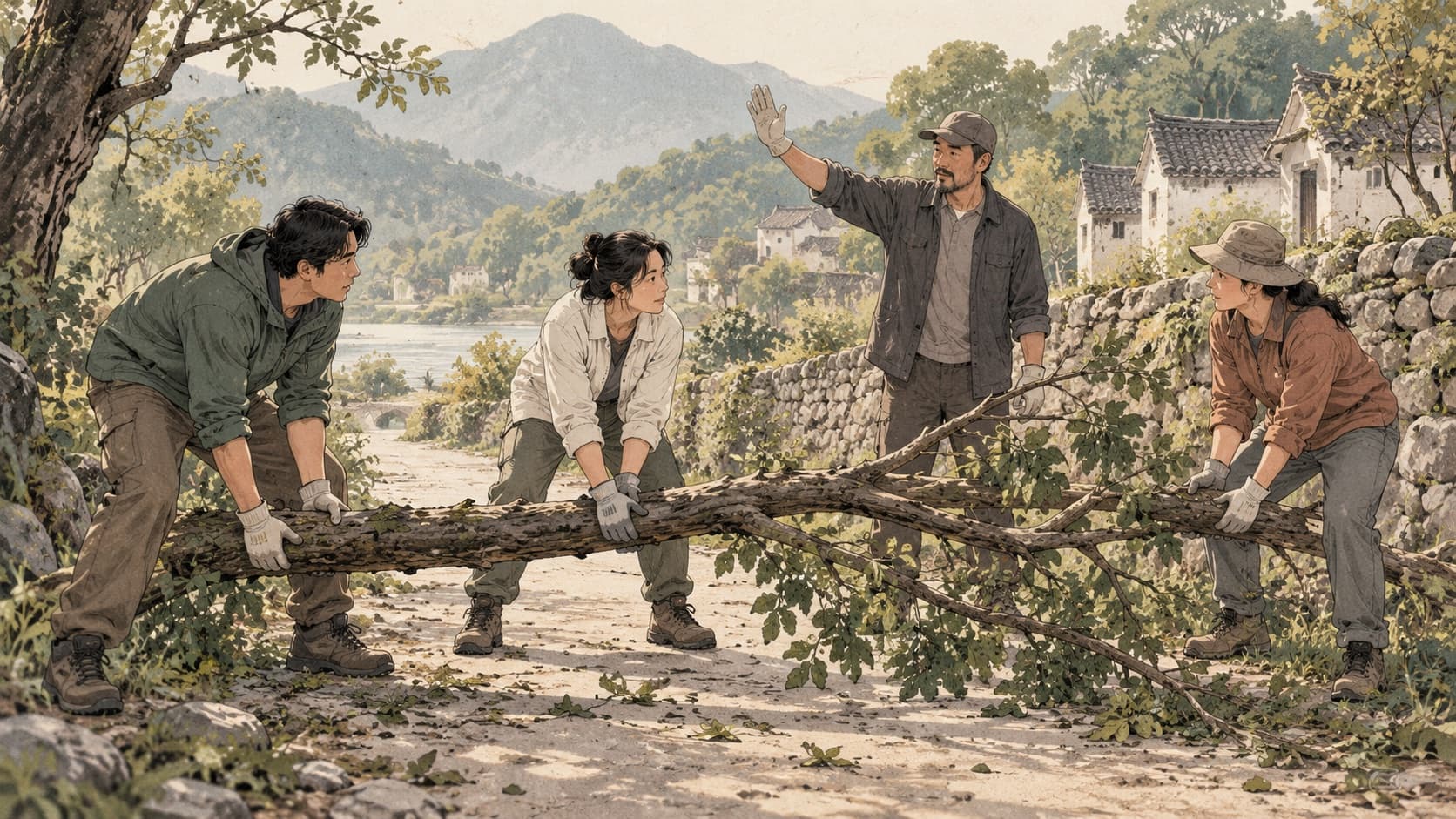
The Great Image describes water within the earth and speaks of accommodating and sustaining the people. That adds a concern for the group being organized, rather than reducing the chapter to the power of a commander. The modern illustration shows people coordinating a nonviolent shared task. It is conceptual fiction, not a representation of an ancient battle, an actual team, or a verified result.
Six line settings: read the particular position
The following original English orientation notes refer to the six distinct statements in the linked Chinese transcription. They are not six predicted events in sequence.
- Line 1: The first says that the army goes out with order and gives an unfavorable judgment where that order is absent. A collective purpose does not by itself supply coordination.
- Line 2: The second places someone within the army with favorable language and repeated royal recognition. It concerns an entrusted central responsibility, not a guaranteed promotion for a modern reader.
- Line 3: The third's image of carrying corpses is unfavorable. Preserve its seriousness as historical military imagery without turning it into a personal prediction of death or a violent instruction.
- Line 4: The fourth describes a withdrawal to the left with no blame. Stepping back can have a different meaning from disorder or abandoning responsibility.
- Line 5: The fifth contrasts appointments through hunting and military images, with a warning about an unsuitable handling of the group. It does not establish a birth-order rule for contemporary leadership.
- Line 6: The upper position concerns the ruler's command, establishing domains, and not appointing unsuitable people. After an achievement, responsibility for what follows remains a separate problem.
Use the changing-lines guide for the position actually recorded in a cast, rather than selecting a more encouraging statement.
A fictional example: assign a shared task responsibly
Imagine neighbors organizing a public cleanup. Enthusiasm is high, but several people issue conflicting instructions and no one knows who is checking the arrangements. A Shi-inspired reflection could clarify one responsible coordinator, agreed roles, and a way for participants to stop and raise a concern. The task remains voluntary. This fictional example is not operational safety guidance or proof that a particular leadership style succeeds. It illustrates a question about coordination and accountability that must still be judged through the group's actual conduct.
Questions for a grounded modern reflection
These prompts are modern editorial reflection, separate from the classical wording and its historical commentary:
- Who is responsible for the decision, and who will bear its consequences?
- Do the group's members understand and accept the purpose and their roles?
- Would a pause, withdrawal, or different appointment better serve the shared task?
Use the chapter without changing the cast
Start with the question and the cast as actually recorded. Identify the primary figure, any changing positions, and the relating figure without recasting to improve the answer. The reading guide explains this distinction. This educational article does not choose, infer, alter, or reroll a cast.
Read the Judgment for the broad setting and the actual line for its particular circumstances. The Great Image and Commentary are distinct source layers. The modern examples and illustration here are fictional teaching material, not observed outcomes or classical quotations. The cited source is a public digital transcription; this article does not certify an ancient edition or attribute unreviewed Gao Heng annotations.
Key takeaways
- Organization and legitimate responsibility are different from domination.
- The lines distinguish effective order, failure, withdrawal, and aftermath.
- Historical violence is not a forecast or a prescription for a modern reader.
Conclusion
Shi is more demanding than a slogan about strength. Read its historical military setting, the actual line, and the care owed to the people involved before making a limited modern analogy.
Does Hexagram 7 tell me to fight someone?
No. Its ancient military setting should not become a modern instruction to use violence or coercion. A contemporary reflection can examine coordination and responsibility while preserving consent and nonviolent ways to address a problem.
Does Shi mean that I should become the leader?
The chapter does not establish your competence, role, or authority over others. Consider the actual task, the particular line, and the group's real agreement before treating leadership as an appropriate personal analogy.
Is retreat always a failure in Hexagram 7?
No. The fourth line describes a form of withdrawal without blame, which differs from other troubled settings. Whether a real retreat is responsible depends on the circumstances and available evidence, not the line in isolation.
Sources
Reflect on one question
Frame a focused question before starting a new reading.
Explore YiInsight →