 YiInsight
YIINSIGHT / Canonical hexagram
Hexagram 63 Meaning: After Completion and the Work of Maintenance
Read hexagram 63, Ji Ji: Water over Fire, the Judgment's beginning and ending contrast, six lines, and a practical example of maintaining completed work.
Hexagram 63: 既濟 · jì jì
Fire below Water. Lines are numbered from the bottom upward.
The short answer
Hexagram 63, Ji Ji or After Completion, concerns an arrangement that has come together while remaining vulnerable to disorder. Its Judgment contrasts an initially favorable setting with disorder at the end, and its Great Image emphasizes anticipating problems. A modern reflection can examine maintenance after a milestone; the figure neither certifies success nor predicts an inevitable collapse.
Overview
Finishing a piece of work changes the task; it does not remove every task. After a launch, a repair, or an agreement, attention can shift from reaching the milestone to keeping the arrangement usable. Ji Ji provides a setting for that inquiry. It should not be reduced to either congratulations or a warning that disaster is certain. The chapter's broad Judgment and particular line statements deserve separate attention.
The Judgment: the end requires its own attention
The fixed Chinese digital transcription distinguishes the Judgment, Commentary on the Judgment, Great Image, and line statements.
The Judgment names a small coming-through, the usefulness of constancy, a favorable beginning, and disorder at the end. The Commentary on the Judgment explains the ordered positions of the figure while also discussing the limit of continuing without change. The orderly configuration and the warning coexist.
An original modern paraphrase is that a completed arrangement should not be treated as self-maintaining. Check what 'complete' means, what remains dependent on regular attention, and where the initial conditions may stop applying. This does not turn the closing phrase into a forecast about your future. A text can highlight the possibility of disorder without proving that a particular project will fail or that a particular relationship has already reached its final state.
Water over Fire: keep the useful arrangement in balance
In the canonical structural registry, hexagram 63 is 63-ji-ji, with Fire below and Water above. Count positions from bottom to top; 1 means a solid line and 0 a broken line. Its stored pattern is 101010. That identifies the figure, not a personal outcome.
The Great Image places water above fire and describes considering trouble in advance and preparing against it. Read that commentary separately from the Judgment. In a modern reflection, maintenance can be ordinary and specific: inspect the thing that wears out, document the handoff, or define who checks a finished task. The point is proportionate preparation rather than constant alarm. Where actual technical or safety expertise is needed, the symbolic image cannot substitute for it.
Six line settings: read the particular position
The following are original modern English orientation notes on the six statements in the linked Chinese transcription. They are not a certified translation or six future events in sequence:
- Line 1: The first joins dragging a wheel and wetting a tail with no blame. A modern note can explore restraint at the start of further movement, without turning the image into literal driving advice.
- Line 2: The second describes a woman losing a covering and its return after seven days without pursuit. Seven days is wording in this statement, not a reliable countdown for a lost item or a relationship.
- Line 3: The third invokes an ancient campaign by Gaozong and three years before success, with a warning about whom to employ. Preserve the historical setting; do not convert it into military advice or a promised three-year result.
- Line 4: The fourth describes material used against a leak and vigilance through the day. Consider whether a small weakness needs an adequate repair, rather than treating anxiety as the repair itself.
- Line 5: The fifth contrasts a substantial neighboring sacrifice with a simpler offering that genuinely receives benefit. As reflection, a careful small act may matter more than a showy display; the ritual language remains historical.
- Line 6: The sixth describes a wet head and danger. It marks a different position from the initial wet tail; the contrast encourages attention to context, not a prediction of physical drowning.
For a cast with a changing line, use the changing-lines guide and read that precise position in context.
A fictional example: completion becomes a handoff
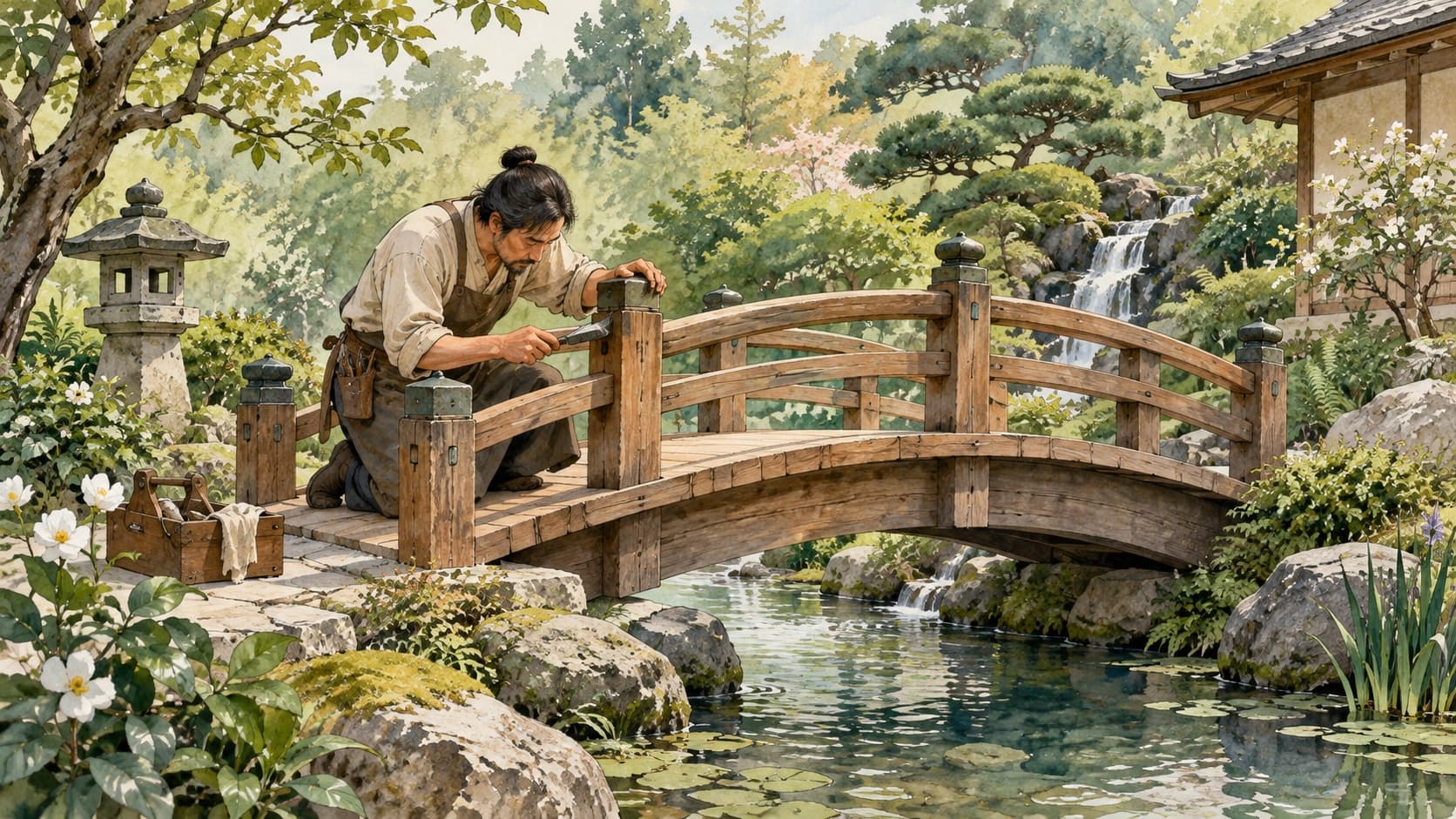
Imagine a small team finishing a community footbridge repair. The inspection is complete, but no one has yet agreed who will check the decking after heavy rain. This is a fictional illustration; actual bridge work requires qualified safety assessment, which an I Ching article cannot provide.
An After Completion reflection focuses on the handoff. The team records the completed work, names a responsible contact, and uses the relevant professional recommendations to establish an inspection routine. They distinguish what is finished from what will need recurring attention.
The modern lesson is not that the bridge is destined to fail. It is that a milestone and a maintenance plan answer different questions. If a later inspection finds a defect, that observation calls for an appropriate repair. It should not be claimed as proof that a classical line predicted the defect.
Questions for a practical modern reflection
These prompts are modern editorial reflection, separate from the quoted classical text and its historical commentary:
- What exact milestone has been completed, and what has not?
- Which conditions still need recurring attention?
- Who owns the handoff and the next practical check?
- What modest preparation would address a plausible problem without exaggerating it?
Choose one small action you can assess with ordinary evidence. Record what happened without treating a favorable symbol as proof that the action will work. If your observation contradicts your first interpretation, preserve the observation rather than forcing it into the text.
Use this chapter without changing the cast
Start with the question as it was actually asked. Identify the recorded primary hexagram, then any actual changing positions and relating figure. This explanatory article does not cast, choose a line, or infer a new figure. Keep the original cast separate from the interpretation you are exploring.
Read the Judgment for its broad setting, the relevant line for its particular context, and the Image as a distinct commentary layer. The reading guide provides a learning path. The English notes and fictional example here are original editorial material based on a public digital transcription. They do not certify an ancient edition or use unreviewed Gao Heng annotations.
Key takeaways
- A completed arrangement can still depend on maintenance.
- Dates and durations in line statements do not establish personal deadlines.
- Anticipating trouble should lead to a specific check rather than a guaranteed failure story.
Conclusion
Ji Ji is a chapter for examining the responsibilities that survive completion. Treat its contrast between beginning and ending as an invitation to remain attentive, not as a certainty about what follows. A clear handoff and proportionate maintenance can make the reflection concrete.
Does hexagram 63 mean my problem is completely solved?
No. The chapter includes an ordered setting and cautions about what follows. Whether a real problem is solved depends on its conditions and the evidence.
Is disorder at the end inevitable?
The phrase belongs to the Judgment. It can prompt attention to changing conditions, but it does not prove that your particular situation will collapse.
How is hexagram 63 different from hexagram 64?
Ji Ji has Water above Fire and addresses an arrangement described as after completion. Wei Ji has Fire above Water and a different setting of unfinished crossing. Keep their structures and passages separate.
Sources
Reflect on one question
Frame a focused question before starting a new reading.
Explore YiInsight →