 YiInsight
YIINSIGHT / Canonical hexagram
Hexagram 62: Small Matters and the Discipline of Staying Within Scale
Read Hexagram 62, Xiao Guo, through the flying bird, six line settings, and careful reflection on modest actions without turning caution into paralysis.
Hexagram 62: 小過 · xiǎo guò
Mountain below Thunder. Lines are numbered from the bottom upward.
The short answer
Hexagram 62, Xiao Guo, explicitly distinguishes small matters from great undertakings and uses a flying bird to favor a lower rather than higher course. Its caution concerns proportion in the chapter's setting. It does not declare that a reader must abandon every ambition or treat all movement as dangerous.
Overview
A small adjustment can be the right response when a dramatic intervention would exceed the available support. Xiao Guo invites attention to that scale. It also complicates simple caution: some positions warn about failing to defend, meeting or passing the right point, and carrying a stance too far. Read the precise position before deciding what being careful means.
The Judgment: a distinction of scale
The pinned Chinese digital transcription separates the Judgment, Commentary on the Judgment, Great Image and six line statements. The English orientation below is original editorial interpretation, not a certified translation.
The displayed Judgment permits small matters rather than great ones, and its bird image favors descending over ascending. The Commentary explains the figure's particular configuration. Together they support attention to proportion, not an independent forecast that a large modern project will fail.
A contemporary reflection might ask which action remains within the resources, role, and knowledge actually available. That does not mean doing nothing. Inspecting a detail, asking a question, or making a reversible repair may be more proportionate than a sweeping commitment. These examples are editorial applications. The chapter itself does not evaluate a reader's business, health, finances, or safety, and its warnings should not replace relevant professional or practical assessment.
The Image: thunder above the mountain
The figure in the pinned Chinese chapter has Mountain below and Thunder above. Its bottom-to-top pattern is 001100, using 1 for solid and 0 for broken. This cross-check identifies hexagram 62, 62-xiao-guo; it is not a personal cast or outcome.
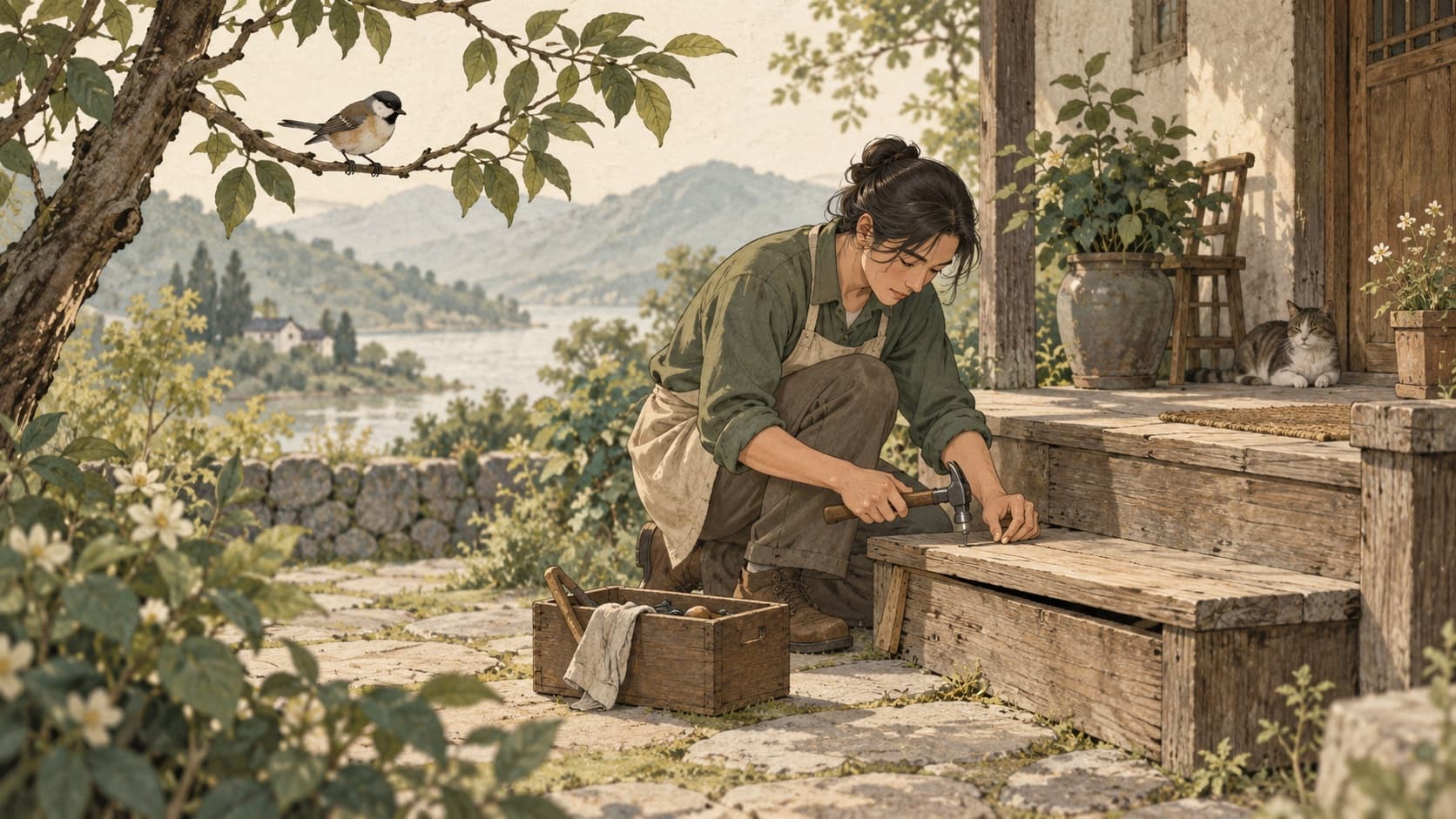
The Great Image describes thunder above the mountain and heightened care in conduct, mourning, and expenditure. Its particular examples belong to the historical commentary. A modern analogy can retain the question of proportion without insisting that every reader adopt a historical ritual practice. The small bird and single-step repair in the illustration are conceptual choices, not an ancient scene or a guarantee that a repair will work.
Six line settings: read the particular position
The following original English orientation notes refer to the six distinct statements in the linked Chinese transcription. They are not six predicted events in sequence.
- Line 1: The first associates the flying bird with an unfavorable outcome. Its image introduces a warning about exceeding the setting, not a prediction about an actual bird or flight.
- Line 2: The second describes passing one relation and meeting another, then not reaching the ruler but meeting the minister. Appropriate contact and overreaching are distinct concerns.
- Line 3: The third warns about insufficient defense and harm. It does not make a factual claim that a particular person intends violence or that a reader is in immediate danger.
- Line 4: The fourth gives no blame while warning about going forward and about persisting indefinitely. Caution itself can require revision rather than becoming a permanent rigid stance.
- Line 5: The fifth presents dense clouds without rain and a ruler taking something from a cave. A promising appearance and a realized result are not automatically the same condition.
- Line 6: The upper position depicts passing beyond rather than meeting, with a bird and misfortune. Do not convert the extreme image into a personal disaster forecast.
Use the changing-lines guide for the position actually recorded in a cast, rather than selecting a more encouraging statement.
A fictional example: repair the step before rebuilding the porch
Consider a fictional community group that notices one loose step at its meeting place. One member proposes an entire renovation before anyone has established the extent of the problem. A Xiao Guo-inspired reflection might begin with an appropriate inspection and a clearly scoped response. That is not technical repair advice; qualified assessment may show that the problem is larger. The example highlights the difference between choosing a proportionate next step and assuming, without evidence, that everything is either trivial or catastrophic.
Questions for a grounded modern reflection
These prompts are modern editorial reflection, separate from the classical wording and its historical commentary:
- What action matches my actual role, information, and available support?
- Which small detail could materially change the next decision?
- Where might I be overreaching, and where might caution itself be excessive?
Use the chapter without changing the cast
Start with the question and the cast as actually recorded. Identify the primary figure, any changing positions, and the relating figure without recasting to improve the answer. The reading guide explains this distinction. This educational article does not choose, infer, alter, or reroll a cast.
Read the Judgment for the broad setting and the actual line for its particular circumstances. The Great Image and Commentary are distinct source layers. The modern examples and illustration here are fictional teaching material, not observed outcomes or classical quotations. The cited source is a public digital transcription; this article does not certify an ancient edition or attribute unreviewed Gao Heng annotations.
Key takeaways
- The chapter distinguishes proportionate action from overreach.
- Small matters do not mean that every problem is small.
- A cautionary position may also warn against rigid indefinite persistence.
Conclusion
Xiao Guo can sharpen a question about scale. Keep the contrast between small and great matters, the particular line's setting, and the ordinary evidence that may require a larger response.
Does Hexagram 62 mean that I should never attempt anything big?
No universal life rule is established. The displayed Judgment distinguishes scale within this setting; a modern long-term ambition still requires its own evidence, planning, support, and assessment.
Is doing nothing the safest interpretation of Xiao Guo?
Not necessarily. Some lines address defense, contact, and limits on persistence. A proportionate response may be an active small step, and a real hazard may require action beyond symbolic interpretation.
Does the flying bird predict a travel accident?
This article makes no such prediction. The bird belongs to the classical imagery and should not be treated as reliable information about an actual journey, aircraft, animal, or personal event.
Sources
Reflect on one question
Frame a focused question before starting a new reading.
Explore YiInsight →