 YiInsight
YIINSIGHT / Canonical hexagram
Hexagram 60: Limitation, Sustainable Boundaries, and Excessive Restraint
Explore Hexagram 60, Jie, through water above a lake, six distinct line settings, and the difference between workable limits and bitter restriction.
Hexagram 60: 節 · jié
Lake below Water. Lines are numbered from the bottom upward.
The short answer
Hexagram 60, Jie or Limitation, concerns measures and boundaries that allow activity to remain workable. Its Judgment also warns against persisting in bitter restriction. The chapter does not praise maximum self-denial: the line settings distinguish timely restraint, a missed opening, unregulated action, and limits that can be lived with.
Overview
A useful limit has a purpose and a scale. It might protect attention, define a shared responsibility, or prevent a resource from being exhausted. A rule can also outlast its purpose or become so harsh that it undermines the activity it was meant to support. Jie helps frame that distinction without replacing practical assessment or personal needs with a symbolic command.
The Judgment includes a warning about bitter limitation
The pinned Chinese digital transcription separates the Judgment, Commentary on the Judgment, Great Image and six line statements. The English orientation below is original editorial interpretation, not a certified translation.
The displayed Judgment names success and immediately cautions against holding to bitter limitation. The Commentary describes measured order in the seasons and in institutions, including concern for resources and people. These images do not establish a universal budget, schedule, diet, or standard of discipline for a reader.
A modern interpretation can ask whether a boundary supports its stated aim at an acceptable cost. A study plan that leaves no time for rest may be strict without being sustainable. A shared rule that no one understands may generate conflict without protecting the resource. Review effects rather than assuming that stricter is always better. Limits involving health or other consequential matters require relevant practical advice, not an inference from a hexagram.
Water above the lake: a measure gives activity a form
The figure in the pinned Chinese chapter has Lake below and Water above. Its bottom-to-top pattern is 110010, with 1 for a solid line and 0 for a broken line. This identifies hexagram 60, 60-jie, not a personal cast or outcome.
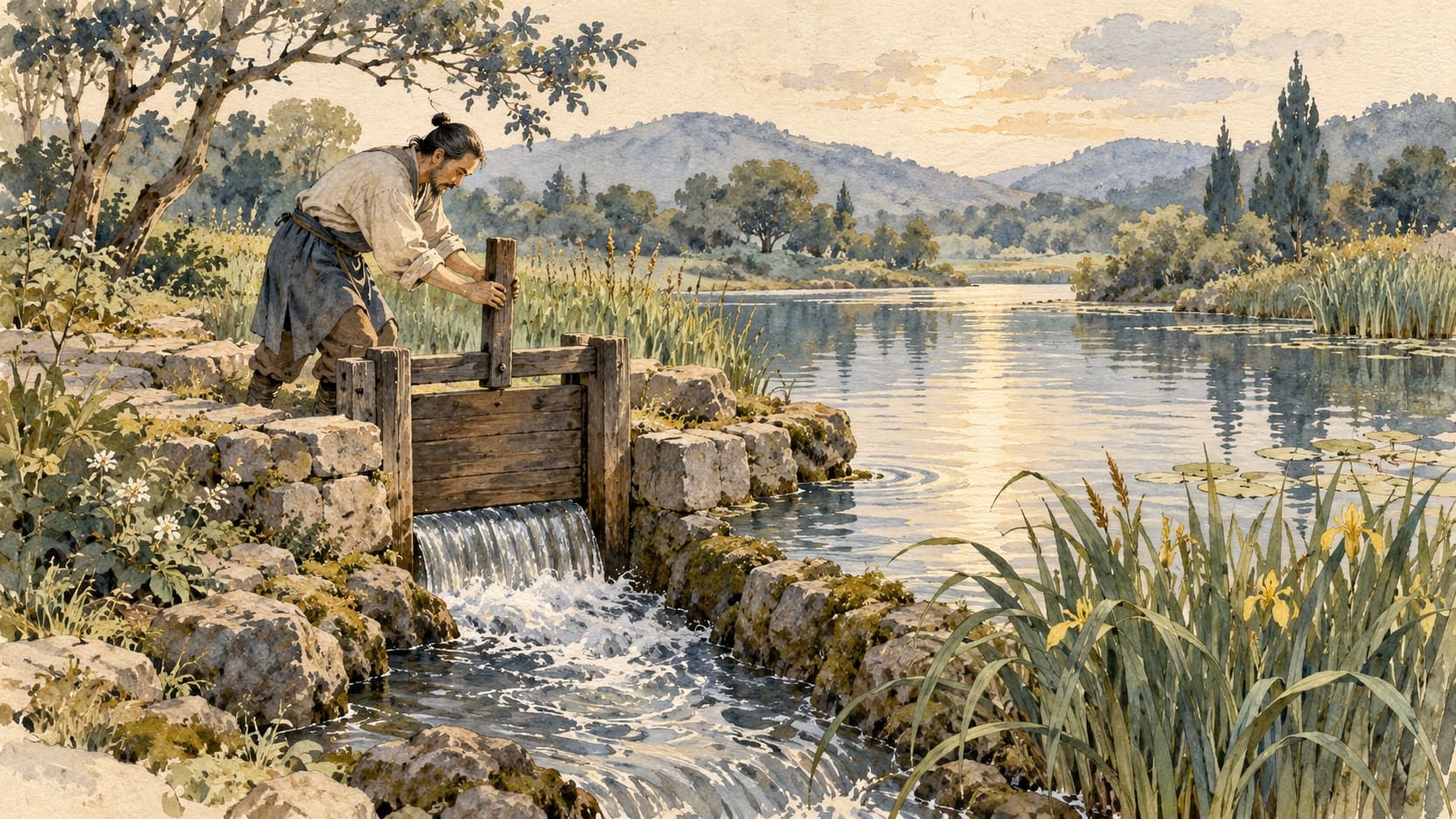
The Great Image places water above the lake and discusses establishing measures and considering conduct. The illustration uses a small managed water channel as a fictional visual analogy. It is not a technical design for flood control. The emphasis is a boundary that gives useful shape to a flow, rather than an attempt to stop all movement or impose one measure everywhere.
Six line settings: read the particular position
The following original English orientation notes refer to the six distinct statements in the linked Chinese transcription. They are not six predicted events in sequence.
- Line 1: The first does not go beyond the inner courtyard and names no blame. Its commentary attends to knowing whether passage is open or closed.
- Line 2: The second also remains within a courtyard but names an unfavorable result. Similar outward restraint can miss a timely opening in a different position.
- Line 3: The third links a lack of regulation with lament. It invites attention to consequences rather than using remorse as evidence that someone is irredeemable.
- Line 4: The fourth presents being at ease with limitation and success. A workable boundary differs from one maintained solely through strain.
- Line 5: The fifth describes sweet limitation, favorable language, and esteem in going forward. Its quality matters, not just its severity.
- Line 6: The upper line returns to bitter limitation and an unfavorable judgment on persistence, while mentioning the disappearance of regret. Do not remove the warning by reading only the reassuring phrase.
Use the changing-lines guide for the position actually recorded in a cast, rather than selecting a more encouraging statement.
A fictional example: test whether a rule still serves the task
Imagine a group that limits every meeting to a short fixed interval. The rule initially protects time, but later prevents an important safety concern from being discussed. A Jie-inspired reflection could keep the ordinary limit while creating a clear exception for necessary review. That is neither limitless discussion nor blind adherence. The group would still need to observe whether the revised arrangement works. The example illustrates a proportionate boundary rather than claiming that flexibility always produces agreement.
Questions for a grounded modern reflection
These prompts are modern editorial reflection, separate from the classical wording and its historical commentary:
- What purpose does this limit serve now?
- Am I preventing waste or missing a necessary opening?
- What evidence would show that the rule has become needlessly harsh?
State the purpose of the existing limit in one sentence. Compare that purpose with its actual effects on the people and activity involved. Look for both insufficient regulation and unnecessary strain. If a change is justified, define a proportionate adjustment and a review point. An exception should have a reason, while persistence should remain open to evidence that the rule is no longer useful.
Use the chapter without changing the cast
Start with the question and the cast as actually recorded. Identify the primary figure, any changing positions, and the relating figure without recasting to improve the answer. The reading guide explains this distinction. This educational article does not choose, infer, alter, or reroll a cast.
Read the Judgment for the broad setting and the actual line for its particular circumstances. The Great Image and Commentary are distinct source layers. The modern examples and illustration here are fictional teaching material, not observed outcomes or classical quotations. The cited source is a public digital transcription; this article does not certify an ancient edition or attribute unreviewed Gao Heng annotations.
Key takeaways
- More restraint is not automatically a better response.
- Similar behavior receives different evaluations in different positions.
- A sustainable boundary should be assessed by purpose and consequences.
Conclusion
Jie asks for attention to the purpose, timing, and lived quality of a limit. Read the particular position and test the boundary against actual effects, especially where discipline has become bitter or automatic.
Does Hexagram 60 tell me to become more disciplined?
Sometimes the relevant question is insufficient regulation, but the chapter also warns against bitter restraint. The actual line and real conditions matter more than a blanket instruction.
Why do the first and second lines evaluate staying inside differently?
The displayed line commentaries distinguish recognizing a closed passage from losing the appropriate time. Outwardly similar actions can fit different circumstances.
Can I use this hexagram to set a strict diet or medical rule?
This article does not support that use. Health decisions require relevant information and appropriate professional guidance, not a symbolic inference about how much restriction to impose.
Sources
Reflect on one question
Frame a focused question before starting a new reading.
Explore YiInsight →