 YiInsight
YIINSIGHT / Canonical hexagram
Hexagram 56: The Traveler and the Care of a Temporary Position
Understand Hexagram 56, Lu or The Traveler, through temporary shelter, six line settings, and a practical distinction between hospitality and ownership.
Hexagram 56: 旅 · lǚ
Mountain below Fire. Lines are numbered from the bottom upward.
The short answer
Hexagram 56, Lu or The Traveler, considers conduct in a temporary or unfamiliar position. Its Judgment speaks of small success and appropriate persistence for the traveler. The line statements contrast shelter, resources, assistance, loss, and overconfidence. It does not predict a journey or guarantee that travel will be safe.
Overview
A traveler may have resources and skill while lacking the support that comes from an established place. Lu brings that distinction into view. The same image can support a modern reflection on visiting, joining a temporary team, or navigating an unfamiliar environment, but those applications are analogies. A real itinerary, agreement, or risk still needs an ordinary practical assessment.
The Judgment: small success in a bounded role
The pinned Chinese digital transcription separates the Judgment, Commentary on the Judgment, Great Image and six line statements. The English orientation below is original editorial interpretation, not a certified translation.
The displayed Judgment's favorable language is qualified by the traveler's situation and the modest scale of success. It is not a general promise of expansion. The Commentary describes a way of meeting the setting without claiming the permanence or authority of a settled household.
A modern reader might ask what can reasonably be expected from a temporary position. Courtesy, clear arrangements, and a manageable load can be useful reflections. They should not be presented as literal translations of every classical term or as guarantees against loss. The line statements include damaged lodging and lost support, so a purely reassuring reading would miss part of the chapter. Notice what is actually secure, what is provisional, and what has only been assumed.
The Image: fire on the mountain
The figure in the pinned Chinese chapter has Mountain below and Fire above. Its bottom-to-top pattern is 001101, using 1 for solid and 0 for broken. This cross-check identifies hexagram 56, 56-lu; it is not a personal cast or outcome.
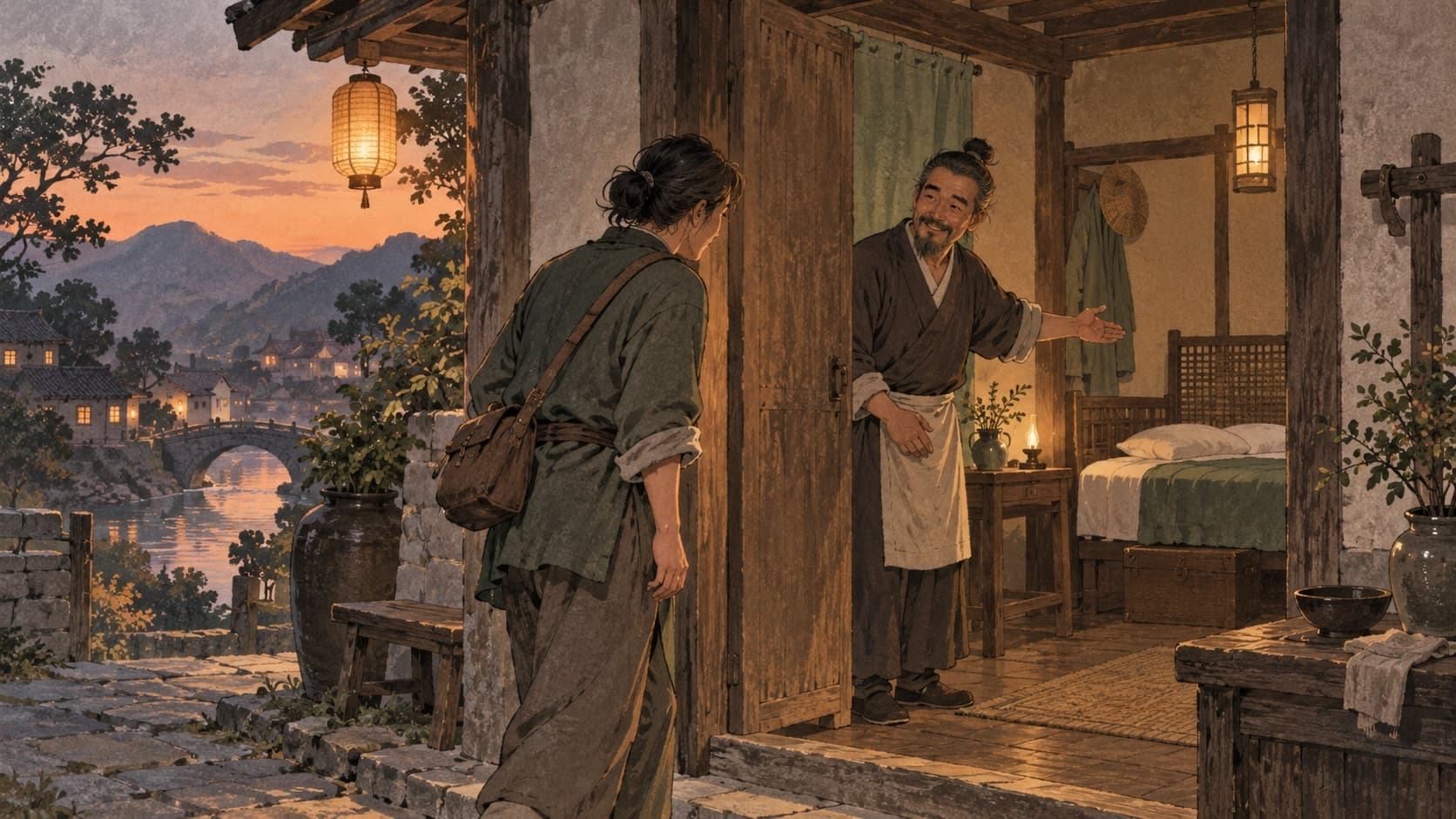
The Great Image describes fire on a mountain and discusses clarity, caution in punishment, and not prolonging confinement. That is a historical governance image, distinct from the Judgment. It is not modern legal advice. A limited editorial analogy is to avoid letting a temporary problem become an indefinite unresolved condition. The illustration of an innkeeper welcoming a traveler is fictional, with no claim of historical reconstruction.
Six line settings: read the particular position
The following original English orientation notes refer to the six distinct statements in the linked Chinese transcription. They are not six predicted events in sequence.
- Line 1: The first depicts a traveler absorbed in petty matters and drawing trouble. It can orient reflection toward proportion without pretending that every inconvenience is self-inflicted.
- Line 2: The second gives lodging, resources, and reliable assistance. The statement distinguishes a supported temporary stay from the possession of a permanent home.
- Line 3: The third describes burned lodging and lost assistance with a warning. These are textual images of a damaged position, not a personal fire prediction.
- Line 4: The fourth has a place to stay and practical resources, yet an unhappy heart. Having basic arrangements in place and feeling settled are different conditions.
- Line 5: The fifth depicts losing an arrow while shooting a pheasant, followed by recognition. It does not guarantee that a sacrifice of resources will earn a modern reward.
- Line 6: The upper position contrasts initial laughter with later grief, alongside a burned nest and lost livestock. Overconfidence and the loss of a base form a different setting from modest arrival.
Use the changing-lines guide for the position actually recorded in a cast, rather than selecting a more encouraging statement.
A fictional example: do not confuse access with ownership
Consider a designer visiting another team's studio for a short collaboration. They have a desk and helpful colleagues, but assume they can reorganize the shared space without asking. A Lu-inspired reflection could first clarify the duration, resources, and permission attached to the visit. The designer may still contribute decisively within those terms. This is a fictional example of a temporary position, not a workplace prediction. Whether the collaboration works depends on the real agreement and conduct of the participants.
Questions for a grounded modern reflection
These prompts are modern editorial reflection, separate from the classical wording and its historical commentary:
- Which parts of my position are temporary, and which support is explicitly available?
- Where am I assuming rights or permanence that have not been agreed?
- What small, clear arrangement would make the present stay more workable?
Use the chapter without changing the cast
Start with the question and the cast as actually recorded. Identify the primary figure, any changing positions, and the relating figure without recasting to improve the answer. The reading guide explains this distinction. This educational article does not choose, infer, alter, or reroll a cast.
Read the Judgment for the broad setting and the actual line for its particular circumstances. The Great Image and Commentary are distinct source layers. The modern examples and illustration here are fictional teaching material, not observed outcomes or classical quotations. The cited source is a public digital transcription; this article does not certify an ancient edition or attribute unreviewed Gao Heng annotations.
Key takeaways
- The traveler's success is framed by a limited position.
- Resources, reliable assistance, and emotional ease are not interchangeable.
- The chapter's losses are not forecasts of literal travel incidents.
Conclusion
Lu can illuminate the difference between being supported for a time and being permanently established. Read the actual line, clarify the real arrangement, and keep practical travel decisions separate from symbolic interpretation.
Does Hexagram 56 tell me to travel?
No universal travel instruction is supported. Travel is the chapter's central image, while a modern journey requires practical information about purpose, arrangements, and relevant risks independently of a reading.
Does a burned lodging line predict a fire?
This article makes no such prediction. The image belongs to a particular classical statement about a damaged position. Use ordinary safety information and appropriate procedures for actual hazards.
Can Lu apply to a temporary job or unfamiliar group?
That can be a clearly labeled modern analogy. It is useful to examine available support and the limits of the role, but the text does not supply facts about an employer, contract, or other person's intentions.
Sources
Reflect on one question
Frame a focused question before starting a new reading.
Explore YiInsight →