 YiInsight
YIINSIGHT / Canonical hexagram
Hexagram 53: Gradual Development and the Conditions for Progress
Explore Hexagram 53, Jian, through geese, the tree-on-a-mountain Image, six changing-line contexts, and realistic reflection on gradual development.
Hexagram 53: 漸 · jiàn
Mountain below Wind. Lines are numbered from the bottom upward.
The short answer
Hexagram 53, Jian or Gradual Development, connects progress with appropriate stages and sound placement. Its geese move through different settings rather than simply climbing a success ladder. The Judgment's marriage imagery is historical context, not a prediction of marriage, pregnancy, or a fixed waiting period for a modern reader.
Overview
Progress can be gradual because foundations need time, but it can also appear gradual because a plan is poorly supported. Jian invites attention to the difference. A shore, a rock, a height, or a tree offers a particular kind of footing. The question is therefore not only how long something will take, but whether the present stage has the conditions it needs.
The Judgment: stages, placement, and historical marriage language
The pinned Chinese digital transcription separates the Judgment, Commentary on the Judgment, Great Image and six line statements. The English orientation below is original editorial interpretation, not a certified translation.
The displayed Judgment uses a woman's marriage as a favorable image and speaks of persistence. The Commentary connects development with appropriate positions and a gradual course. Those historical social images need explanation rather than uncritical reuse as rules about contemporary gender roles.
A modern analogy might ask whether a commitment has reached a stage that can actually support it. That is different from promising that patience alone guarantees a desired outcome. The line statements contain both favorable settings and severe difficulties. Their references to pregnancy, absence, and time are not medical assessments or reliable calendars. Keep them within their textual setting, and use relevant real-world evidence for decisions about relationships, health, or other consequential matters.
The Image: a tree on a mountain
The figure in the pinned Chinese chapter has Mountain below and Wind above. Its bottom-to-top pattern is 001011, using 1 for solid and 0 for broken. This cross-check identifies hexagram 53, 53-jian; it is not a personal cast or outcome.
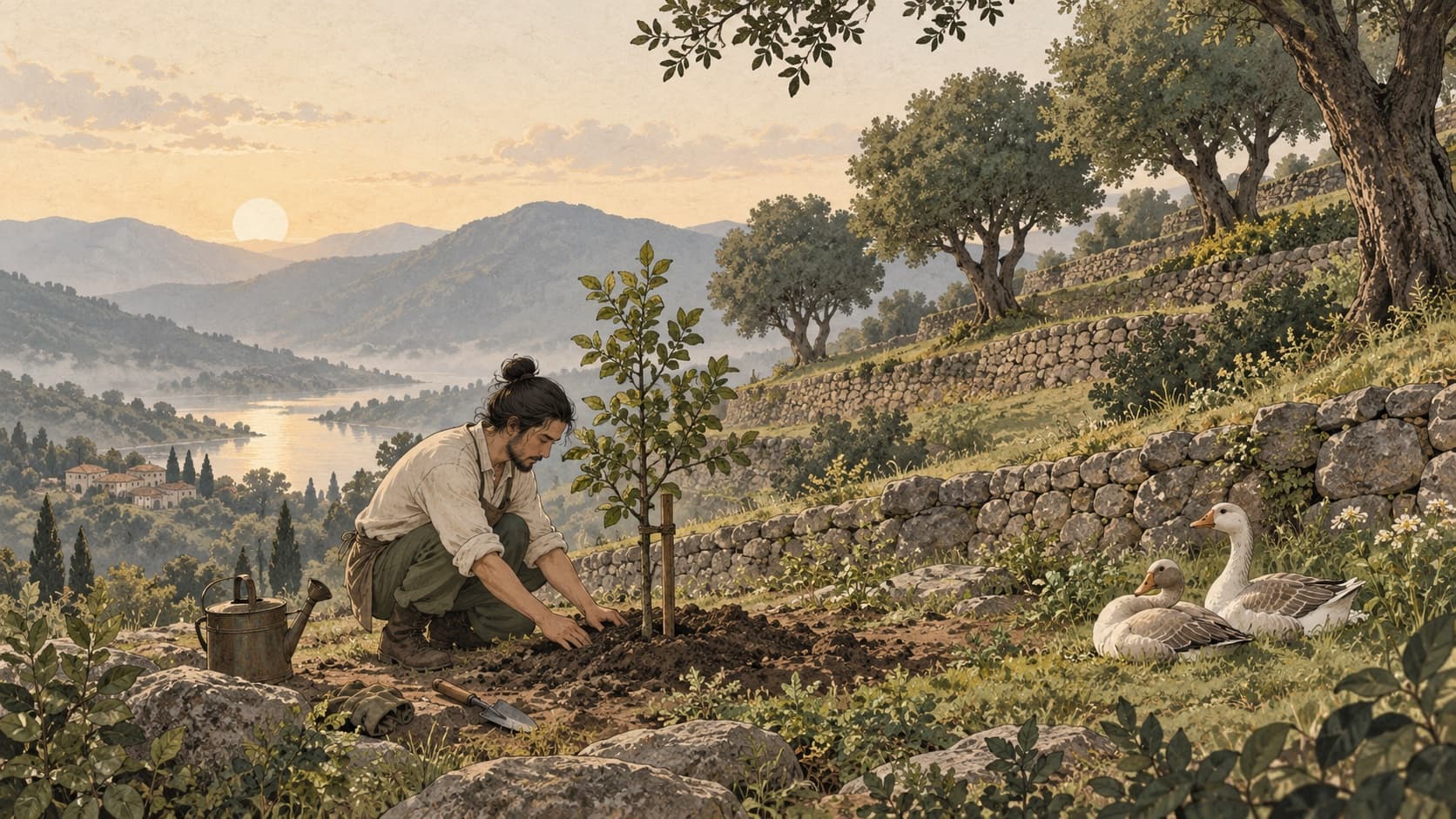
The Great Image describes a tree on a mountain and cultivation of worthy conduct and customs. A growing tree suggests development that becomes established in a place, rather than movement for its own sake. The modern illustration adds a gardener and geese as a conceptual composition. It does not document the classical scene or imply that an individual's progress must follow a natural timetable.
Six line settings: read the particular position
The following original English orientation notes refer to the six distinct statements in the linked Chinese transcription. They are not six predicted events in sequence.
- Line 1: The first goose reaches the shore amid danger and criticism, yet the statement names no blame. A beginning can be exposed without proving that the entire undertaking is wrong.
- Line 2: The second reaches a rock and depicts shared food and ease. It offers a different quality of support from the unsettled beginning at the shore.
- Line 3: The third uses separation, pregnancy, and defensive imagery in a troubled setting. Do not treat those historical symbols as personal predictions or advice about another person's body.
- Line 4: The fourth reaches a tree and may find a level branch. The relevant distinction is finding suitable support, not assuming that every elevated position is secure.
- Line 5: The fifth describes a height, a delay in pregnancy, and eventual favorable language. Its time reference is not evidence of a reader's fertility or a three-year deadline.
- Line 6: The upper goose's feathers become suitable for ceremonial use. Interpretive traditions discuss its setting; this article does not resolve textual variants through an unsupported edition claim.
Use the changing-lines guide for the position actually recorded in a cast, rather than selecting a more encouraging statement.
A fictional example: define what the next stage requires
A fictional apprentice wants to lead a workshop after attending only the introductory sessions. Calling the goal gradual is not enough to show what is missing. A Jian-inspired reflection could identify the next concrete stage: practicing a technique reliably, receiving feedback, and assisting an experienced teacher. These checks make progress observable. They do not mean every learner must follow the same sequence, or that waiting automatically produces competence. If the chosen path offers no workable next stage, the plan itself may need reconsideration.
Questions for a grounded modern reflection
These prompts are modern editorial reflection, separate from the classical wording and its historical commentary:
- What support belongs to the stage I am actually in?
- What would show that the next commitment is ready rather than merely desired?
- Where am I confusing gradual development with indefinite postponement?
Use the chapter without changing the cast
Start with the question and the cast as actually recorded. Identify the primary figure, any changing positions, and the relating figure without recasting to improve the answer. The reading guide explains this distinction. This educational article does not choose, infer, alter, or reroll a cast.
Read the Judgment for the broad setting and the actual line for its particular circumstances. The Great Image and Commentary are distinct source layers. The modern examples and illustration here are fictional teaching material, not observed outcomes or classical quotations. The cited source is a public digital transcription; this article does not certify an ancient edition or attribute unreviewed Gao Heng annotations.
Key takeaways
- Gradual development concerns fitting support as well as elapsed time.
- Different goose settings are not six guaranteed promotions.
- Historical marriage and pregnancy imagery is not a modern prediction.
Conclusion
Jian is most useful when stages are connected to observable conditions. Keep its historical imagery distinct from modern reflection, and resist turning patience into either a guarantee or an endless delay.
Does Hexagram 53 mean that I will get married?
No personal marriage outcome is established. Marriage is part of the displayed Judgment's historical imagery. Its relevance to a modern question depends on interpretation and ordinary facts, not on the image alone.
How long does Jian say I should wait?
This chapter does not provide a general waiting period. Ask what a particular stage needs and how you could observe readiness. A time phrase within one line should not become a universal calendar.
Is slow progress always the right choice with Hexagram 53?
No. Gradual development is not permission to ignore a blocked or unsuitable plan. Compare the actual line setting, available support, and evidence of learning before deciding whether to continue, revise, or stop a particular approach.
Sources
Reflect on one question
Frame a focused question before starting a new reading.
Explore YiInsight →