 YiInsight
YIINSIGHT / Canonical hexagram
Hexagram 51: Shock and the Return of Composure
Understand Hexagram 51, Zhen, through thunder, the ritual vessel image, six distinct line settings, and a careful reflection on responding to surprise.
Hexagram 51: 震 · zhèn
Thunder below Thunder. Lines are numbered from the bottom upward.
The short answer
Hexagram 51, Zhen or Shock, uses thunder and alarm to explore a response to sudden disturbance. The Judgment moves from fear toward laughter while preserving ritual implements. That image concerns composure within shock; it does not predict a disaster or claim that a surprised person must immediately feel calm.
Overview
The first reaction to startling news is often mistaken for the only response available. Zhen distinguishes the arrival of a disturbance from what someone does while it passes. Its different positions include recovery, hurried pursuit, difficulty moving, repeated alarm, and unsettled perception. Reading the actual position prevents the general thunder image from becoming a vague warning about everything ahead.
The Judgment: alarm need not decide the whole response
The pinned Chinese digital transcription separates the Judgment, Commentary on the Judgment, Great Image and six line statements. The English orientation below is original editorial interpretation, not a certified translation.
The displayed Judgment describes alarm and then laughing speech, before saying that even far-reaching thunder does not cause the ritual spoon and offering wine to be lost. The ritual setting is specific; it should not be converted into a modern demand to appear unaffected. The image instead gives a contrast between disturbance and the continued care of an entrusted task.
The Commentary expands the response to thunder through caution and order. In a modern reflection, the question might be which responsibility needs a simple, reliable next step while emotions settle. That is not a treatment for anxiety or an assurance of safety. When a real emergency occurs, follow the appropriate practical procedures rather than interpreting a symbolic passage as an emergency plan.
The Image: repeated thunder and self-examination
The figure in the pinned Chinese chapter has Thunder below and Thunder above. Its bottom-to-top pattern is 100100, using 1 for solid and 0 for broken. This cross-check identifies hexagram 51, 51-zhen; it is not a personal cast or outcome.
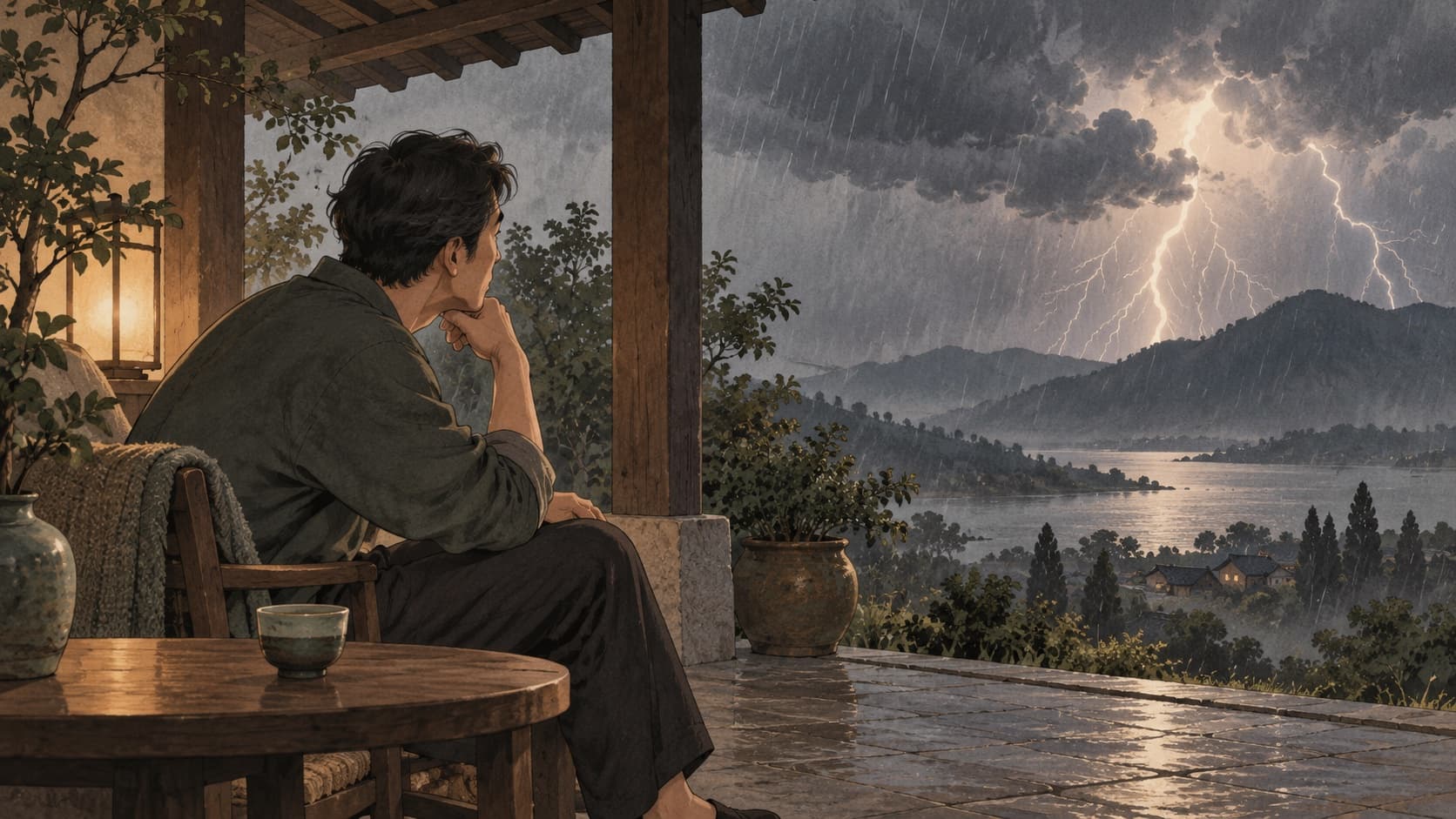
The Great Image describes repeated thunder and a person's fearful self-examination. It does not say that fear proves a future event will occur. The editorial illustration shows someone sheltered during a distant storm with a cup resting on a table. It represents a contrast between disturbance and steadiness, not a photograph of a reading or a guarantee that a particular place is safe.
Six line settings: read the particular position
The following original English orientation notes refer to the six distinct statements in the linked Chinese transcription. They are not six predicted events in sequence.
- Line 1: The first repeats the movement from alarm toward laughter with favorable language. The initial startle and the later response are different parts of the statement.
- Line 2: The second includes danger, lost valuables, a climb, and a warning not to pursue. Its seven-day wording is textual imagery here, not an individual recovery deadline.
- Line 3: The third describes unsettled shock and movement without the named fault. It should not be turned into a general command to act quickly in every alarming circumstance.
- Line 4: The fourth places shock in the mud. Being stirred up and making actual progress are not the same thing; more agitation may leave the practical situation unchanged.
- Line 5: The fifth presents danger as shock comes and goes, while retaining an important undertaking. Repeated disturbance requires a different reading from a single passing surprise.
- Line 6: The upper line emphasizes trembling and darting sight, with warnings around going forward and disturbance nearby. It does not identify a real neighbor or predict a marriage dispute.
Use the changing-lines guide for the position actually recorded in a cast, rather than selecting a more encouraging statement.
A fictional example: stabilize the next decision
Imagine a project team receiving an unexpected deadline change. One person proposes abandoning the work immediately, while another insists nothing has changed. A Zhen-inspired reflection could separate the news from those reactions: confirm the deadline, preserve the current files, and ask which decision actually needs to be made today. This fictional example illustrates composure as a sequence of bounded actions. It does not claim that the team will succeed, or that any frightening news is merely a misunderstanding.
Questions for a grounded modern reflection
These prompts are modern editorial reflection, separate from the classical wording and its historical commentary:
- What has actually changed, and what am I adding through my first reaction?
- Which entrusted task can I keep simple while I regain perspective?
- Am I moving usefully, pursuing a loss, or only becoming more agitated?
Use the chapter without changing the cast
Start with the question and the cast as actually recorded. Identify the primary figure, any changing positions, and the relating figure without recasting to improve the answer. The reading guide explains this distinction. This educational article does not choose, infer, alter, or reroll a cast.
Read the Judgment for the broad setting and the actual line for its particular circumstances. The Great Image and Commentary are distinct source layers. The modern examples and illustration here are fictional teaching material, not observed outcomes or classical quotations. The cited source is a public digital transcription; this article does not certify an ancient edition or attribute unreviewed Gao Heng annotations.
Key takeaways
- The thunder image does not forecast a personal disaster.
- Composure can coexist with an honest recognition of alarm.
- A line's timing language is not a guaranteed modern calendar.
Conclusion
Zhen can clarify the difference between shock and response. Preserve the recorded cast, attend to the precise line, and check the situation through ordinary evidence before acting on an analogy.
Does Hexagram 51 predict an earthquake or accident?
This article provides no such prediction. Thunder and shock are part of the displayed classical imagery. A real hazard should be assessed with relevant information and ordinary safety procedures, independently of a reading.
Does the seven-day line mean that my loss will return in a week?
No literal personal deadline is supported here. The phrase occurs in the second line's particular setting and should first be read in that context, rather than extracted as a guaranteed date.
Is it wrong to feel frightened after receiving Zhen?
The chapter itself acknowledges fear and unsettled perception. It should not become a test of emotional performance. Use the text for reflection while seeking appropriate practical or personal support when needed.
Sources
Reflect on one question
Frame a focused question before starting a new reading.
Explore YiInsight →