 YiInsight
YIINSIGHT / Canonical hexagram
Hexagram 50: The Cauldron, Nourishment, and Responsibility
Read Hexagram 50, Ding, through its cauldron imagery, six line positions, and a practical distinction between real support and an impressive container.
Hexagram 50: 鼎 · dǐng
Wind below Fire. Lines are numbered from the bottom upward.
The short answer
Hexagram 50, Ding or The Cauldron, presents a vessel associated with cooking, offerings, and nourishment. Its favorable Judgment should be read alongside line statements about contents, handles, carrying, and broken support. A useful modern question is whether the form you have created can responsibly carry what matters.
Overview
A program, institution, or personal practice can look impressive while failing to nourish anyone. Ding gives unusually concrete images for separating the container from its function. Its vessel must be cleaned, filled, supported, and handled. The chapter is not a claim that any project called a transformation will succeed, nor a reason to ignore a visibly broken foundation.
The Judgment: a favorable vessel still needs sound support
The pinned Chinese digital transcription separates the Judgment, Commentary on the Judgment, Great Image and six line statements. The English orientation below is original editorial interpretation, not a certified translation.
The displayed Judgment is brief and strongly favorable. The Commentary supplies a cooking and offering context, including nourishment of worthy people. These are distinct textual layers: the longer commentary should not be silently presented as if every phrase occurred in the Judgment itself.
The line statements complicate a simple success slogan. Something can be present in the vessel yet not accessible; something valuable can be spilled when a leg breaks. A modern interpretation may ask about responsibility for a process, the people it serves, and the means of carrying it. This is an analogy from the vessel imagery, not evidence that a new service, relationship, or business will be profitable. Examine what is actually being provided and who can rely on it.
The Image: fire above wood and a settled position
The figure in the pinned Chinese chapter has Wind below and Fire above. Its bottom-to-top pattern is 011101, using 1 for solid and 0 for broken. This cross-check identifies hexagram 50, 50-ding; it is not a personal cast or outcome.
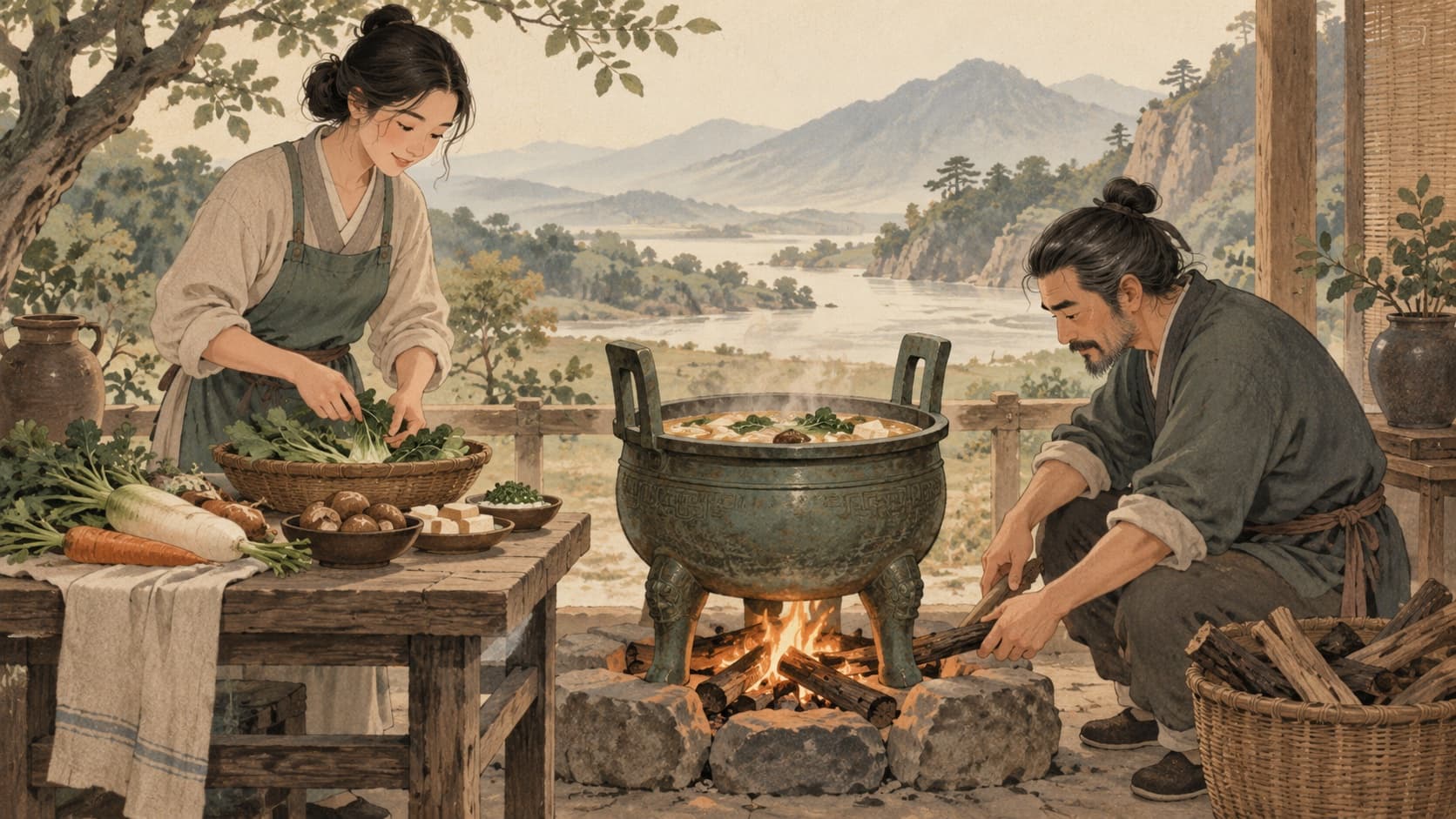
The Great Image places fire above wood and describes making one's position correct and settling the mandate. Read that language in its own historical setting before using it as a personal metaphor. A contemporary practice might clarify who is responsible for a shared task and whether that person has the needed support. The illustrated cauldron is conceptual artwork, not an archaeological reconstruction or proof of a historical ritual.
Six line settings: read the particular position
The following original English orientation notes refer to the six distinct statements in the linked Chinese transcription. They are not six predicted events in sequence.
- Line 1: The first overturns the vessel to remove what is undesirable. Its domestic hierarchy imagery is historical; the useful modern analogy is clearing a container before asking it to nourish.
- Line 2: The second says that the cauldron has contents and describes an opposing person's affliction and inability to approach. It does not establish facts about a real rival's health.
- Line 3: The third focuses on changed handles and blocked movement, with valued food not eaten before a turn in conditions. Contents and practical access are different matters.
- Line 4: The fourth gives a broken leg and spilled public food. Responsibility is especially visible when a structure entrusted with something cannot carry its load.
- Line 5: The fifth presents yellow handles and a metal carrying bar with favorable persistence. Sound means of support and handling belong alongside whatever the vessel contains.
- Line 6: The upper position uses a jade carrying bar and favorable language. Its refined image does not cancel the earlier warning about what happens when support fails.
Use the changing-lines guide for the position actually recorded in a cast, rather than selecting a more encouraging statement.
A fictional example: test the support before adding more
Consider a community kitchen whose menu expands faster than its storage and cleaning routines. Calling the expansion nourishing does not make the process safe or workable. A Ding-inspired reflection could first inspect the supporting arrangements, clarify responsibilities, and reduce the menu until the team can consistently deliver it. The kitchen is a fictional teaching example, not a recommendation derived from a real casting. Its success would have to be judged through actual operations, not inferred from a favorable symbol.
Questions for a grounded modern reflection
These prompts are modern editorial reflection, separate from the classical wording and its historical commentary:
- What is the vessel in this situation, and whom is it supposed to nourish?
- Are valuable contents present but inaccessible because the handles or process are inadequate?
- Which support needs repair before I place a greater load on it?
Use the chapter without changing the cast
Start with the question and the cast as actually recorded. Identify the primary figure, any changing positions, and the relating figure without recasting to improve the answer. The reading guide explains this distinction. This educational article does not choose, infer, alter, or reroll a cast.
Read the Judgment for the broad setting and the actual line for its particular circumstances. The Great Image and Commentary are distinct source layers. The modern examples and illustration here are fictional teaching material, not observed outcomes or classical quotations. The cited source is a public digital transcription; this article does not certify an ancient edition or attribute unreviewed Gao Heng annotations.
Key takeaways
- The Judgment, Commentary, and six vessel images are separate layers.
- Having valuable contents does not prove an ability to deliver them.
- Support and responsibility matter as much as the appearance of the container.
Conclusion
Ding becomes more practical when the vessel, its contents, and its support are examined separately. Let the actual line locate the concern rather than reducing the whole chapter to transformation or success.
Does Hexagram 50 guarantee a successful transformation?
No. The favorable Judgment belongs to a chapter that also depicts blocked handles and a broken leg. It provides imagery for interpretation, while the outcome of a contemporary project requires independent practical evidence.
Is Ding only about cooking?
Cooking and the offering vessel are central to the displayed text. Broader applications to institutions or personal practices are modern analogies and should be identified as such, rather than represented as literal classical instructions.
How should a changing line in Hexagram 50 be used?
Read the particular vessel condition at that position and preserve the original recorded cast. Do not select whichever line sounds most encouraging or treat all six conditions as a timetable for the same project.
Sources
Reflect on one question
Frame a focused question before starting a new reading.
Explore YiInsight →