 YiInsight
YIINSIGHT / Canonical hexagram
Hexagram 47: Exhaustion, Constraint, and What Still Remains Possible
Explore Hexagram 47, Kun, through its Judgment, lake-without-water Image, six line settings, and a grounded reflection on limited resources.
Hexagram 47: 困 · kùn
Water below Lake. Lines are numbered from the bottom upward.
The short answer
Hexagram 47, Kun, concerns constraint and exhaustion rather than a verdict that everything has failed. The Judgment pairs a difficult setting with the possibility of maintaining integrity, while warning that words may not be believed. Its line images distinguish different kinds of confinement; none makes exhaustion a permanent identity.
Overview
When resources narrow, it is tempting either to make a grand promise or to explain the problem until someone finally agrees. Kun draws attention to a harder question: what remains reliable when explanation no longer changes the circumstances? Read it as a chapter about conduct under constraint, then locate the actual changing position before drawing a personal analogy.
The Judgment: integrity when words lose their force
The pinned Chinese digital transcription separates the Judgment, Commentary on the Judgment, Great Image and six line statements. The English orientation below is original editorial interpretation, not a certified translation.
The displayed Judgment names constraint, speaks of favorable integrity for a great person, and says that spoken words are not believed. Those statements belong together. The favorable language does not erase the constraint; it draws attention to how someone meets it. Conversely, the warning about speech does not mean that every conversation must stop.
The Commentary describes firmness covered over and a person who does not lose their proper place in difficulty. A modern reflection might distinguish a verifiable action from another attempt to argue for credibility. That is an editorial application, not a claim that the ancient text describes a contemporary workplace. A serious practical problem still calls for relevant support and ordinary evidence, rather than an obligation to endure it silently.
The Image: a lake without water
The figure in the pinned Chinese chapter has Water below and Lake above. Its bottom-to-top pattern is 010110, using 1 for solid and 0 for broken. This cross-check identifies hexagram 47, 47-kun; it is not a personal cast or outcome.
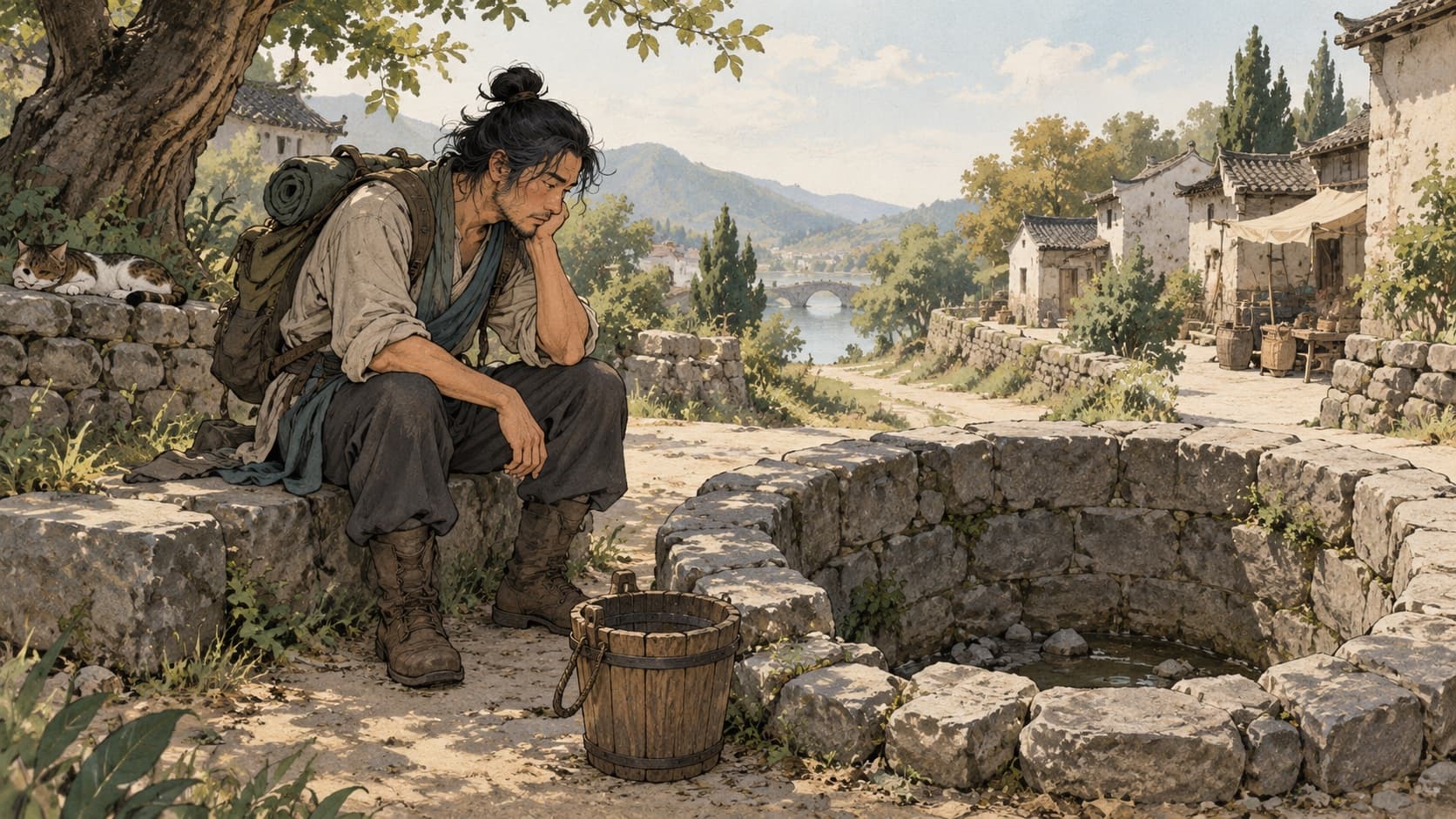
The Great Image describes a lake without water and speaks of carrying through one's purpose. This is a stark depletion image, not a promise that motivation can replace sleep, food, money, or assistance. Keeping a purpose may mean reducing its present scope. The illustration of a traveler pausing beside a depleted well is a modern visual analogy; it is not an ancient event documented by the text.
Six line settings: read the particular position
The following original English orientation notes refer to the six distinct statements in the linked Chinese transcription. They are not six predicted events in sequence.
- Line 1: The first position places someone on a bare stump and in a dark valley. Its prolonged lack of seeing is a textual image, not a personal three-year forecast.
- Line 2: The second combines constraint amid food and drink with ceremonial language. Having something available does not automatically mean being able to use it well.
- Line 3: The third piles up an obstructing stone, thorny support, and an empty domestic encounter. It is a particularly troubled setting, rather than a claim about a partner's intentions.
- Line 4: The fourth describes a slow arrival and obstruction associated with a metal carriage, yet allows an ending. Delay and total impossibility should not be treated as synonyms.
- Line 5: The fifth uses harsh bodily and official-dress imagery before describing gradual relief and offerings. These historical symbols are not instructions to harm anyone or predictions of injury.
- Line 6: The last depicts entanglement and unease, followed by reflection on regret and movement. A change of response is possible in the text; guaranteed personal rescue is not established.
Use the changing-lines guide for the position actually recorded in a cast, rather than selecting a more encouraging statement.
A fictional example: reduce the promise before repeating it
Imagine a volunteer coordinator with fewer helpers than an event requires. Reassuring everyone that the original plan will happen adds no staff. One possible Kun-inspired reflection is to list the tasks that have actual support, cancel the unsupported activities, and tell participants the smaller plan clearly. This is not the uniquely correct interpretation, and the example is fictional. The useful evidence afterward is whether the available people can carry out the revised work, not whether a reassuring phrase resembles the hexagram's favorable wording.
Questions for a grounded modern reflection
These prompts are modern editorial reflection, separate from the classical wording and its historical commentary:
- Which resource is actually depleted, and which limitation have I only assumed?
- What can I demonstrate through one bounded action instead of another promise?
- What kind of rest, assistance, or reduced scope would preserve what matters?
Use the chapter without changing the cast
Start with the question and the cast as actually recorded. Identify the primary figure, any changing positions, and the relating figure without recasting to improve the answer. The reading guide explains this distinction. This educational article does not choose, infer, alter, or reroll a cast.
Read the Judgment for the broad setting and the actual line for its particular circumstances. The Great Image and Commentary are distinct source layers. The modern examples and illustration here are fictional teaching material, not observed outcomes or classical quotations. The cited source is a public digital transcription; this article does not certify an ancient edition or attribute unreviewed Gao Heng annotations.
Key takeaways
- Constraint is the setting; it is not a permanent label for the person.
- The six positions show distinct difficulties, not six inevitable future events.
- Speech, endurance, and practical support require separate judgments.
Conclusion
Kun can help distinguish a constrained situation from a complete loss of agency. Retain the hard facts of the constraint, the particular line setting, and the possibility of a smaller honest response.
Does Hexagram 47 mean that I should give up?
It does not supply a universal instruction to give up or persist. Its different line settings matter. Compare the actual limitation with the purpose you are trying to preserve, and use ordinary evidence to assess your options.
Does Kun predict three years of difficulty?
No personal timeline is established here. The first line's three-year language belongs to the displayed classical statement; applying it literally to a modern life would go beyond the evidence used by this article.
Can Hexagram 47 explain why someone does not believe me?
It offers a textual warning about words not being believed, not access to another person's mind. Check communication, demonstrated conduct, and relevant facts before treating the image as an explanation of a real relationship.
Sources
Reflect on one question
Frame a focused question before starting a new reading.
Explore YiInsight →