 YiInsight
YIINSIGHT / Canonical hexagram
Hexagram 37 Meaning: Jia Ren, Family, and Dependable Everyday Conduct
Read hexagram 37, Jia Ren, through Wind over Fire, its historical household language, six line settings, and a modern example of shared responsibility.
Hexagram 37: 家人 · jiā rén
Fire below Wind. Lines are numbered from the bottom upward.
The short answer
Hexagram 37, Jia Ren, is Family. Its Judgment and commentary use historically gendered household roles, while the Image emphasizes substantive words and consistent conduct. A modern reflection can ask how shared life is supported by dependable responsibilities. It does not require reproducing ancient gender roles or accepting harmful control.
Overview
A household is sustained by repeated conduct as much as by a shared name. Hexagram 37 explores the order of family life in an ancient social setting. A careful contemporary reading preserves that setting while stating clearly which practical ideas are modern adaptations. Historical authority does not automatically become a rule for a present household.
Keep the historical household language visible
The fixed Chinese digital transcription distinguishes the Judgment, Commentary on the Judgment, Great Image, and line statements.
The Judgment is “家人:利女貞.” It refers to favorable constancy associated with the woman in the household. The Commentary on the Judgment elaborates distinct inner and outer positions for women and men and names family relationships. These are historically gendered formulations; the source does not present the modern principle of freely negotiated, equal household roles.
The editorial adaptation here is to consider dependable responsibilities among the people who share a home or regular work. That adaptation is explicitly modern, not a claim that the ancient text already expressed today's social arrangements. A reader can reflect on coordination and trust without treating sex, age, or rank as an automatic entitlement to obedience. Actual safety, consent, and fairness remain practical standards outside a symbolic chapter.
Wind from Fire: words with substance, conduct with continuity
In the canonical structural registry, hexagram 37 is 37-jia-ren, with Fire below and Wind above. Count positions from bottom to top; 1 means a solid line and 0 a broken line. Its stored pattern is 101011. That identifies the figure, not a personal outcome.
The Great Image names wind emerging from fire and says the exemplary person has substance in words and constancy in action. This commentary supplies a more specific point of reflection than the broad title Family. A promise and a repeated practice can be compared.
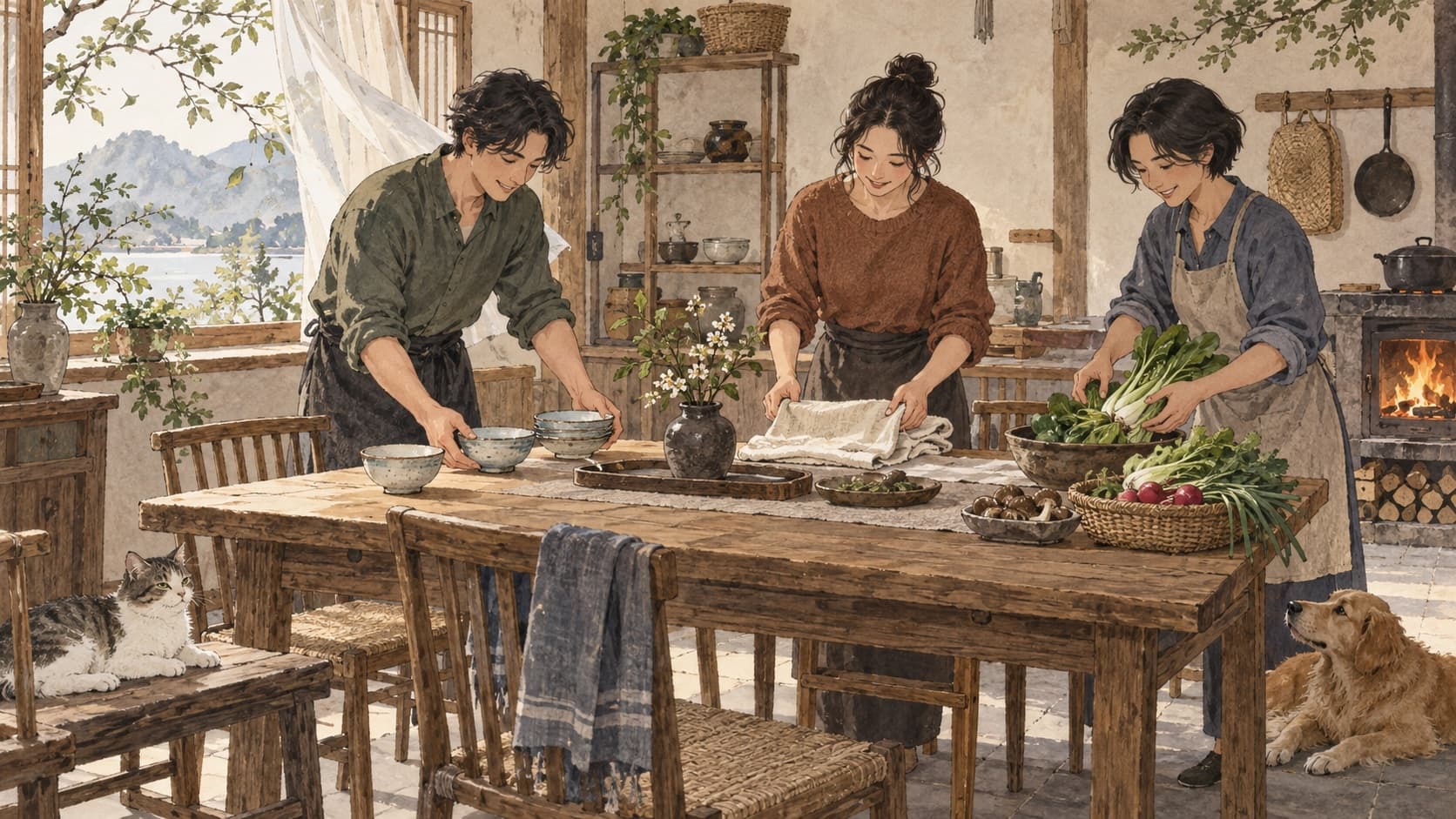
For a contemporary household, an agreement about dishes, noise, or shared supplies matters only if people understand it and can rely on its enactment. This is an editorial application rather than a translation of ancient kinship duties. Consistency need not mean refusing to revise an unfair agreement. The modern illustration of adults sharing practical tasks shows the adaptation, not a reconstructed historical household.
Six line settings: read the particular position
The following are original modern English orientation notes on the six statements in the linked Chinese transcription. They are not a certified translation or six future events in sequence:
- Line 1: speaks of setting bounds or order in the household and the disappearance of regret. It begins with an arrangement rather than a completed result.
- Line 2: refers to food provision within the household and constancy. Its historically assigned role should not be imposed as a modern gender rule.
- Line 3: contrasts stern household conduct with excessive laughter or looseness and includes mixed evaluative language. It does not justify intimidation or abuse.
- Line 4: speaks of enriching the household and favorable conditions. The text does not specify a modern income target or promise wealth.
- Line 5: depicts a ruler coming to or fulfilling the household, with no anxiety and favorable language. The political image is part of the ancient setting.
- Line 6: joins sincerity with an imposing or dignified bearing and a favorable end. The associated commentary turns attention back toward one's own conduct.
For a cast with a changing line, use the changing-lines guide and read that precise position in context.
A fictional example: a shared home with unclear promises
Imagine Ren, a fictional adult sharing an apartment with two friends, keeps reminding everyone to replace basic kitchen supplies. Each person agrees in conversation, but nobody knows whether the agreement means buying the next item, checking the cupboard, or reimbursing someone else.
A modern reflection on hexagram 37 shifts attention from accusing a housemate of being unreliable to making the words substantial. They choose a clear weekly check, agree how costs are shared, and review the arrangement after a month. Tasks are negotiated around availability rather than assigned by gender or seniority.
This is a fictional adaptation, not evidence that the agreement worked or that the classical text prescribed it. It illustrates a connection between understandable words and repeatable conduct. If a task remains unfair or impractical, consistency includes discussing and revising it rather than enforcing it unquestioningly.
Questions for a practical modern reflection
These prompts are modern editorial reflection, separate from the quoted classical text and its historical commentary:
- Which shared responsibility has never been clearly described?
- Do our words name an action, an owner, and a reasonable time?
- Can everyone question or revise the arrangement?
- Am I asking for dependable conduct or unquestioning obedience?
- What repeated practice would make a promise believable?
Choose one small action you can assess with ordinary evidence. Record what happened without treating a favorable symbol as proof that the action will work. If your observation contradicts your first interpretation, preserve the observation rather than forcing it into the text.
Use this chapter without changing the cast
Start with the question as it was actually asked. Identify the recorded primary hexagram, then any actual changing positions and relating figure. This explanatory article does not cast, choose a line, or infer a new figure. Keep the original cast separate from the interpretation you are exploring.
Read the Judgment for its broad setting, the relevant line for its particular context, and the Image as a distinct commentary layer. The reading guide provides a learning path. The English notes and fictional example here are original editorial material based on a public digital transcription. They do not certify an ancient edition or use unreviewed Gao Heng annotations.
Key takeaways
- Jia Ren's household setting is historically gendered.
- The Image emphasizes words with substance and constant action.
- A modern adaptation can negotiate roles without claiming that the ancient text did so.
Conclusion
Hexagram 37 can help examine the conduct that sustains shared life. Keep its historical gender and kinship language distinct from a modern adaptation. The Image's connection between substantive words and consistent action offers a concrete point of reflection, while fairness and safety remain matters for the people actually involved.
Does hexagram 37 require traditional gender roles?
This article does not prescribe them. It identifies the historical language and clearly separates a modern application based on negotiated responsibilities.
Does strictness in line 3 justify controlling someone?
No. Ancient evaluative imagery is not a warrant for intimidation, coercion, or abuse. Assess conduct by the real circumstances and people's safety.
Can Family apply to housemates or a regular working group?
That is a possible modern analogy, not the literal historical household setting. Label the adaptation and test whether it actually clarifies the shared responsibilities.
Sources
Reflect on one question
Frame a focused question before starting a new reading.
Explore YiInsight →