 YiInsight
YIINSIGHT / Canonical hexagram
Hexagram 34: Great Power and the Discipline Not to Force
Read Hexagram 34, Da Zhuang, through its Judgment, thunder above heaven, six line settings, and the difference between strength and force.
Hexagram 34: 大壯 · dà zhuàng
Heaven below Thunder. Lines are numbered from the bottom upward.
The short answer
Hexagram 34, Da Zhuang or Great Power, joins strength with the question of how it is used. Its Judgment emphasizes constancy, and its ram-and-fence images show that force can produce entanglement. The figure does not guarantee victory or establish that your preferred action is justified.
Overview
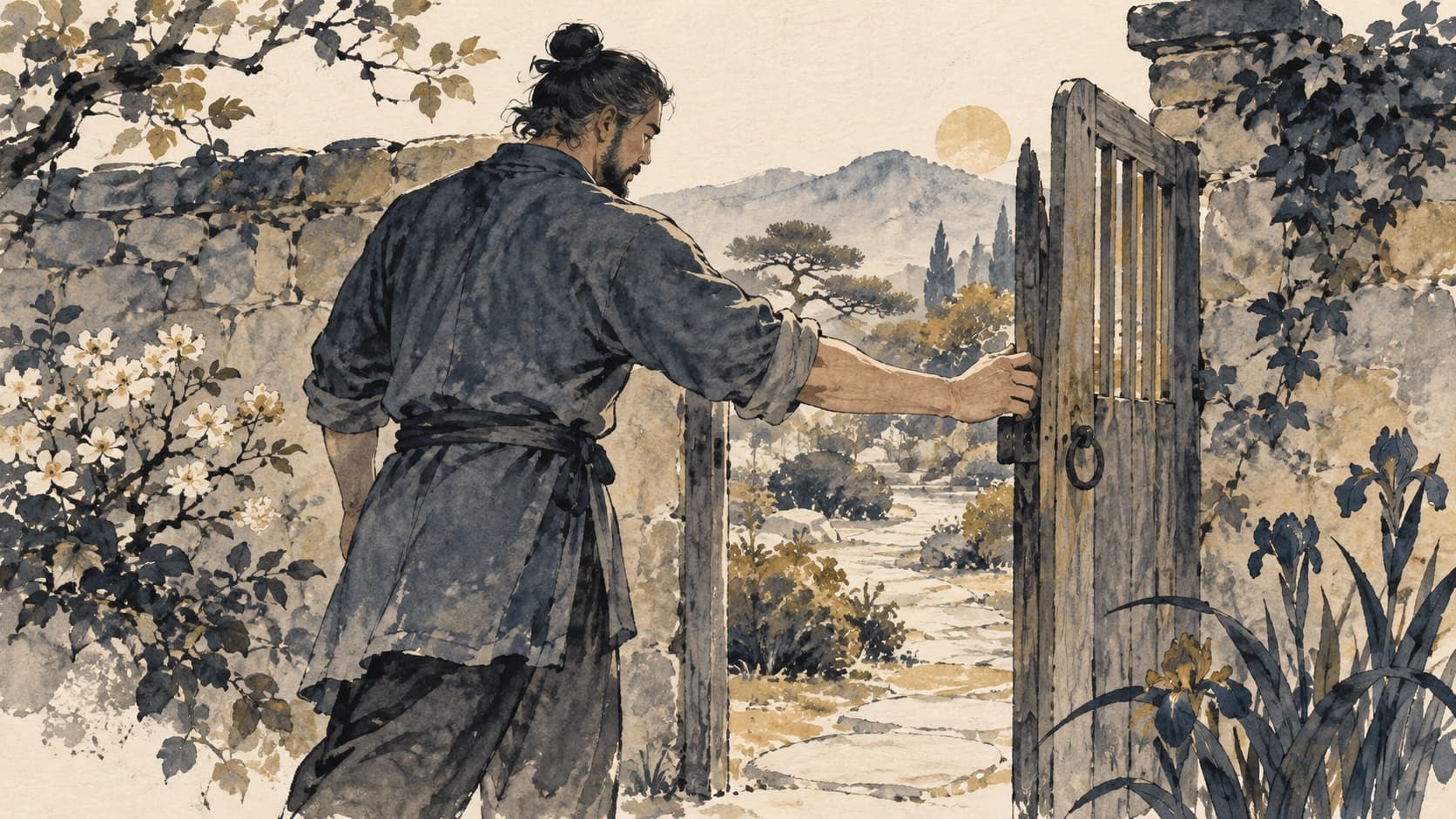
Having more energy, influence, or capacity does not settle what you should do with it. This chapter makes that distinction unusually vivid. Before applying its broad theme, identify the actual position in your cast: the line about an opening in a fence is not interchangeable with a ram unable to advance or retreat.
The Judgment: strength needs a sound direction
The fixed Chinese digital transcription distinguishes the Judgment, Commentary on the Judgment, Great Image, and line statements.
The short Judgment centers on the benefit of constancy. The Commentary links strength with movement and then brings the discussion back to what is correct and great. Reading only the English title can therefore lose the chapter's central qualification.
As a modern reflection, ask whether the action is proportionate and whether it serves a defensible purpose. Confidence is not evidence that a plan is workable. Having authority over a decision is not evidence that the people affected have been heard. Those distinctions must be assessed in the real situation, not inferred from a favorable-sounding hexagram name.
Thunder above heaven: a boundary on action
In the pinned Chinese chapter, hexagram 34 is 34-da-zhuang, with Heaven below and Thunder above. Count positions from bottom to top; 1 means a solid line and 0 a broken line. Its stored pattern is 111100. That identifies the figure, not a personal outcome.
The Great Image places thunder above heaven and describes not taking a step contrary to proper conduct. Its boundary matters as much as its energy. A modern analogy is using available capacity within an agreed process rather than treating capacity itself as permission. This is an ethical reflection, not a claim that the chapter supplies detailed rules for every present-day situation.
Six line settings: read the particular position
The following are original modern English orientation notes on the six statements in the linked Chinese transcription. They are not a certified translation or six future events in sequence:
- Line 1: Strength in the toes accompanies an unfavorable movement. The image puts force at the beginning of a step without establishing that the whole course is sound.
- Line 2: The second line gives a favorable judgment to constancy. Its brevity should not be expanded into a promise about a specific personal success.
- Line 3: A ram strikes a fence and entangles its horns. The statement contrasts uses of strength and warns that an apparently forceful approach can create its own trap.
- Line 4: The fence opens without entanglement, alongside the image of a strong vehicle support. Distinguish an available passage from success achieved by repeated collision.
- Line 5: Losing the ram carries no regret in this position. Do not assume that retaining every form of force is the only acceptable outcome.
- Line 6: The ram can neither withdraw nor proceed. The statement acknowledges the impasse and connects difficulty with a favorable possibility, rather than recommending more blind pressure.
For a cast with a changing line, use the changing-lines guide and read that precise position in context.
A fictional example: a team that can ship but should inspect first
Imagine a software team with enough people to release a feature quickly. A lead takes this capacity as proof that the release should happen immediately. A colleague points out that a dependency has not been checked and a support team has not received instructions.
In this fictional reflection, Great Power becomes a question about disciplined use of capacity. The team assigns a short dependency check and clarifies responsibilities before deciding. This does not prove delay is always wise. It separates the ability to act from the evidence that the action is ready, then lets the results of the check inform the decision.
Questions for a practical modern reflection
These prompts are modern editorial reflection, separate from the quoted classical text and its historical commentary:
- Am I treating capacity as permission?
- What would a clear passage look like instead of another collision?
- Which limit protects the purpose of this action?
Choose one small action you can assess with ordinary evidence. Record what happened without treating a favorable symbol as proof that the action will work. If your observation contradicts your first interpretation, preserve the observation rather than forcing it into the text.
Use this chapter without changing the cast
Start with the question as it was actually asked. Identify the recorded primary hexagram, then any actual changing positions and relating figure. This explanatory article does not cast, choose a line, or infer a new figure. Keep the original cast separate from the interpretation you are exploring.
Read the Judgment for its broad setting, the relevant line for its particular context, and the Image as a distinct commentary layer. The reading guide provides a learning path. The English notes and fictional example here are original editorial material based on a public digital transcription. They do not certify an ancient edition or use unreviewed Gao Heng annotations.
Key takeaways
- Capacity and justification are separate questions.
- Force can create entanglement.
- The line about an open fence differs from the trapped ram.
Conclusion
Great Power is not a slogan for escalation. Keep strength connected to a sound direction, distinguish an opening from an obstacle, and inspect the consequences of the next step.
Does Hexagram 34 mean I will win?
No. The chapter questions how strength is used. It does not establish a competition's outcome or another person's response.
Should I keep pushing through resistance?
Not automatically. Several lines show force becoming trapped. Inspect what the resistance is and whether the method itself creates it.
Is restraint weakness in this hexagram?
No. The Judgment and Great Image qualify the use of strength. A deliberate limit can be consistent with that setting.
Sources
Reflect on one question
Frame a focused question before starting a new reading.
Explore YiInsight →