 YiInsight
YIINSIGHT / Canonical hexagram
Hexagram 3 Meaning: Zhun, Difficulty at the Beginning, and First Organization
Read hexagram 3, Zhun, through Water over Thunder, its Judgment and Image, six line settings, and a fictional example of organizing a new beginning.
Hexagram 3: 屯 · zhūn
Thunder below Water. Lines are numbered from the bottom upward.
The short answer
Hexagram 3, Zhun, is Difficulty at the Beginning. Its Judgment combines an opening for progress with caution about advancing and the need to establish support. The Image connects clouds and thunder with ordering what is tangled. A modern reflection asks what a new beginning needs to become workable; it does not declare the project doomed.
Overview
A beginning can contain promise and confusion at the same time. Hexagram 3 gives that combination a distinctive place in the I Ching. It is not a generic instruction to persevere regardless of conditions. Its line scenes include hesitation, seeking help, an unguided chase, and distress, each with a different emphasis.
Promise appears beside a warning against premature advance
The fixed Chinese digital transcription distinguishes the Judgment, Commentary on the Judgment, Great Image, and line statements.
The Judgment uses favorable language about progress and constancy, but also says not to use a forward undertaking and speaks of establishing rulers. An original English paraphrase is that a beginning can develop, while action needs ordering and appropriate support. The ancient political phrase is part of the source's setting; it is not a modern instruction to surrender judgment to an authority.
For a new task, this tension can prevent two hasty conclusions: that confusion proves failure, or that promise makes preparation unnecessary. A modern application asks which responsibilities, relationships, or practical arrangements are missing. That is editorial reflection rather than a certified translation of every term. It does not mean that every stalled beginning deserves indefinite investment. Whether to continue must still be assessed from the actual task and its conditions.
Clouds and Thunder: ordering what has not settled
In the canonical structural registry, hexagram 3 is 3-zhun, with Thunder below and Water above. Count positions from bottom to top; 1 means a solid line and 0 a broken line. Its stored pattern is 100010. That identifies the figure, not a personal outcome.
The Great Image names clouds and thunder and connects the exemplary person with organizing or weaving things together. This commentary is distinct from the Judgment. Its activity is neither passive waiting nor random motion: elements that are present but unsettled need an arrangement.
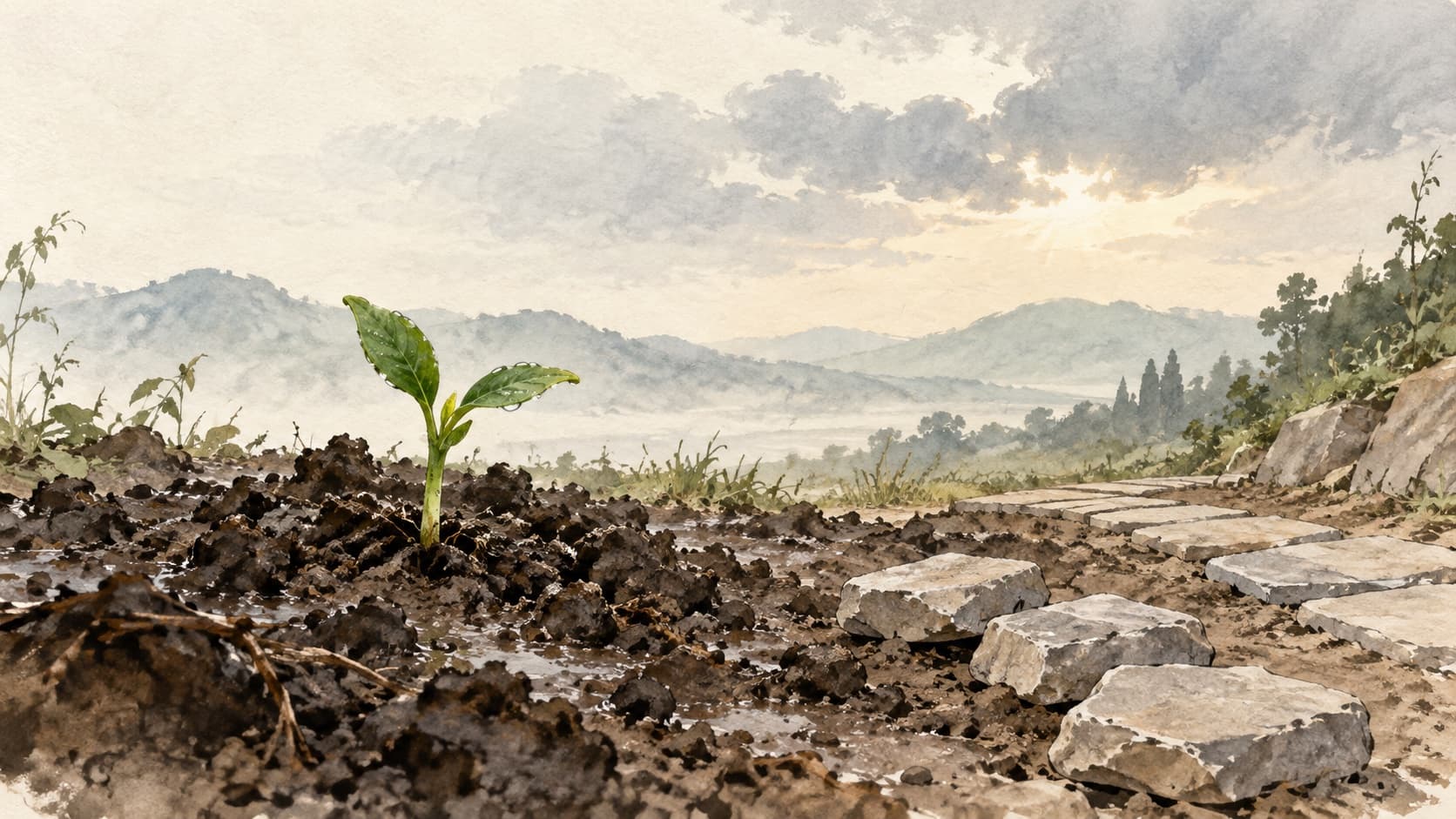
A contemporary example might be a group with enthusiasm but no agreed handoff, meeting time, or responsibility. Naming those missing connections can be more useful than asking whether the beginning is fortunate in the abstract. The lower Thunder and upper Water distinguish Zhun's figure. The seedling illustration offers another modern metaphor for emergence; it is not in itself a classical explanation or evidence that something will grow.
Six line settings: read the particular position
The following are original modern English orientation notes on the six statements in the linked Chinese transcription. They are not a certified translation or six future events in sequence:
- Line 1: depicts hesitation or circling, with constancy and establishing support. Its pause belongs to an unsettled beginning.
- Line 2: depicts difficulty, returning horses, and a marriage scene with a long interval. Do not turn its ten years into a personal dating timetable.
- Line 3: follows deer without a guide into the forest and favors giving up the chase. Lack of guidance matters more than persistence alone.
- Line 4: again depicts returning horses, but seeking a marriage connection accompanies favorable movement. A similar image can have a different context.
- Line 5: describes constrained benefits, contrasting small constancy with a larger unfavorable course. Scale matters within this scene.
- Line 6: depicts repeated returning and tears of blood. This is distressing ancient imagery, not a prediction or a demand to prolong suffering.
For a cast with a changing line, use the changing-lines guide and read that precise position in context.
A fictional example: a new project without a handoff
Imagine Noor, a fictional resident, starts a neighborhood seed exchange. People bring seeds enthusiastically, but nobody records which packets have growing information or who should replenish the table. Noor assumes the messy first week means the idea cannot work.
A modern reflection on hexagram 3 suggests examining the beginning's missing arrangement. Noor chooses one small table, agrees on a weekly check with another resident, and provides a simple way to attach growing notes. The group tests that limited setup before adding more locations.
This is a fictional practical illustration, not a measured success story. It connects the problem with organizing unsettled elements, while leaving open the possibility that the test shows insufficient interest. A clearer beginning makes assessment possible; it does not ensure the project deserves expansion. The changed question is what support is missing, rather than whether difficulty alone is a verdict.
Questions for a practical modern reflection
These prompts are modern editorial reflection, separate from the quoted classical text and its historical commentary:
- What is promising but still unorganized?
- Which next action is premature?
- Who can provide relevant guidance rather than general encouragement?
- What small arrangement would let us test the idea?
- What evidence would tell us to stop or change direction?
Choose one small action you can assess with ordinary evidence. Record what happened without treating a favorable symbol as proof that the action will work. If your observation contradicts your first interpretation, preserve the observation rather than forcing it into the text.
Use this chapter without changing the cast
Start with the question as it was actually asked. Identify the recorded primary hexagram, then any actual changing positions and relating figure. This explanatory article does not cast, choose a line, or infer a new figure. Keep the original cast separate from the interpretation you are exploring.
Read the Judgment for its broad setting, the relevant line for its particular context, and the Image as a distinct commentary layer. The reading guide provides a learning path. The English notes and fictional example here are original editorial material based on a public digital transcription. They do not certify an ancient edition or use unreviewed Gao Heng annotations.
Key takeaways
- Difficulty at the Beginning is not a verdict of failure.
- The Judgment combines possibility with caution and support.
- The unguided chase shows a limit to persistence.
Conclusion
Hexagram 3 holds emergence, difficulty, and first organization together. The Judgment cautions against premature advance; the Image emphasizes ordering; the lines show that pauses and connections have distinct settings. A modern application can make a small beginning workable while preserving the freedom to assess whether it should continue.
Does hexagram 3 mean my new project will fail?
No. It supplies a symbolic setting, not outcome evidence. Examine organization, support, and the task's actual conditions.
Should I keep trying until the beginning succeeds?
Not automatically. Line 3 includes giving up an unguided chase. A clear test can reveal whether to continue, change, or stop.
Why do similar horse images appear in different lines?
A repeated image does not erase the line's context. Lines 2, 4, and 6 combine it with different actions and judgments, so read the relevant passage closely.
Sources
Reflect on one question
Frame a focused question before starting a new reading.
Explore YiInsight →