 YiInsight
YIINSIGHT / Canonical hexagram
Hexagram 28 Meaning: Da Guo, Great Exceeding, and an Unequal Load
Explore hexagram 28, Da Guo, through its bending-beam Judgment, Lake over Wind, six line images, and a modern reflection on load and support.
Hexagram 28: 大過 · dà guò
Wind below Lake. Lines are numbered from the bottom upward.
The short answer
Hexagram 28, Da Guo, is Great Exceeding. The Judgment depicts a bending beam and favorable movement, while the lines distinguish fragile support, renewed growth, a raised beam, and dangerous overreach. A modern reflection asks whether a load has outgrown its support. It does not prove that collapse is imminent or praise unlimited self-sacrifice.
Overview
Sometimes the problem is not too little effort but a structure carrying more than it can reasonably support. Hexagram 28 offers imagery for that disproportion. Its text includes both an opening for action and severe cautions. Read the particular setting rather than applying the title as a label for every stressful day.
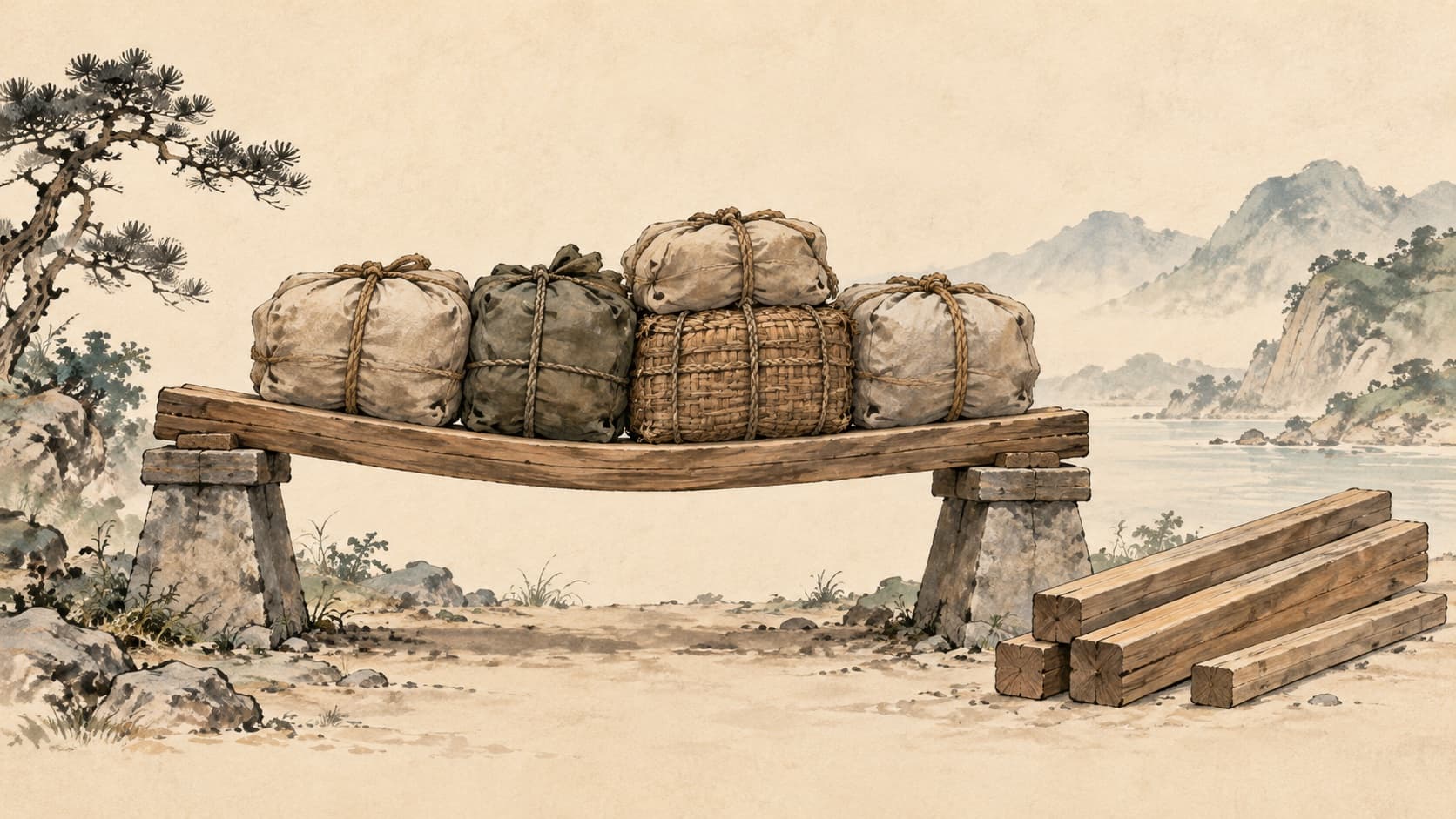
The bending beam calls attention to proportion
The fixed Chinese digital transcription distinguishes the Judgment, Commentary on the Judgment, Great Image, and line statements.
The Judgment begins with the image “棟橈,” a bending beam, then includes favorable movement and progress. An original English paraphrase is that an exceptional load asks for an appropriate response rather than ordinary repetition. The text does not identify the reader's load or establish the physical state of a real building.
The Commentary on the Judgment explains the figure through weak beginnings and endings around a strong middle. This is a textual explanation of the hexagram's structure, not an engineering calculation. A modern application might concern too many responsibilities held by one person or a project whose requirements have outgrown its arrangements. The useful question is what supports the load. Simply trying harder may leave the underlying imbalance intact, but the right practical response must be assessed from actual circumstances.
Lake over Wind: standing apart without panic
In the canonical structural registry, hexagram 28 is 28-da-guo, with Wind below and Lake above. Count positions from bottom to top; 1 means a solid line and 0 a broken line. Its stored pattern is 011110. That identifies the figure, not a personal outcome.
The Great Image describes the lake overwhelming wood. It then presents the exemplary person standing independently without fear and withdrawing from the world without distress. This belongs to the commentary layer and should remain distinct from the Judgment's beam image. It offers a stance under unusual conditions rather than a guarantee that every burden can be borne.
The modern editorial explanation here is to retain judgment when the usual arrangements are inadequate. Independence need not mean refusing assistance. Withdrawal need not mean abandoning every responsibility. Either can be considered as a way of changing one's relationship to an excessive demand. The beam illustration is conceptual; it provides no measurement or advice about the safety of an actual structure.
Six line settings: read the particular position
The following are original modern English orientation notes on the six statements in the linked Chinese transcription. They are not a certified translation or six future events in sequence:
- Line 1: places white thatch beneath an object and speaks of no blame. Care at the base appears before the heavier scenes.
- Line 2: depicts an old willow producing shoots and an old man with a young wife. These are ancient metaphors, not relationship guidance based on age.
- Line 3: repeats the bending beam with unfavorable language. Confidence alone does not erase the strain in this scene.
- Line 4: depicts a raised beam with favorable language and a further caution. Support and circumstance differ from line 3.
- Line 5: shows an old willow flowering rather than producing shoots, with neither blame nor praise. The difference between appearances and durable renewal matters to the scene.
- Line 6: describes crossing water beyond one's depth, with misfortune but no blame. Absence of blame does not make the danger harmless or desirable.
For a cast with a changing line, use the changing-lines guide and read that precise position in context.
A fictional example: one volunteer becomes the whole system
Imagine Ellis, a fictional organizer of a local repair event, answers every message, buys supplies, assigns tables, and handles cancellations. The event has grown, but its organization still assumes one person can remember everything. Ellis interprets fatigue as a need for greater determination.
A modern reflection on hexagram 28 changes the question from personal toughness to proportion. Ellis lists the tasks, shares the booking information, and asks two other volunteers to own distinct parts of the event. A smaller event is also considered if the support is still insufficient.
This is a fictional example rather than evidence of a successful intervention. The response addresses how work is supported instead of treating overextension as proof of virtue. The practical assessment is whether responsibilities, information, and backup are now matched to the actual load. A symbolic reading cannot determine that on its own.
Questions for a practical modern reflection
These prompts are modern editorial reflection, separate from the quoted classical text and its historical commentary:
- Which demand has grown beyond the arrangement supporting it?
- What part depends on one person or one fragile connection?
- Can the load be reduced before support is expanded?
- What is genuine renewal, and what only looks encouraging?
- Am I mistaking lack of blame for lack of danger?
Choose one small action you can assess with ordinary evidence. Record what happened without treating a favorable symbol as proof that the action will work. If your observation contradicts your first interpretation, preserve the observation rather than forcing it into the text.
Use this chapter without changing the cast
Start with the question as it was actually asked. Identify the recorded primary hexagram, then any actual changing positions and relating figure. This explanatory article does not cast, choose a line, or infer a new figure. Keep the original cast separate from the interpretation you are exploring.
Read the Judgment for its broad setting, the relevant line for its particular context, and the Image as a distinct commentary layer. The reading guide provides a learning path. The English notes and fictional example here are original editorial material based on a public digital transcription. They do not certify an ancient edition or use unreviewed Gao Heng annotations.
Key takeaways
- Great Exceeding centers an exceptional relation between load and support.
- The raised and bending beams occur in different line settings.
- No blame in the final line does not remove its danger.
Conclusion
Hexagram 28 can help name disproportion without romanticizing it. Keep the bending beam, the Great Image, and the contrasting line scenes distinct. A contemporary reflection can consider redesign, assistance, or reducing the load. Favorable movement in the text is not a promise that unsupported effort will succeed.
Does hexagram 28 mean everything is about to collapse?
No. The symbolic beam image is not evidence of an imminent event. Identify the real strain and assess it using ordinary information.
Should I take on more because this is an exceptional time?
The text includes serious overreach. A modern application can consider changing support or reducing a demand rather than automatically accepting more.
Can I use the beam illustration to assess a building?
No. It is a conceptual editorial image. Real structural conditions require appropriate inspection and expertise, not symbolic interpretation.
Sources
Reflect on one question
Frame a focused question before starting a new reading.
Explore YiInsight →