 YiInsight
YIINSIGHT / Canonical hexagram
Hexagram 26 Meaning: Da Chu, Great Taming, and Prepared Capacity
Explore hexagram 26, Da Chu, through its Judgment, Mountain over Heaven, six line settings, and a practical example of preparing before advancing.
Hexagram 26: 大畜 · dà chù
Heaven below Mountain. Lines are numbered from the bottom upward.
The short answer
Hexagram 26, Da Chu, is Great Taming: strength held, cultivated, and prepared for use. Its Judgment values constancy and speaks of crossing a great river. The Image connects learning from earlier words and deeds with developing character. A modern reading can distinguish useful preparation from indefinite delay; neither advance nor success is guaranteed.
Overview
Having energy is different from being ready to use it. Hexagram 26 explores that distinction through images of restraint, training, and accumulated capacity. Its favorable language appears beside warnings to stop or practice. Read those tensions together rather than turning the title into a promise of unstoppable power.
The Judgment holds strength to a purpose
The fixed Chinese digital transcription distinguishes the Judgment, Commentary on the Judgment, Great Image, and line statements.
The classical Judgment includes “利貞” and “利涉大川”: favorable constancy and the image of crossing a great river. It also contains the phrase about not eating at home. These short expressions belong to the ancient text, whose social setting differs from a modern reader's situation. An original English paraphrase is: cultivate a steady purpose, allow capacity to serve beyond private comfort, and prepare for a substantial undertaking.
This paraphrase does not resolve every translation question in the passage. In particular, the household phrase should not be converted into a literal instruction to move out, change employers, or spend money. The Commentary on the Judgment discusses restraining strength and nourishing worthy people; that is a separate interpretive layer. A contemporary application can ask what preparation an undertaking needs, while ordinary evidence determines whether it is actually feasible.
Mountain over Heaven: learning that changes conduct
In the canonical structural registry, hexagram 26 is 26-da-chu, with Heaven below and Mountain above. Count positions from bottom to top; 1 means a solid line and 0 a broken line. Its stored pattern is 111001. That identifies the figure, not a personal outcome.
The Great Image names Heaven within the Mountain and says the exemplary person learns earlier sayings and past actions to accumulate virtue. This commentary is distinct from the Judgment. Its emphasis is not merely collecting information: the remembered material is connected with how a person conducts themselves.
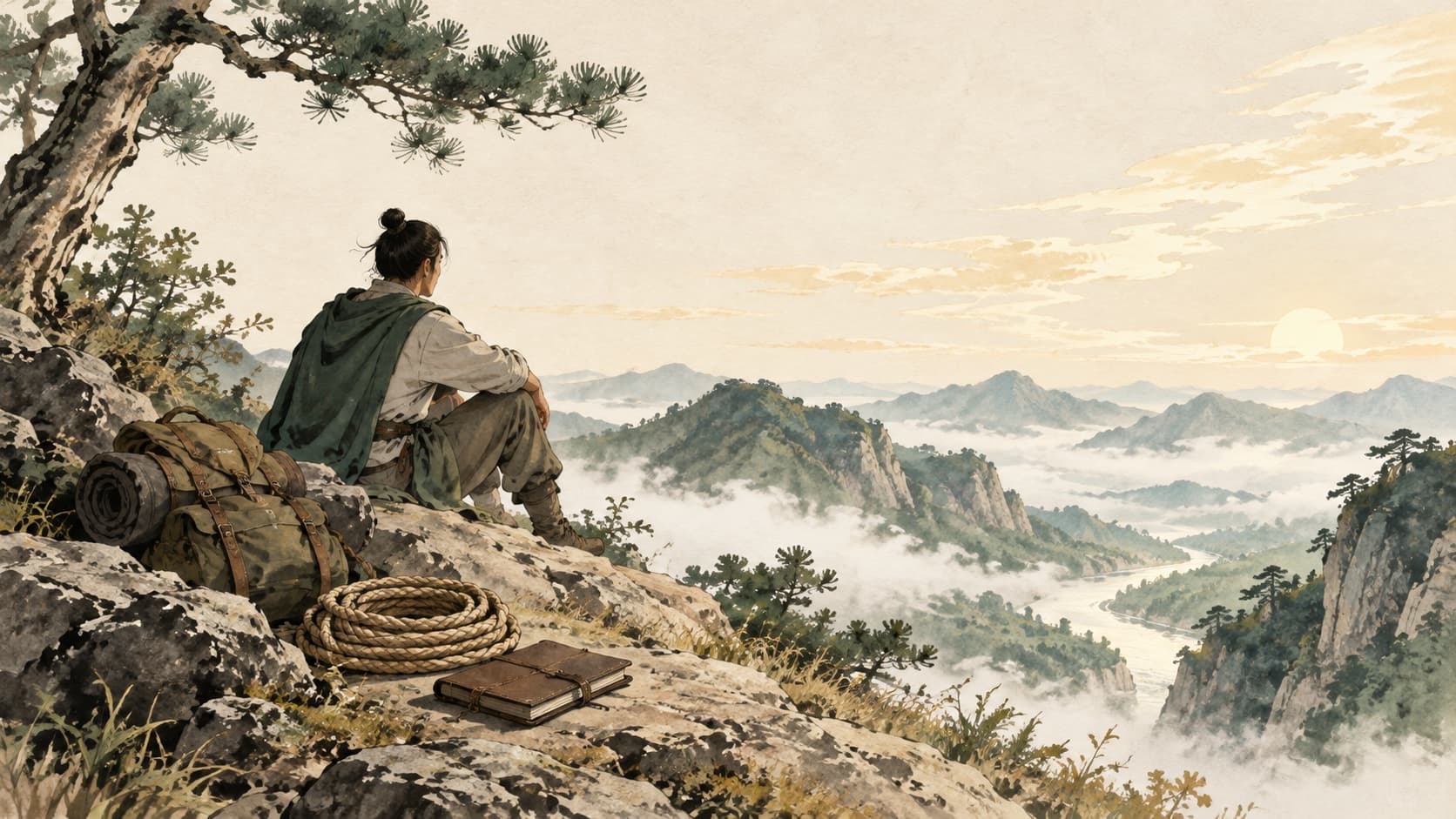
A modern reflection might compare reading a manual with practicing the skill it describes. Knowing a method is useful, but the question is whether it changes a repeated habit. The Mountain and Heaven pairing can orient that reflection without being a scientific account of how mountains or weather work. The article's illustration of a paused traveler is another modern aid, not a classical quotation.
Six line settings: read the particular position
The following are original modern English orientation notes on the six statements in the linked Chinese transcription. They are not a certified translation or six future events in sequence:
- Line 1: names danger and the advantage of stopping. A pause can belong to the text's strength rather than contradict it.
- Line 2: depicts a carriage with a component disengaged. The digital transcription records a textual variant; this overview does not decide between editions.
- Line 3: introduces good horses, difficult constancy, and daily training in vehicle and defense skills. Preparation and forward movement appear together.
- Line 4: uses the image of a young ox with a restraint at its horns. Read it as ancient imagery, not an animal-handling instruction.
- Line 5: depicts a castrated boar's tusk, with favorable language. The striking image is not a recommendation to control another person.
- Line 6: opens onto a heavenly thoroughfare and speaks of progress. Its broad scope differs from the earlier stopping and restraint.
For a cast with a changing line, use the changing-lines guide and read that precise position in context.
A fictional example: ready to teach, still needing practice
Imagine Mara, a fictional volunteer, is asked to lead a weekend navigation workshop. She knows the theory and wants to announce a difficult route immediately. A rehearsal reveals that her directions depend on landmarks a newcomer would not recognize.
A modern reflection on hexagram 26 helps her separate enthusiasm from prepared capacity. She practices one short route with a colleague, rewrites ambiguous directions, and sets a clear point for deciding whether the longer route is appropriate. The pause has a task and an end condition; it is not simply waiting to feel completely confident.
Nothing in this example proves that a hexagram improves teaching or guarantees safety. The practical value, if any, can be assessed by how understandable the directions become. The contrast is between storing knowledge privately and developing a skill that others can use.
Questions for a practical modern reflection
These prompts are modern editorial reflection, separate from the quoted classical text and its historical commentary:
- What specific skill is the undertaking asking of me?
- What would a small rehearsal reveal?
- Which restraint protects the purpose, and which merely postpones it?
- Whose earlier experience could change my approach?
- What observable condition would make me ready to advance?
Choose one small action you can assess with ordinary evidence. Record what happened without treating a favorable symbol as proof that the action will work. If your observation contradicts your first interpretation, preserve the observation rather than forcing it into the text.
Use this chapter without changing the cast
Start with the question as it was actually asked. Identify the recorded primary hexagram, then any actual changing positions and relating figure. This explanatory article does not cast, choose a line, or infer a new figure. Keep the original cast separate from the interpretation you are exploring.
Read the Judgment for its broad setting, the relevant line for its particular context, and the Image as a distinct commentary layer. The reading guide provides a learning path. The English notes and fictional example here are original editorial material based on a public digital transcription. They do not certify an ancient edition or use unreviewed Gao Heng annotations.
Key takeaways
- Great Taming includes cultivated capacity as well as restraint.
- The Image connects earlier words and deeds with conduct.
- The six lines do not all advise the same degree of movement.
Conclusion
Hexagram 26 brings restraint and capacity into the same conversation. The Judgment points toward a substantial undertaking; the Image emphasizes learning and character; the lines distinguish stopping, training, prevention, and wider movement. Use a modern application to define preparation, then assess readiness through the real conditions of your task.
Does hexagram 26 mean I should always wait?
No. Its lines include stopping, training, and eventual movement. Ask what preparation is missing rather than assuming every delay is beneficial.
Does crossing the great river mean I should travel?
The classical phrase can be explored as an image of a demanding undertaking. This article does not establish a literal travel instruction for your situation.
How is Great Taming different from having great possessions?
Hexagram 26 centers restraint and cultivation of strength. Hexagram 14 is a separate canonical entity concerning Great Possession; the two titles should not be treated as interchangeable.
Sources
Reflect on one question
Frame a focused question before starting a new reading.
Explore YiInsight →