 YiInsight
YIINSIGHT / Canonical hexagram
Hexagram 23: Splitting Apart and Protecting the Foundation
Explore Hexagram 23, Bo, through the eroding bed image, mountain over earth, six line settings, and practical reflection on foundations.
Hexagram 23: 剝 · bō
Earth below Mountain. Lines are numbered from the bottom upward.
The short answer
Hexagram 23, Bo or Splitting Apart, presents erosion of support rather than an invitation to push ahead blindly. Its bed imagery brings deterioration progressively closer, while the Great Image emphasizes strengthening what is below. It does not prove that a relationship, career, or physical structure is about to collapse.
Overview
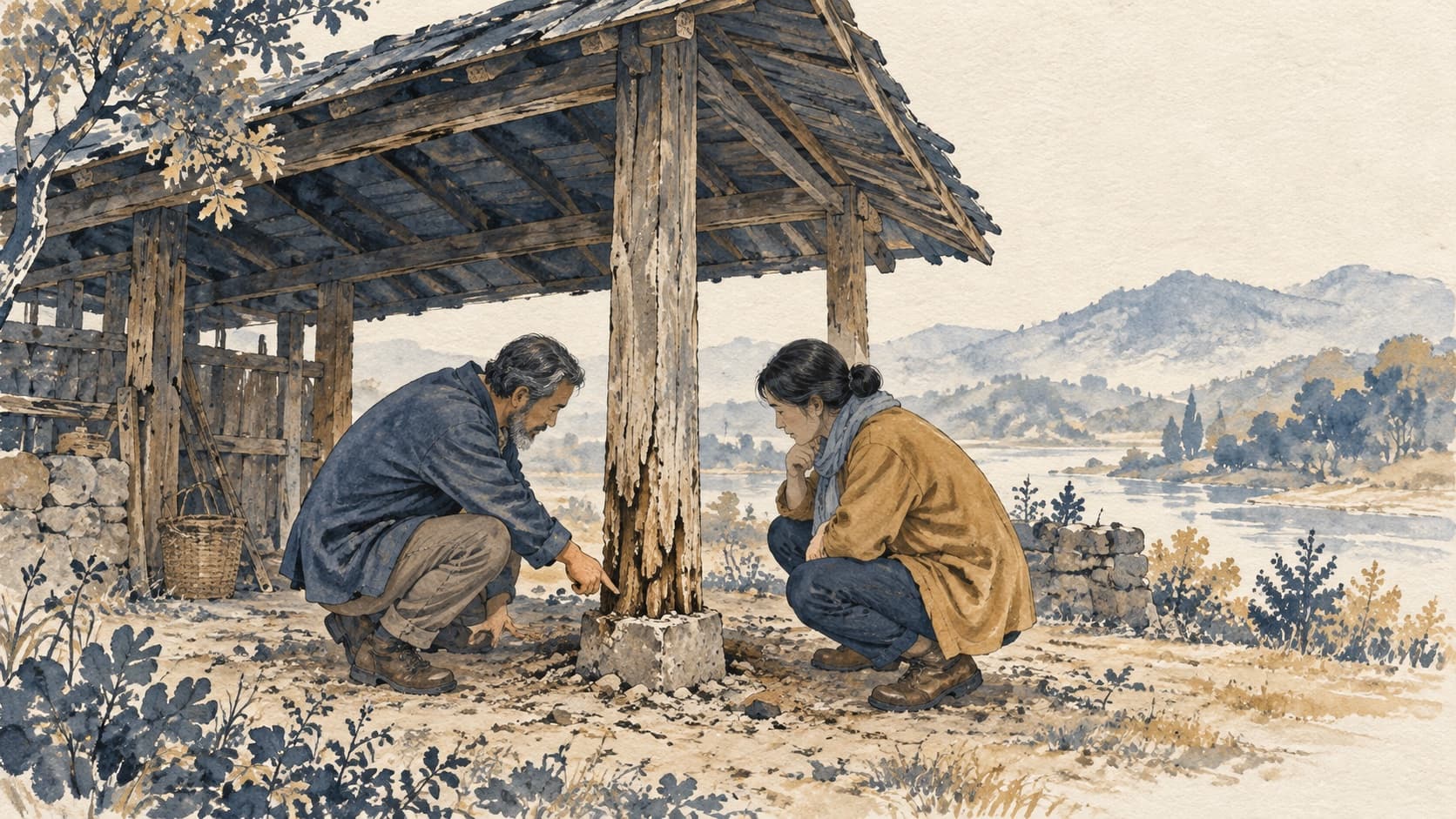
When something is wearing out, adding more above it may increase the burden. Bo directs attention toward the support that makes an undertaking possible. Its images are strong, but interpreting them as a fixed disaster forecast misses the distinction between symbolic language and evidence about your particular circumstances.
The Judgment: inspect a consequential punctuation choice
The fixed Chinese digital transcription distinguishes the Judgment, Commentary on the Judgment, Great Image, and line statements.
The displayed digital Judgment separates its wording with punctuation, while the Commentary presents the phrase about going somewhere together and explains a setting of erosion. That difference matters: this article does not pretend the web transcription is an edition-critical resolution of the ancient text.
The broad reading offered here follows the chapter's recurring loss-of-support imagery and the Commentary's caution about advancing. A modern parallel is checking whether an undertaking still has the people, materials, and agreements it depends on. This does not establish which part is failing; that requires inspection rather than interpretation alone.
Mountain on earth: strengthen what bears the load
In the pinned Chinese chapter, hexagram 23 is 23-bo, with Earth below and Mountain above. Count positions from bottom to top; 1 means a solid line and 0 a broken line. Its stored pattern is 000001. That identifies the figure, not a personal outcome.
The Great Image places the mountain upon the earth and associates stability with making the lower support substantial. In modern reflection, the impressive visible result depends on less visible foundations. A team may need maintained documentation or realistic staffing more urgently than another announcement. The lesson is not to romanticize deprivation, but to identify what keeps people and work supported.
Six line settings: read the particular position
The following are original modern English orientation notes on the six statements in the linked Chinese transcription. They are not a certified translation or six future events in sequence:
- Line 1: The bed is stripped at its feet. The initial image locates deterioration in a supporting part rather than in the visible upper surface.
- Line 2: The stripping moves to another part of the bed frame. The repetition increases proximity; do not flatten the two positions into the same sentence.
- Line 3: A shorter statement about stripping carries no blame. Its distinct judgment prevents a blanket assumption that every position predicts the same harm.
- Line 4: The bed image reaches the skin and has an unfavorable judgment. It is intense symbolic wording, not a diagnosis or proof of immediate personal danger.
- Line 5: Strung fish and favor through palace women form a historical court image. Do not turn this into a prescription for modern gender roles or relationship manipulation.
- Line 6: An uneaten large fruit remains, followed by contrasting outcomes for the noble and lesser person. The transcription marks a vehicle wording variant; avoid claiming a single certified translation.
For a cast with a changing line, use the changing-lines guide and read that precise position in context.
A fictional example: pausing an unsupported expansion
Imagine a community workshop preparing a second weekly class. The tools have become unreliable, and only one volunteer knows the booking process. Rather than interpreting every inconvenience as a sign of doom, the organizer makes a list of the supports the additional class would need.
She repairs the essential equipment, documents bookings, and asks volunteers about realistic availability before announcing expansion. This fictional example illustrates attention to foundations. It does not show that retreat is always correct: after these checks, the additional class might be feasible. The decision depends on what the checks reveal, not on forcing the project to enact the hexagram's imagery.
Questions for a practical modern reflection
These prompts are modern editorial reflection, separate from the quoted classical text and its historical commentary:
- Which essential support is being taken for granted?
- What can be protected without pretending the problem is solved?
- What evidence would justify resuming expansion?
Choose one small action you can assess with ordinary evidence. Record what happened without treating a favorable symbol as proof that the action will work. If your observation contradicts your first interpretation, preserve the observation rather than forcing it into the text.
Use this chapter without changing the cast
Start with the question as it was actually asked. Identify the recorded primary hexagram, then any actual changing positions and relating figure. This explanatory article does not cast, choose a line, or infer a new figure. Keep the original cast separate from the interpretation you are exploring.
Read the Judgment for its broad setting, the relevant line for its particular context, and the Image as a distinct commentary layer. The reading guide provides a learning path. The English notes and fictional example here are original editorial material based on a public digital transcription. They do not certify an ancient edition or use unreviewed Gao Heng annotations.
Key takeaways
- Inspect foundations before expanding a strained undertaking.
- The line judgments are not uniformly unfavorable.
- A digital transcription is not a certified critical edition.
Conclusion
Bo is a prompt to notice erosion and preserve support. Read each position separately, acknowledge textual uncertainty, and use practical evidence to decide what needs repair or restraint.
Does Hexagram 23 mean everything will fall apart?
No. It supplies a symbolic setting of erosion. Whether a particular undertaking is failing depends on real evidence, not the figure alone.
Should I immediately end a relationship?
The hexagram cannot make that decision. Consider the actual behavior, your needs, and available support; do not infer another person's intentions from symbolic imagery.
Why mention a textual variant?
The linked transcription displays alternatives. Acknowledging them prevents these introductory notes from appearing more certain than their source supports.
Sources
Reflect on one question
Frame a focused question before starting a new reading.
Explore YiInsight →