 YiInsight
YIINSIGHT / Canonical hexagram
Hexagram 20: Contemplation Before Choosing a Direction
Read Hexagram 20, Guan, through its Judgment, wind-over-earth Image, six line settings, and a practical example of observation before action.
Hexagram 20: 觀 · guān
Earth below Wind. Lines are numbered from the bottom upward.
The short answer
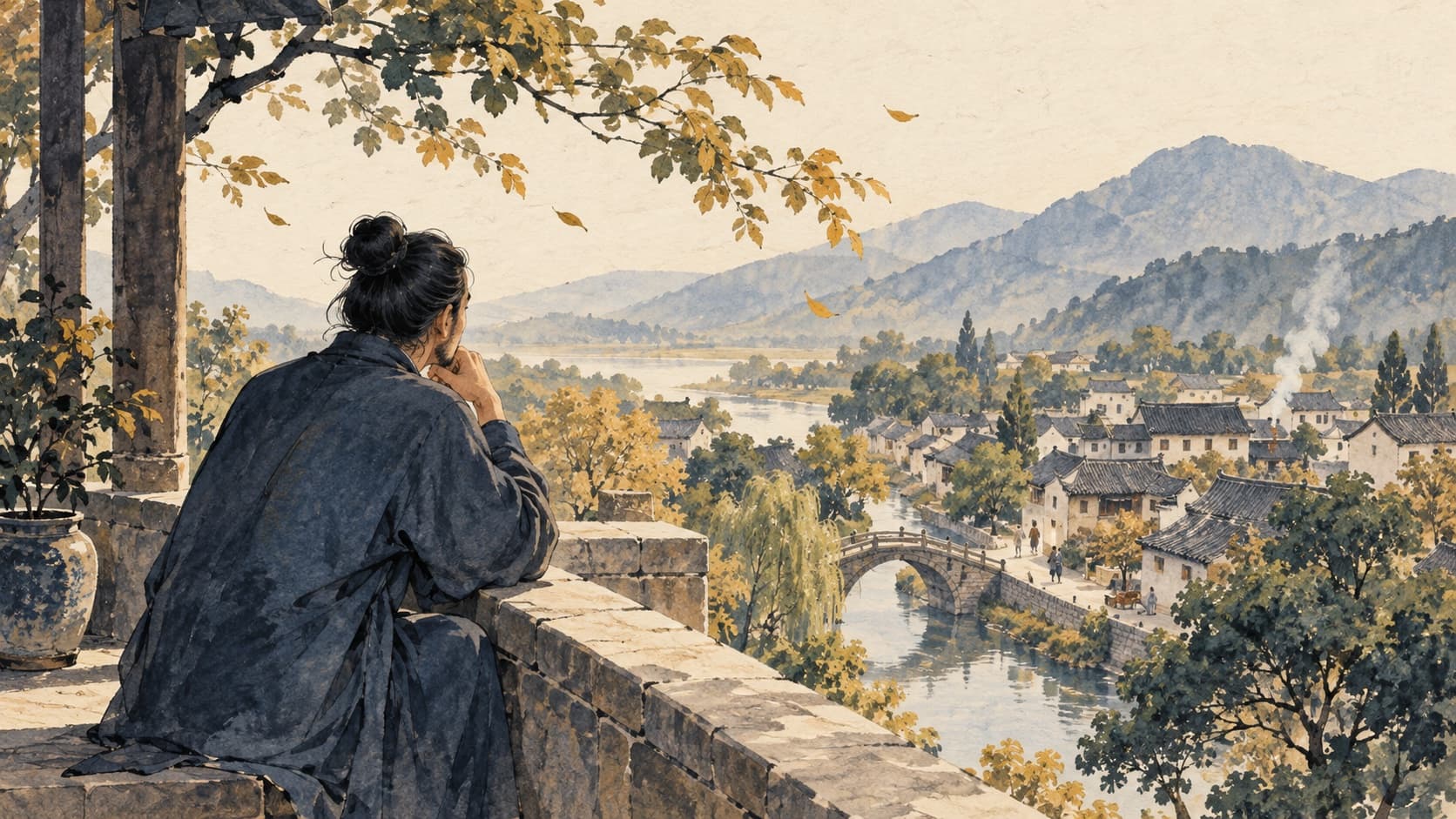
Hexagram 20, Guan or Contemplation, puts observation and the quality of attention at the center of a reading. Its text moves from narrow seeing toward examination of a life and its wider effects. It does not predict what another person thinks or require you to remain passive indefinitely.
Overview
A pause can reveal information, but it can also become an excuse to avoid a decision. Guan offers a useful distinction: looking carefully means noticing your own position, what remains outside your view, and what your conduct shows to others. Read the actual line before turning this broad theme into a personal instruction.
The Judgment: attention before the offering
The fixed Chinese digital transcription distinguishes the Judgment, Commentary on the Judgment, Great Image, and line statements.
The Judgment presents ritual washing before the offering, with sincerity and a solemn bearing. This is a specific ceremonial image, not a generic command to wait. The Commentary expands the setting toward exemplary observation and influence.
A modern reader can distinguish preparation from performance: have you actually looked at the situation, or merely rehearsed how you will appear? That is an editorial question, not a translation of every ritual term. The chapter cannot establish whether a colleague is trustworthy or whether a relationship will continue. Those questions still require conversation and observable behavior.
Wind over earth: broaden the field of view
In the pinned Chinese chapter, hexagram 20 is 20-guan, with Earth below and Wind above. Count positions from bottom to top; 1 means a solid line and 0 a broken line. Its stored pattern is 000011. That identifies the figure, not a personal outcome.
The Great Image describes wind moving over the earth and ancient rulers inspecting regions, observing people, and establishing instruction. Its attention is outward as well as inward. A modern parallel is listening across different parts of an organization before deciding what everyone needs. Do not confuse your elevated viewpoint with complete information: a broad overview can still omit the person closest to a problem.
Six line settings: read the particular position
The following are original modern English orientation notes on the six statements in the linked Chinese transcription. They are not a certified translation or six future events in sequence:
- Line 1: Childlike observation marks a limited perspective. The statement judges this differently for different roles; responsibility changes what adequate attention requires.
- Line 2: Peeping observation offers a partial view in historically gendered language. Treat that social framing as historical, not a modern rule about women's capacities.
- Line 3: Looking at one's own life is connected with advancing or retreating. Examine your actual conduct before treating movement as inherently better than returning.
- Line 4: Observing the brightness of a country accompanies being a guest of the king. This setting concerns encountering a larger public order, not guaranteed promotion.
- Line 5: Observing one's own life returns at a position of responsibility. The Image commentary connects that self-examination with observing the people affected by it.
- Line 6: Observing that life shifts the wording again. Keep this distinct from the earlier self-focused lines; it does not provide access to another person's private thoughts.
For a cast with a changing line, use the changing-lines guide and read that precise position in context.
A fictional example: listening before redesigning a service
Imagine a library coordinator whose opening-hour survey has received mostly online responses. She initially concludes that everyone wants later evenings. In a fictional reflection using Guan, she asks whose situation is missing from the survey. She talks with visitors who use paper notices, records staffing constraints, and checks attendance by hour.
Her next step is a small trial, with a date for reviewing the results. This is contemplation with a boundary and an observable consequence. The hexagram does not prove which timetable is right. If the trial contradicts her expectations, the attendance record remains evidence; the symbolic reading is not used to dismiss it.
Questions for a practical modern reflection
These prompts are modern editorial reflection, separate from the quoted classical text and its historical commentary:
- Which people or facts are outside my current view?
- What does my own behavior reveal about my stated aim?
- What observation would change my next decision?
Choose one small action you can assess with ordinary evidence. Record what happened without treating a favorable symbol as proof that the action will work. If your observation contradicts your first interpretation, preserve the observation rather than forcing it into the text.
Use this chapter without changing the cast
Start with the question as it was actually asked. Identify the recorded primary hexagram, then any actual changing positions and relating figure. This explanatory article does not cast, choose a line, or infer a new figure. Keep the original cast separate from the interpretation you are exploring.
Read the Judgment for its broad setting, the relevant line for its particular context, and the Image as a distinct commentary layer. The reading guide provides a learning path. The English notes and fictional example here are original editorial material based on a public digital transcription. They do not certify an ancient edition or use unreviewed Gao Heng annotations.
Key takeaways
- Observation includes your own conduct and its effects.
- A narrow view is not a complete account.
- The changing position determines which line setting matters.
Conclusion
Guan invites a more responsible view of a situation. Widen the evidence, examine your own part, and choose a bounded next step rather than converting observation into endless delay.
Does Hexagram 20 mean I should do nothing?
No. Its observation can inform action. Decide what you need to learn and when you will reassess, instead of treating contemplation as an indefinite prohibition.
Does it reveal another person's feelings?
No. The chapter supplies symbolic language, not evidence of a person's private thoughts. Use direct communication and observable conduct.
Should I read all six lines as a timeline?
No. The notes describe different positions. Keep the changing positions from your actual cast separate from the other lines.
Sources
Reflect on one question
Frame a focused question before starting a new reading.
Explore YiInsight →