 YiInsight
YIINSIGHT / Canonical hexagram
Hexagram 15: Modesty, Proportion, and Useful Work
Understand hexagram 15: Modesty expressed through proportion. Read the Judgment, six line settings, structural image, and a clearly labeled modern example.
Hexagram 15: 謙 · qiān
Mountain below Earth. Lines are numbered from the bottom upward.
The short answer
Hexagram 15, Qian, concerns modesty and a capable person bringing an undertaking to completion. The mountain-within-earth image supports proportion and balanced distribution. Its lines combine humility with effort and responsibility, so modesty need not mean denying ability or avoiding necessary action.
Overview
Hexagram 15 becomes easier to read when its different textual layers remain visible. Start with the broad situation described by the Judgment. Then identify the particular position named in your recorded cast. The Image commentary offers another perspective, and a modern example can help you test an interpretation against ordinary experience. This guide uses that sequence to explore modesty expressed through proportion. Read the chapter as a set of distinctions: what is happening, where you stand, which action fits that position, and what observable result would make you revise your interpretation.
The Judgment: Modesty expressed through proportion
The fixed Chinese digital transcription distinguishes the Judgment, Commentary on the Judgment, Great Image, and line statements.
The Judgment links modesty with passage and with bringing matters to an end. The Commentary describes the reduction of what is excessive and the support of what is low or lacking. This frames modesty as a relation of proportion, not simply a quiet style of speech.
A person may acknowledge a useful skill without claiming superiority in every setting. Likewise, recognizing another person's contribution does not require erasing one's own. A practical reading asks whether resources, credit, attention, and responsibility are distributed in a way that fits the work.
The later lines include military imagery. That complicates any simplistic reading of modesty as universal passivity. It does not provide modern permission for aggression. Keep those historical images in their textual setting and distinguish firmness about a task from domination of a person. Completion and proportion remain better questions than whether one has appeared sufficiently self-effacing.
Read the structural image in context
In the pinned Chinese chapter, hexagram 15 is 15-qian, with Mountain below and Earth above. Count positions from bottom to top; 1 means a solid line and 0 a broken line. Its stored pattern is 001000. That identifies the figure, not a personal outcome.
Mountain below earth gives the Great Image a basis for taking from what is too much and adding to what is too little, weighing things for an even distribution. This does not require making every contribution identical. It calls for judgment about what is appropriate to each circumstance.
In a group task, one person may need more instruction while another can work independently. A proportionate response notices that difference. Modesty then appears as the willingness to let the task determine the arrangement instead of letting status determine it.
Six line settings: read the particular position
The following are original modern English orientation notes on the six statements in the linked Chinese transcription. They are not a certified translation or six future events in sequence:
- Line 1: The first line intensifies modesty and connects it with crossing a great river. Humility can accompany a demanding undertaking.
- Line 2: The second line describes modesty that becomes audible or recognized. Sincere conduct can be noticed without a campaign for praise.
- Line 3: The third line combines labor and modesty with completion. Contribution matters alongside the manner in which it is presented.
- Line 4: The fourth line expresses modesty in action or gesture. Consider how the principle becomes visible in ordinary conduct.
- Line 5: The fifth line includes neighbors and a military image. Preserve its historical context; do not treat it as a command to attack a contemporary opponent.
- Line 6: The top line again makes modesty known and includes mobilization against a domain. Distinguish accountability and appropriate scope from an expansion of personal power.
For a cast with a changing line, use the changing-lines guide and read that precise position in context.
A fictional modern example
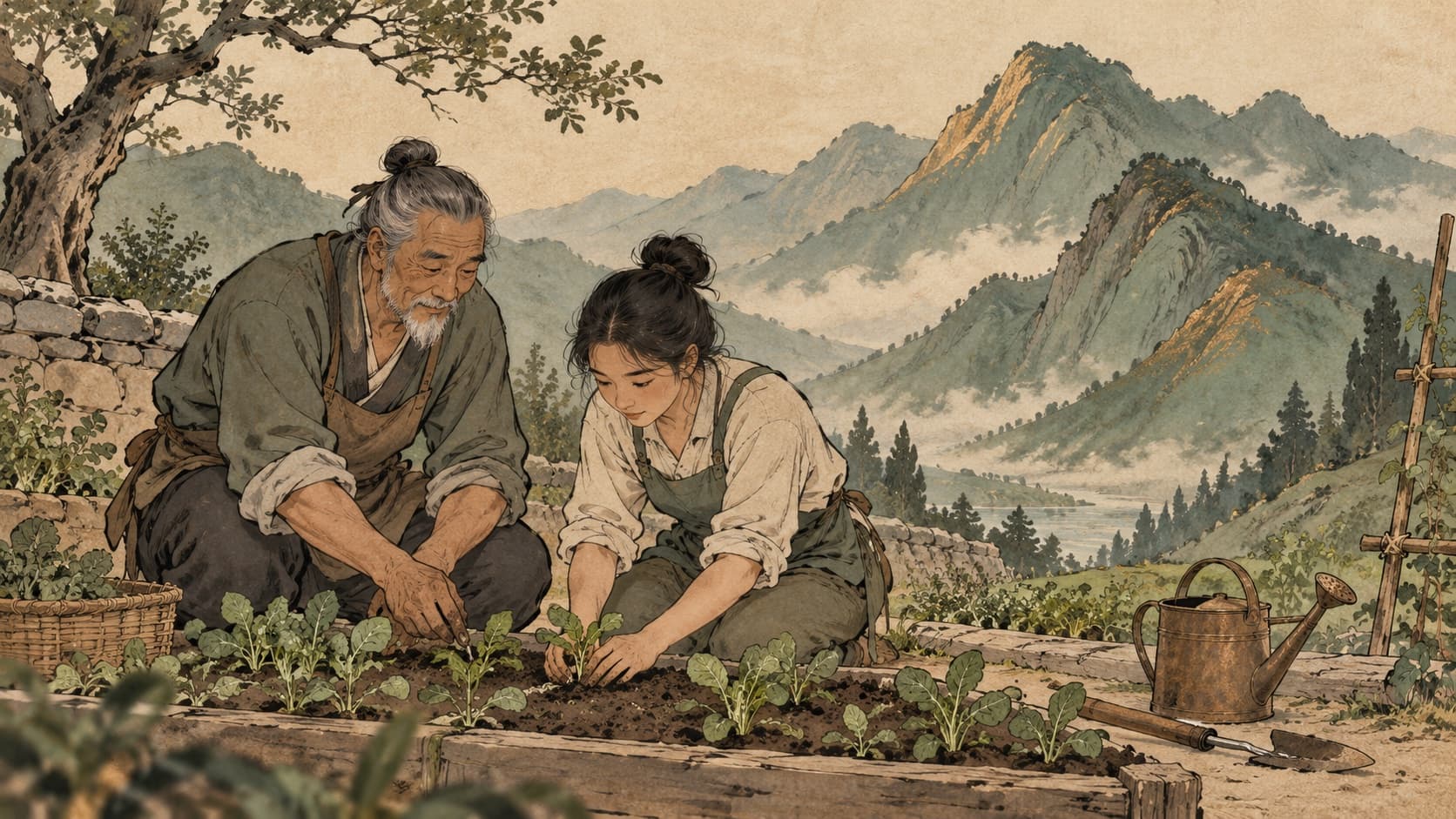
An experienced gardener joins a community planting day. Instead of taking every difficult task, she demonstrates one technique and lets newer volunteers try it. She gives more help where it is needed and credits the team for completing the beds.
When one bed is placed where it will receive too little light, she explains the problem plainly. Modesty does not require pretending that every arrangement is equally suitable. The team changes the position and records why.
This fictional example combines skill, restraint, and proportion. Its success would be assessed through the quality of the shared work and the volunteers' growing ability, not by counting compliments or assuming that self-effacement is always beneficial.
Questions for a practical modern reflection
These prompts are modern editorial reflection, separate from the quoted classical text and its historical commentary:
- Where is there excess, and where is support lacking?
- Which skill can you contribute without making the task about your status?
- What firm correction would serve the work while respecting the people?
Choose one small action you can assess with ordinary evidence. Record what happened without treating a favorable symbol as proof that the action will work. If your observation contradicts your first interpretation, preserve the observation rather than forcing it into the text.
Use this chapter without changing the cast
Start with the question as it was actually asked. Identify the recorded primary hexagram, then any actual changing positions and relating figure. This explanatory article does not cast, choose a line, or infer a new figure. Keep the original cast separate from the interpretation you are exploring.
Read the Judgment for its broad setting, the relevant line for its particular context, and the Image as a distinct commentary layer. The reading guide provides a learning path. The English notes and fictional example here are original editorial material based on a public digital transcription. They do not certify an ancient edition or use unreviewed Gao Heng annotations.
Key takeaways
- Modesty expressed through proportion is the chapter-level theme, not a guaranteed outcome.
- Read the actual changing position rather than combining all six into a prediction.
- Keep classical text, commentary, and the fictional modern example distinct.
Conclusion
Return to the actual question and the precise line, if any, before drawing a conclusion from hexagram 15. Its central concern here is modesty expressed through proportion. Choose a modest interpretation that you can explain in plain language, identify one observable next step, and keep a record of what happened. The text supplies a lens; the outcome still needs to be observed.
What does hexagram 15 mean?
Hexagram 15, Qian, concerns modesty and a capable person bringing an undertaking to completion. The mountain-within-earth image supports proportion and balanced distribution. Its lines combine humility with effort and responsibility, so modesty need not mean denying ability or avoiding necessary action.
Do all six lines of hexagram 15 apply to my reading?
The six positions show different settings. Begin with the line or lines actually recorded as changing in your cast. When none change, read the primary figure and the chosen method consistently; do not invent a changing line to obtain a preferred answer.
How should I use the modern example?
Use it to understand a distinction in the chapter. It is an invented teaching example, not a documented reading outcome or a prediction about your situation. Replace its details with facts you can actually observe.
Sources
Reflect on one question
Frame a focused question before starting a new reading.
Explore YiInsight →