 YiInsight
YIINSIGHT / Method and reflection
Three Treasures of Taoism in Tao Te Ching Chapter 67
Read chapter 67 with a source worksheet: record the Chinese wording, separate commentary, label your editorial gloss, and keep questions easy to revisit.
The short answer
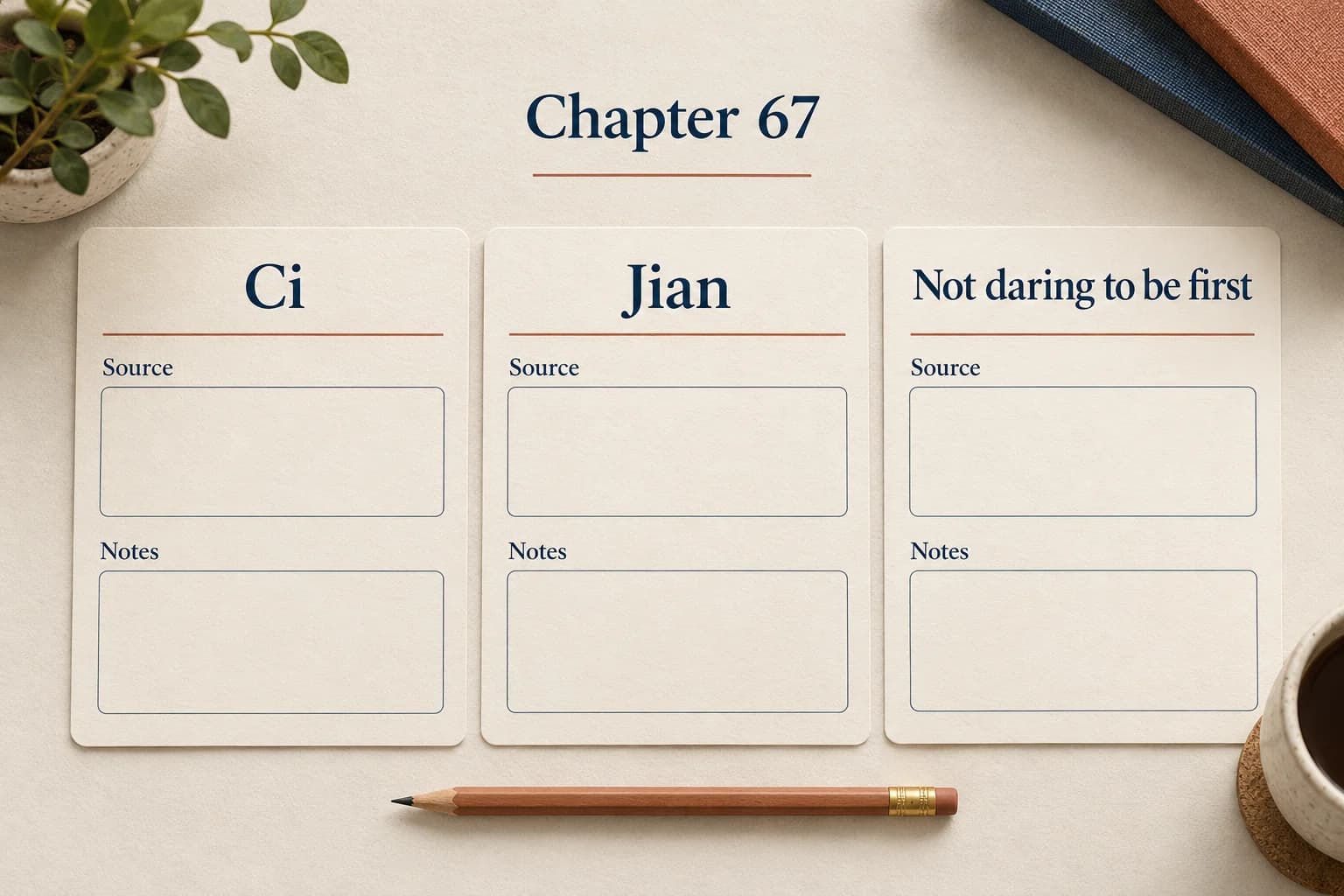
Here, “three treasures of Taoism” means only the list in this received Wang Bi chapter 67: 慈, 儉, 不敢為天下先. Tentative editorial glosses: compassion (ci), frugality (jian), and not daring to be first.
Overview
Start with a small reading task: find one passage, preserve its wording, and make your questions easy to retrace. This guide offers a worksheet for that task. Keep the original text visible while you work, then give each note a clear job. The result should be a compact record another reader can follow without guessing what you copied or supplied yourself.
Start with one received text
Keep this reading within chapter 67 of the linked received text. At the top of your notes, record its displayed title, the chapter number, and the URL with its chapter anchor. Add the date of your reading so a later check has a reference point. Give the file a descriptive name, such as Chapter 67 — list and notes.
If you need to settle which book you are opening, use Tao Te Ching and I Ching: book identity before starting. Return to the chapter afterward. A question about another work belongs on a separate note with its own locator; a familiar English phrase is not a substitute for that locator.
Locate the three entries
Find the base-text list: 一曰慈,二曰儉,三曰不敢為天下先. Give its entries separate rows numbered 1–3. Match the reading labels and tentative editorial glosses above to those rows. Keep the entire third entry together, and leave space beside each row for a question.
For brief context, locate 慈故能勇 and 儉故能廣. Tentative editorial gloss of the pairings: compassion–courage; frugality–breadth.
Draw two lines, each connecting an entry to its paired clause. Use those connections to form a question about word choice. Put a question mark beside any English choice you cannot yet explain. Keep the surrounding passage visible so you can check where each selected phrase begins and ends.
Separate the list from commentary
Here, the unbracketed list is base text; the angle-bracketed notes are Wang Bi commentary. For a short layer check, locate 〈且,猶取也。〉.
Copy that note into a Commentary field, retaining its brackets. Give it its own passage cue rather than attaching it to whichever English word feels closest. A matching word alone is not enough to place a note.
Next, inspect your draft line by line. If a sentence came from your own explanation, move it into an Editorial gloss field. If you cannot identify where a copied fragment begins or ends, return to the linked passage before completing the note. Use Sources and editorial method to organize these layers consistently.
Make a source-wording worksheet
| Field | What Rowan records |
|---|---|
| Locator | Page title, chapter anchor, and a short passage cue. |
| Base wording | An exact excerpt, with its punctuation preserved. |
| Commentary | A separately located bracketed excerpt, or Not copied. |
| Own question | A question in Rowan’s words, kept outside the excerpts. |
Imagine an invented reader, Rowan, preparing a worksheet with four fields. This fictional worksheet exercise practices source recording. The table below defines its four fields; the hero illustration separately organizes the chapter’s three named terms.
- Set the locator. Save the chapter link and add a cue such as three-item list. Reopen the link once. Confirm that the cue identifies the intended passage instead of relying on the page title alone.
- Record base wording. Copy the shortest passage needed for your question. Check its beginning, ending, and punctuation against the source. Put any tentative English wording below it under Editorial gloss. Never overwrite the copied line when revising that gloss.
- Record commentary separately. If you select a note, preserve its bracket boundaries and record its position beside the surrounding base text. If you have not copied one, enter Not copied. That records your work without suggesting the page contains no commentary.
- Write your own question. Rowan’s invented example is: What would make me revise my English word choice? Add a next action, such as comparing that choice against a separately identified source. Keep the question open until that material is available.
Finish by covering the gloss and checking your locator. Could someone else find the exact excerpt? Then cover the excerpt: can you still tell which notes are your own? Revise the labels wherever the answer is unclear.
What remains unresolved about other traditions
For a proposed comparison with another three-treasure tradition, create an Unresolved comparison entry. Record the proposed connection as a question, then list what you would need to examine: a separately identified work, a precise passage locator, its wording, and an identified interpretation or translation if you plan to use one.
Do not fill missing cells with remembered definitions. Leave them blank and state the next retrieval task. For example: Find the passage being compared and record how that source identifies its terms. Only after both records exist should you write a comparison sentence. Keep its scope as narrow as the passages support, and preserve any remaining uncertainty beside the sentence.
Key takeaways
- Preserve a chapter link and a passage cue that another reader can follow.
- Keep copied wording, commentary, and editorial glosses in distinct fields.
- Turn uncertain comparisons into specific source requests before drawing conclusions.
Conclusion
Save the four worksheet fields together. If a field remains unfinished, record the missing action beside it. When you revisit the note, revise the gloss separately and retain the excerpt you checked.
How should I name a saved note?
Use the chapter number, your passage cue, and a revision date. Keep that filename attached to the locator card so exported images or printed cards can be matched to the full record.
What if I change my mind about an English word?
Add a dated revision under Editorial gloss and state what prompted it. Preserve the earlier wording when it helps explain the change; leave the copied excerpt intact.
Can I share an unfinished worksheet?
Yes. Mark unfinished fields explicitly and include the source link. Ask your reader a specific checking question, such as whether the passage cue is precise enough.
Sources
Reflect on one question
Frame a focused question before starting a new reading.
Explore YiInsight →