 YiInsight
YIINSIGHT / Method and reflection
Minor Arcana Tarot Cards List: 56 Names in Waite’s Index
Find all 56 Minor Arcana names in the supplied Waite Part 3 transcription, organized by suit and rank, with a practical method for checking source headings.
The short answer
This minor arcana tarot cards list covers 56 named entries in the inspected Waite Part 3 transcription: Wands, Cups, Swords and Pentacles, with 14 ranks per suit. Locate an entry using both its rank and its suit.
Overview
A partial name can leave a lookup unfinished: “Queen” identifies a rank, while “Cups” identifies a suit. Use this guide to complete the name, locate the matching heading and keep a source record that another reader can follow.
Inspected source edition and index scope
This guide uses the supplied headings from Waite’s The Pictorial Key to the Tarot, Part 3, whose displayed header shows 1910/1922. Those dates are recorded as displayed; they do not independently authenticate a physical edition.
The index covers section 2’s named entry headings. We extract rank and suit labels without borrowing the paragraphs beneath them. Identify the part and suit block whenever you record a match.
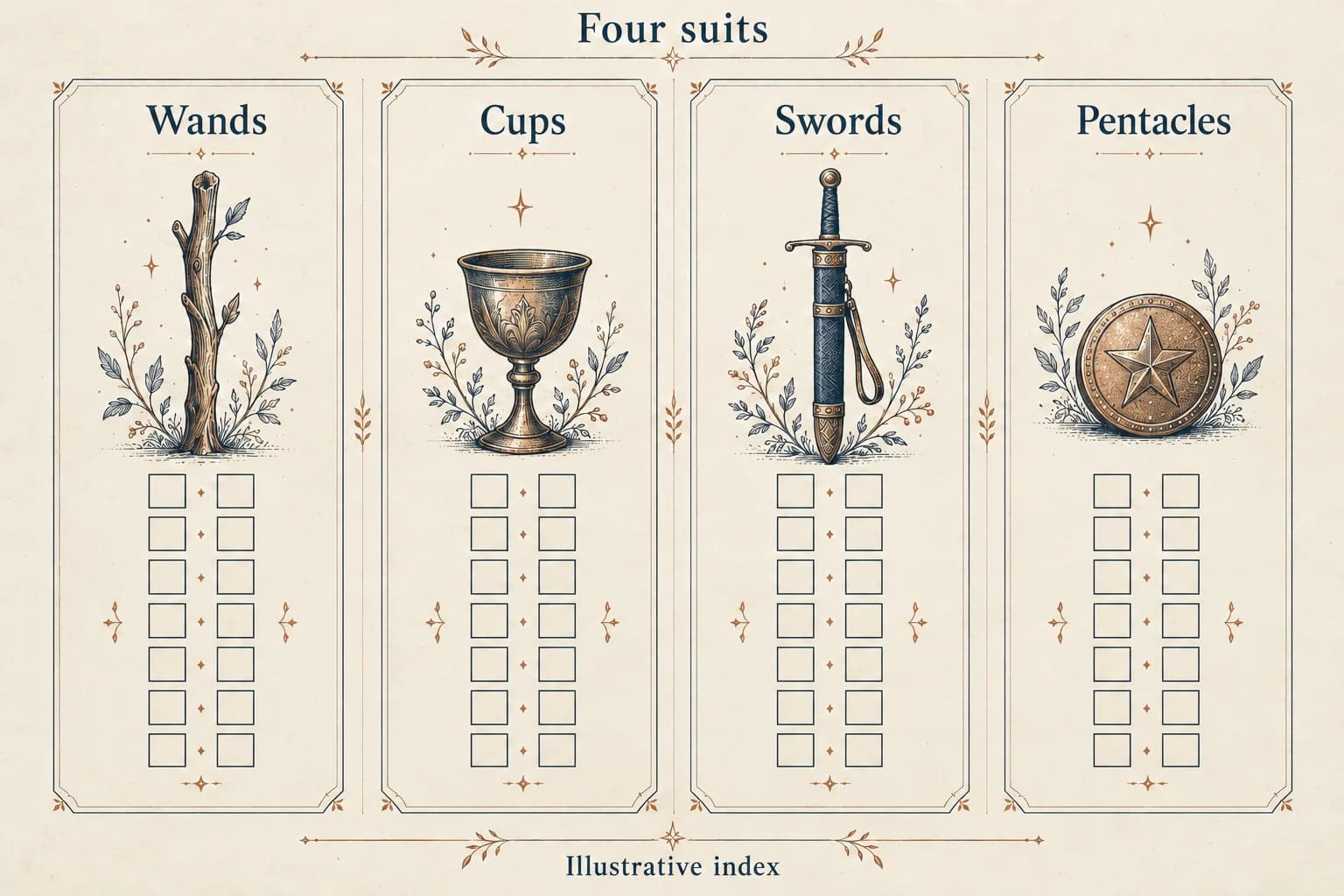
Four named suits: Wands, Cups, Swords and Pentacles
Choose the suit first when you know it. Wands, Cups, Swords and Pentacles each contain the same 14 rank labels in the supplied headings. A rank alone therefore leaves four possible entries.
For example, Queen of Wands and Queen of Cups share a rank but occupy different suit blocks. Keep those records distinct when shortening a note.
Keep the source’s spelling. If another reference uses an unfamiliar rank or suit label, record that wording separately and check its own headings before equating it with an entry here.
Complete 56-name index from the inspected source
| Wands | Cups | Swords | Pentacles |
|---|---|---|---|
| King of Wands | King of Cups | King of Swords | King of Pentacles |
| Queen of Wands | Queen of Cups | Queen of Swords | Queen of Pentacles |
| Knight of Wands | Knight of Cups | Knight of Swords | Knight of Pentacles |
| Page of Wands | Page of Cups | Page of Swords | Page of Pentacles |
| Ten of Wands | Ten of Cups | Ten of Swords | Ten of Pentacles |
| Nine of Wands | Nine of Cups | Nine of Swords | Nine of Pentacles |
| Eight of Wands | Eight of Cups | Eight of Swords | Eight of Pentacles |
| Seven of Wands | Seven of Cups | Seven of Swords | Seven of Pentacles |
| Six of Wands | Six of Cups | Six of Swords | Six of Pentacles |
| Five of Wands | Five of Cups | Five of Swords | Five of Pentacles |
| Four of Wands | Four of Cups | Four of Swords | Four of Pentacles |
| Three of Wands | Three of Cups | Three of Swords | Three of Pentacles |
| Two of Wands | Two of Cups | Two of Swords | Two of Pentacles |
| Ace of Wands | Ace of Cups | Ace of Swords | Ace of Pentacles |
This is our editorial table, not the book’s layout. Read down each column to retain that suit’s inspected heading order. We insert “of” between rank and suit: these are normalized index names, not verbatim source headings. The columns follow the supplied suit order. Source: Waite, Part 3, section 2.
Find an entry by rank and suit
Hypothetical lookup: suppose a reference note says “Page of Cups” and you want to locate its source heading.
- Separate the name into rank, Page, and suit, Cups.
- Find the Cups column above and follow it to the Page row.
- Open Part 3 and use page search for Cups. A match may occur elsewhere, so locate the Cups suit block before proceeding.
- Within that block, inspect the Page heading and confirm both labels.
- Record the supplied label, “CUPS Page”, beside our normalized name, “Page of Cups”.
Searching the whole normalized phrase may fail because the heading’s wording and arrangement differ. If needed, return to the suit heading and scan its rank labels. Finish when both rank and suit agree.
Minor Arcana index, Major Arcana and interpretations
The source distinguishes these Minor Arcana suit entries from its Trumps Major category, which falls outside this table. A table row is not a Major Arcana number. If your note contains only a number, check its source for a name and category before matching it here.
Finding a heading establishes its location, without interpreting the accompanying text. For other source-navigation tasks, browse the sources guide collection.
Source limits: no cast, reading or product-feature claim
For a reusable source note, record the work title, Part 3, section 2, displayed header, suit, rank and page URL. Keep the supplied heading label beside your normalized index name so another reader can retrace the match.
For the hypothetical example, a compact record could read: “The Pictorial Key to the Tarot; Part 3; section 2; header 1910/1922; suit Cups; rank Page; supplied label CUPS Page; normalized name Page of Cups,” followed by the source URL. Labeling both forms keeps the transcription wording distinct from our indexing choice.
For more on documenting a source, see sources and editorial method. This guide provides name navigation only; it performs no cast or reading and makes no claim about a YiInsight Tarot feature.
Key takeaways
- The inspected transcription supplies four named suits, 14 ranks per suit and 56 entries overall.
- Each column preserves heading order; “of” is our normalized wording.
- Search by suit, inspect the rank and record the source.
Conclusion
Choose the suit, confirm the rank and save the source label with its reference. The complete table gives you a consistent lookup format while preserving the inspected sequence within each suit.
Why does the table begin with King?
King comes first in the supplied heading sequence for each suit. Keeping that sequence through Ace helps you compare each column with its source block.
Why might a complete name produce no search match?
The table inserts “of” and presents rank before suit. Search for the suit, then inspect the rank heading within that suit’s block.
Can I use these labels for another edition?
Use them as a comparison reference, then check that edition’s own headings. The supplied evidence does not establish identical naming across uninspected editions.
Sources
Reflect on one question
Frame a focused question before starting a new reading.
Explore YiInsight →