 YiInsight
YIINSIGHT / Method and reflection
Gnostic I Ching: Reading James DeKorne’s Book of Changes in Layers
Read James DeKorne’s Gnostic Book of Changes by separating translator labels, attributed commentary and Editor notes, with an original navigation example.
The short answer
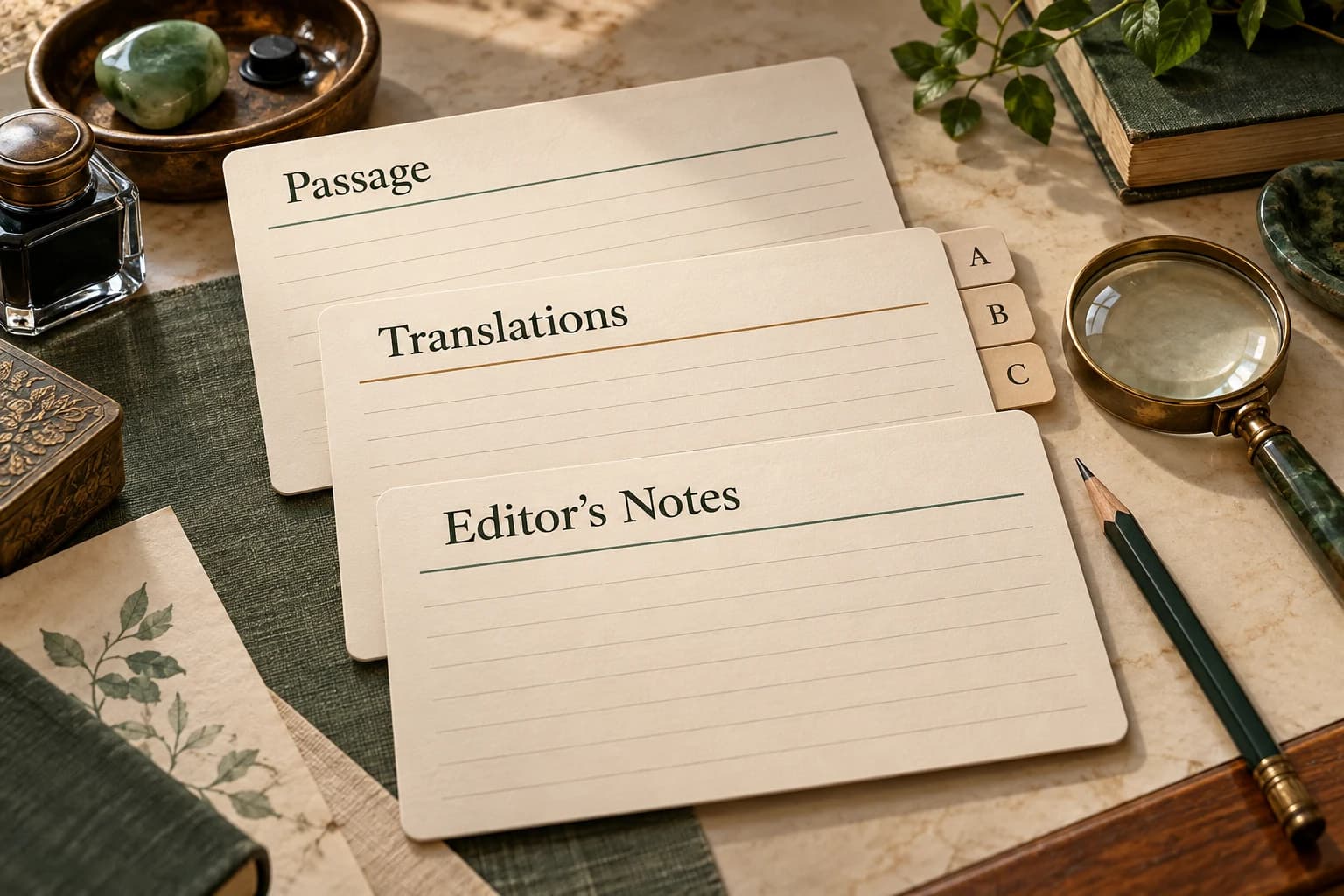
In James DeKorne’s Gnostic I Ching (Gnostic Book of Changes), the inspected Hexagram 1 page on GBCh presents three distinct layers: the classical *I Ching* structure (Judgment, Image, Lines), multiple named translators quoted in parallel, and the editor's modern interpretive notes. Reading them in sequence—and keeping those layers separate—is the whole skill.
Overview
James DeKorne's *Gnostic Book of Changes* (GBCh), hosted at jamesdekorne.com/GBCh/GBCh.htm, is a personal study archive for readers comparing *I Ching* renderings. Its homepage describes the project plainly: a personal study guide assembling multiple existing translations alongside the editor's own commentary. The site explicitly notes that many of the translations it draws on remain under copyright—public availability does not establish permission to republish the included translations. This guide links the official pages and reproduces no translation passages.
The payoff of understanding GBCh's structure arrives immediately: once you see that the inspected Hexagram 1 page is running *three* simultaneous conversations—the classical text, multiple translators, and one editor's modern notes—you stop misreading DeKorne's Jungian glosses as ancient commentary, and you stop treating one translator's phrasing as the "correct" version.
The chapter introduction at jamesdekorne.com/GBCh/ch1.htm explains the author's orientation: the work approaches the *I Ching* through a Gnostic, Western esoteric, and Jungian psychological framework. This is a stated interpretive lens, not a claim of scientific validation or historical equivalence with classical Chinese traditions—and readers benefit from holding that distinction clearly throughout.
What the *Gnostic Book of Changes* Is
This guide examines the official HTML pages of GBCh as a personal study archive. The homepage is explicit that this is a personal compilation. Translations quoted within it remain under their respective copyrights.
Because it is HTML, the "book" has no fixed pages—navigation is by hexagram number and by the labeled sections within each hexagram page. This is different from a print edition where you might use a page number as a locator. For the inspected Hexagram 1 example, record hexagram number + section label; confirm the labels on any other page before using them.
Three Reading Layers on the Inspected Hexagram Page
| Layer | What it contains | How to identify it |
|---|---|---|
| Classical structure | Judgment, Image, numbered Lines | Structural headings matching *I Ching* sections |
| Translator parallels | Multiple named translators quoted under each section | Labeled by surname (e.g., **Legge**, **Wilhelm/Baynes**) |
| Editorial commentary | Modern interpretive notes | The **Editor:** label specifically; read other names in **NOTES AND PARAPHRASES** separately |
The inspected Hexagram 1 page in GBCh layers these three distinct types of content:
Keeping these three layers mentally separated is the foundational navigation skill for GBCh. Treating the layers as one continuous voice would obscure who is speaking.
Decoding the Translator Labels Under Judgment, Image, and Lines
Hexagram 1 at jamesdekorne.com/GBCh/hex1.htm provides the inspected example of GBCh's label system. Under the Judgment, Image, and each numbered Line, the page presents parallel passages from multiple named translators. The labels visible on Hexagram 1 include:
Legge, Wilhelm/Baynes, Blofeld, Liu, Ritsema/Karcher, Wu
Each label identifies whose translation or rendering appears in that slot. These are distinct voices, and they frequently differ from one another in both word choice and interpretive emphasis. The label spelling matters: the archive uses "Wilhelm/Baynes" as a paired credit, distinguishing the translator (Wilhelm) from the English-language translator of Wilhelm's German text (Baynes).
A caution worth holding: this guide describes Hexagram 1's visible layout. GBCh contains 64 hexagrams assembled over time; the guide does not make a universal claim that every page follows an identical order or includes every translator in every position. When reading an unfamiliar hexagram, scan the labels on that specific page rather than assuming a fixed template.
Separating Traditional Commentary from DeKorne's Modern Notes
On the inspected Hexagram 1 page, two labeled sections require particular care:
COMMENTARY appears as a section heading. Not everything under this heading is DeKorne's own voice. Some commentary passages carry traditional attribution labels—for example, the combined label Confucius/Legge—identifying a classical or commentarial layer being quoted or paraphrased. When you see an attribution such as Confucius/Legge within COMMENTARY, you are reading attributed traditional material, not a modern editorial insertion.
NOTES AND PARAPHRASES is the section that most prominently features the editor's modern interpretive perspective. Even within this section, multiple voices can appear. The label Editor: specifically identifies DeKorne's own editorial voice. Other labeled voices within NOTES AND PARAPHRASES may represent paraphrases attributed to other named sources.
A practical rule: before forming an impression of what a section says, identify *whose label appears above it*. The difference between ancient transmitted commentary and a twentieth-century Jungian gloss is significant—and the labels are exactly how GBCh signals that difference.
A Step-by-Step Reading Sequence for a GBCh Hexagram
A practical sequence using the inspected Hexagram 1 page as an example; verify labels independently on any other page:
Step 1 — Choose a primary translation to anchor your reading. Pick one translator whose work you know or want to learn (for example, Wilhelm/Baynes). Read only that translator's rendering under The Judgment, The Image, and your relevant Lines. This gives you one coherent version of the oracle text.
Step 2 — Scan the parallel translators for meaningful variation. Once you have one rendering in mind, look at what Legge, Blofeld, or another labeled translator says in the same slot. A difference may arise from wording, interpretation or edition; disagreement alone does not establish a textual crux.
Step 3 — Read COMMENTARY carefully with attribution in view. Read the exact attribution. For example, Confucius/Legge is a combined attribution label; it is not the same credit as Editor:. If a label is unclear, leave the authorship question open rather than silently assigning it to DeKorne.
Step 4 — Engage NOTES AND PARAPHRASES selectively. This section reflects DeKorne's Gnostic and Jungian interpretive framework, as explained in ch1.htm. It can be genuinely illuminating—but it is a modern lens, not an ancient one. Read it as a thoughtful editor's perspective, not as a continuation of the classical text.
Integrating Multi-Translator Comparison into Your Study
GBCh's side-by-side format can develop a skill that single-translation reading cannot: the ability to notice *where translations agree* and *where they diverge*; neither observation by itself resolves the underlying Chinese. Consider noting the specific translator labels when a passage seems particularly striking—this tracks whether you are responding to the classical text itself or to one editor's phrasing.
For broader context on how to approach a reading once you have located your hexagram, see How to Read an *I Ching* Reading. For editorial method across the YiInsight guides more broadly, see Sources and Editorial Method. For thinking about the *I Ching* as a synchronistic encounter rather than a prediction device, see Synchronicity and Meaning.
Key takeaways
- The inspected Hexagram 1 page has three reading layers: classical structure, parallel named translators, and editorial notes. This guide has not verified that structure across every hexagram page. Keep the labels distinct and inspect other pages individually.
- Translator labels matter: Legge, Wilhelm/Baynes, Blofeld, Liu, Ritsema/Karcher, Wu, and Editor: each identify a distinct voice. The Editor: label specifically marks DeKorne's own commentary; traditional attribution labels within COMMENTARY identify a different layer.
- DeKorne's interpretive framework is Gnostic and Jungian, as stated in ch1.htm. This is an attributed modern lens—but it is a stated perspective, not a universally validated historical equivalence with classical Chinese tradition.
Conclusion
The *Gnostic Book of Changes* is genuinely useful if you approach it as what it says it is: a personal study archive layering multiple translations and an editor's modern interpretive commentary. The density that makes new readers retreat becomes manageable the moment you see the label system as a navigation tool. Read one translator at a time. Track the labels. Distinguish the Editor: voice from attributed traditional material. And treat DeKorne's Gnostic/Jungian notes as one thoughtful reader's lens, not as classical authority.
Is everything in the COMMENTARY section written by DeKorne?
No. On the inspected Hexagram 1 page, COMMENTARY includes the combined attribution label Confucius/Legge. Keep that combined credit intact: it is not the same label as Editor:, which marks DeKorne’s own editorial voice. Do not turn the combined label into a claim that Legge himself is a classical authority; identify the exact attribution above the passage.
What does the "Editor:" label mean specifically?
On the inspected Hexagram 1 page, Editor: identifies DeKorne's own editorial commentary, distinguishing it from the named translators (Legge, Wilhelm/Baynes, Blofeld, Liu, Ritsema/Karcher, Wu) and from traditionally attributed material. Within NOTES AND PARAPHRASES especially, this label is how the site marks which voice is the compiler's own perspective.
Can I download GBCh as a PDF for offline reading?
The GBCh homepage notes that many of the translations it assembles remain under copyright. The material is available as online HTML, but that format does not establish permission to republish the included translations. This guide does not link or recommend a complete PDF download of the site's content. For offline *I Ching* reading, consult licensed print editions of the translations you want to study.
Sources
Reflect on one question
Frame a focused question before starting a new reading.
Explore YiInsight →